How to Clean an Oil-Slicked Penguin

Tuesday, Mar. 15, 2016, The Writer’s Almanac

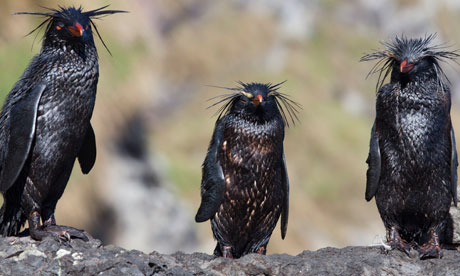
rockhopper-penguins-007

How to Clean an Oil-Slicked Penguin
by Andrew Gent

Like the punch line to a very bad joke
the obvious and actual answer
is: “carefully”.
First, you must learn to hold the penguin
from behind, to avoid the beak,
pressing both wings against the body
until you need to hold each out
(again, carefully) to clean
in and around the extremities.
Next, contrary to logic,
you apply more oil
(cooking oil works best)
to loosen and remove
the thicker crude. Working it (carefully)
into the feathers. Next
you clean what remains
with dishwashing detergent
four, five, maybe even six times.
Careful (yet again) to avoid
the eyes and mouth.
You want to clean the feathers
without removing their natural
protective coating, or else
the penguin will sink like a stone
having lost its normal buoyancy.
Finally, you let it rinse off
in a pool of clean water.
Let the penguin do the work,
preening its coat and reclaiming
what little remains of its dignity.
Do not expect thanks.
In fact, it will continue
to bite and scratch.
But, if you are lucky,
it might survive.
Which is the most
we can hope for.


“How to Clean an Oil-Slicked Penguin” by Andrew Gent from Explicit Lyrics. © The University of Arkansas Press, 2016. Reprinted with permission. (buy now)

SPECKLED MILK

6f9b0bd7-adc8-463c-8f16-0bf9bc250395

by Bill Yarrow 

THOUGHTS ON WRITING

The first rule of writing is to not add descriptors to things inherently described. A ball need never be described as round because a ball, inherently, is round. Grass need never be described as green because grass naturally is green. Milk need never be described as white because milk normally is white. Adjectives are required only when the object to be described deviates from its inherent self. Thus a lozenge-shaped ball, blue or yellow grass, pink or speckled milk.

No need to say he watched with his eyes or she touched with her hands because we use our eyes to see and we use our hands to touch. If she touched his shoe with her toe, however, that’s a different story.

No one would write, “He sneezed with his nose,” “She danced with her feet,” or “He breathed with his lungs,” but people do write, “She pinched him with her fingers” (or worse, “with her thumb and index finger”) and “He kissed her with his lips.” Why? Let kiss be kiss and pinch be pinch. Over-scrupulous specificity is not a good.

Let the normal be normal and never over explain. He opened the window is sufficient. “He placed two hands on the window pull and lifted upward” or “he grabbed the door handle and pulled it outward” belabors the action and obscures the obvious. If you have something to say, say it directly. He kissed her. He parked the car. He cleaned the toilet. Add a detail only if it is an unexpected detail. He kissed her on the chin. He parked the car on the lawn. He cleaned the toilet in his suit.

Chekhov writes to Gorky: “You understand it at once when I say, ‘The man sat on the grass;’ you understand it because it is clear and makes no demands on the attention. On the other hand, it is not easily understood, and it is difficult for the mind, if I write, ‘A tall, narrow-chested, middle-sized man, with a red beard, sat on the green grass, already trampled by pedestrians, sat silently, shyly, and timidly looked about him.’ That is not immediately grasped by the mind, whereas good writing should be grasped at once—in a second.”

Description should be eloquent and precise, not fevered, not desperate, not consumed by the greed to be foolishly exhaustive and insanely comprehensive.

Consider these lines, both of which come from the William Carlos Williams poem that begins “By the road to the contagious hospital”

 “the reddish / purplish, forked, upstanding, twiggy / stuff of bushes and small trees / with dead, brown leaves under them”—that description is unfocused, desperate, inept.

 “the stiff curl of wild carrot leaf”—now, that description is eloquent, precise, thrillingly good!

Do not double up on words. Use “separated,” not “separated out.” Use “divided, not “divided up.” Use “together,” not “both together.” Use “sat,” not “sat down.” Use “fell,” not “fell down” (unless “down” is used as a preposition and requires an object, e.g. “down the stairs”). Use “lifted,” not “lifted up.”

Never exaggerate. Let words speak for themselves. “Hot,” not “scalding hot.” “Cold,” not “freezing cold.” “Handsome,” not “dashingly handsome.” “I sweated,” not “I sweated bullets.” “I jumped,” not “I jumped out of my skin.” “Red, not “beet red.” Or “blood red.” Or “firehouse red.” (An exaggeration is never far from a cliché.)

Do not add an adverb which does the same work as the verb. No need to say “moaned softly” when “moaned” will do. A moan, by its nature, is soft. No need to say “missed terribly” when “missed” will do. Adding “terribly” dilutes the force of “missed.”

Do not use “so” as an intensifier without using the word “that” to complete the comparison. Not “I was so embarrassed,” but “I was so embarrassed that I could not speak.” If you complete a comparison, make sure you are adding to the original idea rather than merely reiterating the idea. “I was so embarrassed that I turned red” is a reiterative sentence because people who are embarrassed do turn red. Better to say simply, “I was embarrassed” or “I turned red.” One or the other.

If you are going to sin, sin on the side of clarity. Add more words than fewer words. Repeat words if the repetition will help clarify the action or the idea. Consider the shortened form of the sentence from the preceding paragraph: “If you complete a comparison, make sure you are adding to rather than merely reiterating.” Add words for clarity.

Good writing is rhythmic. Prose rhythm may be established in a number of ways. [Note” not “a number of different ways.”] Thus, there are no hard and fast rules regarding word choice, particularly the number of words used. “I showered” and “I took a shower” are both fine ways to express the same idea. Two words are not universally preferable to four words. Choosing always the smallest possible number of words may make writing more difficult to decipher—like reading a telegram. Writing needs to breathe. Repetition is OK. The use of parenthetical elements is OK. The use of parallel phrases is to be encouraged. Triplets are to be admired. Good writing owes allegiance to precision, not constriction.

 Use “sprinted” rather than “ran quickly,” not because “sprinted” is one word rather than two but because it may be the precise word you are looking for.

 Use “reclined” rather than “leaned back,” not because “reclined” is one word rather than two but because it may be the precise word you are looking for.

 Use “contemplated” rather than “thought carefully,” not because “contemplated” is one word rather than two but because it is the precise word you are looking for.

 Use “labored” rather than “worked hard,” not because “labored” is one word rather than two but because it may be the precise word you are looking for.

 Use “glanced” rather than “looked quickly,” not because “glanced” is one word rather than two but because it may be the precise word you are looking for.

 Use “shouted” rather than “called loudly,” not because “shouted” is one word rather than two but because it may be the precise word you are looking for.

But “sprinted,” “reclined,” “contemplated,” “labored,” “glanced,” and “shouted” may not be the precise words you are looking for, so, in that case, don’t use them. Use whatever words you need whenever you need them.

Those people who see style as affectation see everything as affectation.

WE MUST NOT SAY SO
(with apologies to John Berryman)

Milk, friends, is white.
We must not say so.
Swans, friends, are white.
We must not say so.
Grass, friends, is green.
We must not say so.
Birds have two wings.
We must not say so.
River water is wet.
We must not say so.
We clap with our hands.
We must not say so.
The sky above is blue.
We must not say so.

but trucks sputter (or brake)
butter softens (or burns)
the factory closes (or hires)
the soil erodes (or dries up)
lips blister (or tighten)
leaves scatter (or shimmer)
paper cuts sting (or heal)
radiators knock (and hiss)


This essay appeared in Blue Fifth Review: Blue Five Notebook Series (Winter 2016 / 16.1) as “We must Not Say So.”        https://bluefifthreview.wordpress.com/


SEE MORE FROM BILL YARROW ON  HELIOShttps://heliosliterature.com/2014/11/26/processes/

Bill Yarrow is the author of THE LICE OF CHRIST (MadHat Press 2014), INCOMPETENT TRANSLATIONS AND INEPT HAIKU (Cervena Barva Press 2013), POINTED SENTENCES (BlazeVOX 2012), FOURTEEN (Naked Mannekin, 2011), and WRENCH (erbacce-press 2009).


CROSSROADS

by Ricky Hawthorne


woman-standing-red-traffic-light-22129474

Une brève réunion


The traffic light changed from green to red

And there you were

Knowing me, grinning

At my stupefaction

Calling me by name

Running heavily across the traffic

Toward me as if a returning lover

At the climax of a movie


‘John’,  you cried and only then I knew you too

‘My God you look well,

What are we, fifty-five?’

(I play tennis oh, and I have a gym membership)

I head the corporation now you know


‘And smart in that suit;

But surely you were a dustman

The last time I saw you?’

(I went to college, at night, after work)


‘Yes, father’s retired now’


‘Where are you living now?

Never, however did you afford that?’

(Sixteen hour days and sacrifice)


I’ll inherit the house of course

‘And just back from Barbados — A second honeymoon’

(I thought of ours, in Skeggie, and smiled)


And the car and the Cretan Villa…


Then your conversation evaporated

Like a plump dewdrop

Pricked by a sunbeam

From a new star


Yes, these were yours long ago

My patron, my king

And here where all roads meet

We will always measure the distance


So we shook hands

For the first time while

Above us the lights turned green;

You went west, I east

But what I didn’t tell you was

That I’d done it all for you


– See more at: https://scriggler.com/DetailPost/Poetry/20936#sthash.q0iMr5gB.dpuf


6466

Ricky Hawthorne


Bio:  Ricky graduated from Warwick University Coventry, UK, with triple honors in literature, theater and film.
Three screenplays:
Myth – a modern allegory on Middle Eastern Current Events
The Abandoned – A doomed menage a trois straddles the carnage of WWI France
Pottersville  – Xmas Eve and Ricky, redundant, separated and drunk, crashes his car and ends up in Pottersville, the nightmare town from his favorite film
Three teleplays all adapted from his own short stories:
Is This Yours – A cell predicts horse-race winners but what else does it tell?
A Turn of the Wheel – A contradictory SatNav sends its poor driver around the bend
The Bell –  Recuperating in an old cottage Simon gets caught up in its ghastly history
Three Dramas
Ahasuerus –  The Wandering Jew finds himself outside a Concentration Camp in 1943
Lenten Observance – A devout Catholic is torn between family and God when he discovers his autistic son is gay
Litter – An examination of global warming from the inner human psyche

NOW

heart-vs-mind-fighting-28446089

by Michelle Cote


I was at the bottom with

No end in sight.

Mind numbing pain and sorrow

Blocked my vision and stopped my breath,

But then, from a soul sister, in the silence of despair,

Came a glimmering of hope,

A way to stop my ego, to

Reign in my mind.

She brought wise words of knowing,

A knowing and watching, a feeling and seeing.

And as I accepted that seeing and knowing,

the thoughts began to drop away

One by one like autumn leaves.

leaves

There came an absence of words,

A deep stilling of my soul.

Finally a way to be, just be, the only way,

But not quite a total release as I was yet

too weak, too exhausted from my struggle.

Parts of my ego and anger still held on, their grip

Like tentacles wrapped around my heart.

 I wanted to let go, I thought that maybe

the “wanting” was in the way,

But I accepted that soon even the wanting would be

of no consequence, it would drop away on its own and

The anger would stop sneaking up on me,

Grabbing me from behind when I least expected it.

 I know now that my ego and willful mind will not

Let go without a fight.

A fight to remain in charge, to perpetuate their control

And continue deluded behavior.

change ahead


But I have changed, grown,

and can now watch them from a safe distance and

At times even smile at their antics,

But I grow tired of their stubbornness,

their uncooperative nature,

their disdain for what is best for me.

They do not have my best interest at heart.

They have no heart.

Those two are not who I am

and when I am finally in tune to the being that is my true self,

All else will naturally fall away

and I won’t have to “deal” with either of them,

Nothing else will exists but the Now and

There I will happily stay.


Michelle Cotes loves to write poetry. Her poems describe her emotions beautifully. Michelle is in the process of working on two novels. She loves to garden and preserve what she grows by canning and freezing.  She lives in what she describes as  “a very cute little white cottage in the big woods.”

Her poetry can be found at http://heartwordsforpoetry.org  where this poem first appeared. Her poem “My Hope” was recently re-blogged here on Helios.


The Blending of Many

https://joellycameron.wordpress.com/2015/12/28/the-blending-of-many

by Joelly Cameron

images-1

Like snow, you fall around me.
I listen, content to your body breathing,
As we lay covered in flannel.
My fingers caught up in your pectoral curls,
And the way your eyes crinkle when you are content.
I wonder if it is possible to lie between the snowflakes,
And still be warm in this blatant vulnerability?
I have become exposed to this new awareness.This sense of bareness between us.
Yet, I welcome the fall, and the obviousness of you.

We have become like trees, rustling living beings,
That search for things we didn’t know we were looking for,
And aren’t sure that we want.
Like the leftover boxes that still lay on my bedroom floor.
That once contained something we wanted, but maybe outgrew.

Yet, for a time we held tightly to them, because we thought
They were what we needed.


See also https://heliosliterature.com/2015/02/16/castles-in-spain/

 D0fbGYy4_400x400

Joelle Cameron

Audible Hor d’Oeuvres: Two Poems by Eloisa Perez-Lozano

Guest Contributor's avatarFourth and Sycamore

By Eloisa Pérez-Lozano

My Turn to Read

microphone Image credit Jan Mehlich

My concentration begins to wane
during the poet’s last stanza
not because I’m bored
but because I’m next.

My foot taps just a little faster
as I scan the poem, line by line
lingering over certain words
and making mental notes.

I hear my name hang in the air
followed by encouraging claps.
I rise from my chair and try not to trip
as head to the podium.

I look down at my typed-up thoughts
and realize they’re about to come alive
audible hors d’oeuvres for my audience
who waits to sample my soul.

I breathe in deeply, breathe out slowly,
swallow my nerves and fears
about not being worthy to read
and begin.

An Ode to Writing

penIt grabs you, shakes and stuns you
Then soothes, and lulls, caresses
You’re putty in its ink

Every page is packed

View original post 121 more words

Isabelle Stengers’ new book available open access

Jeremy Schmidt's avatarJeremy J Schmidt

Isabelle Stengers’ new book, In Catastrophic Times, is available for free as a .pdf download at this site. Here is a description of the book (which you can also buy in hard copy as well following the link above):

There has been an epochal shift: the possibility of a global climate crisis is now upon us. Pollution, the poison of pesticides, the exhaustion of natural resources, falling water tables, growing social inequalities – these are all problems that can no longer be treated separately. The effects of global warming have a cumulative impact, and it is not a matter of a crisis that will “pass” before everything goes back to “normal.”

Our governments are totally incapable of dealing with the situation. Economic warfare obliges them to stick to the goal of irresponsible, even criminal, economic growth, whatever the cost. It is no surprise that people were so struck…

View original post 32 more words

Anti-Islam Propaganda

Ken Finton's avatarKenneth Harper Finton

12208604_980033425352897_7041136503211647923_n

It is not so much that Islam is a peaceful religion designed to co-exist with others, but outright misrepresentations such as above is making its way around the world. Remember Christians war against Christians and all religions that believe they are the only truth are false ideologies.

Verse by verse, you can see the result of the attempt to make was on Islam. See: http://corpus.quran.com/translation.jsp?chapter=3&verse=85

At the above site you can read seven parallel translations of each verse and see the original Arabic in a word by word translation. This mistranslated propaganda is obviously created to provoke tension and war.

Verse (2:191) – English Translation

As above: “Slay the unbelievers wherever you find them.”

Shakir: And kill them wherever you find them, and drive them out from whence they drove you out, and persecution is severer than slaughter, and do not fight with them at the Sacred Mosque until…

View original post 717 more words

The Universe from Nothing

Scientific GOD Journal | November 2015 | Volume 6 | Issue 10 | pp. 655-657 Pal, H. S., The Problem with the Universe from Nothing (Part II) 

ISSN: 2153-831X Scientific GOD Journal Published by Scientific GOD, Inc. http://www.SciGOD.com

The Problem with the Universe from Nothing (Part II)

500px-Wormhole_travel_as_envisioned_by_Les_Bossinas_for_NASA

Himangsu S. Pal*

* Correspondence: Himangsu S. Pal. E-Mail: sekharpal1946@rediffmail.com

ABSTRACT 

Scientists have shown how the total matter-energy content of the universe has always remained zero. If the universe appeared out of nothing, initially there was no space, time, matter and energy. However, we are not satisfied with this explanation and want to know how the total space-time content of the universe has always remained zero. Otherwise, scientists will have to explain as to whence appeared the extra residual space-time that was not already there at the beginning.

Key Words: Universe, nothing, substance, space, time, energy, matter, gravity.

When scientists say that the universe can simply come out of nothing without any divine intervention, they think of the universe in terms of its energy content only. In the book ‘The Grand Design’, page 281, scientist Stephen Hawking has written that bodies like stars or black holes cannot just appear out of nothing, but a whole universe can.1 The message is very clear from this: The total energy of a whole universe is zero and that is why it can come out of nothing; but stars or black holes will fail to do so, because their total energy is not zero. But universe means not only its energy; universe means its space-time as well. So if we now apply the same logic to space-time as well, then we can say that the total space-time of a whole universe must also always have to be zero, because in that case only a whole universe can appear out of nothing. Here my question is: How does the total space-time of an ever-expanding universe always remain zero?

As the universe appeared out of nothing, so initially there was no space, time, matter and energy. Scientists have successfully shown how the total matter-energy content of the universe has always remained zero. But we are not satisfied with that explanation, we want something more. We also want to know how the total space-time content of the universe has always remained zero. And it should always remain zero if the universe has actually appeared out of nothing. Otherwise scientists will have to explain as to whence appeared the extra residual space-time that was not already there at the beginning.

If stars or black holes cannot appear out of nothing simply because their total energy is not zero, then can a whole universe appear out of nothing if its total space-time is not zero?

The last question above will further boil down to this one: Do the physicists think that energy cannot just appear out of nothing, but space-time can, supposing that the total space-time of the present universe is not zero? Scientific GOD Journal | November 2015 | Volume 6 | Issue 10 | pp. 655-657 Pal, H. S., The Problem with the Universe from Nothing (Part II) 

ISSN: 2153-831X Scientific GOD Journal Published by Scientific GOD, Inc. http://www.SciGOD.com

656

Or, do they think that like life, mind and consciousness, space and time are also emergent entities only, and therefore, not directly coming from big bang nothing?

Something can appear out of nothing provided that the totality of that something always remains zero. Actually anything can come out of nothing if this condition is fulfilled. This is the principle which some scientists have relied upon when they have proposed that our universe could have arisen out of nothing due to a quantum energy fluctuation in a void. They have found that the total energy of the universe is exactly zero. The total energy being zero, the total matter will also be zero due to matter-energy equivalence. If the total matter as well as the total energy of the universe is zero, then why should they have to come from anything at all? They could have come from nothing as well. So these scientists have proposed that our universe has simply appeared out of nothing. But when they have proposed this theory, they remained totally oblivious of the fact that universe means not only its matter and energy, universe means its space-time as well. So, if the universe has actually appeared out of nothing, then just like matter and energy, space-time also has appeared out of that primordial nothing. So like matter and energy, the total space-time also should always remain zero.

However, if it is the case that space-time has not directly appeared out of nothing, then the total space-time need not have to be zero. No sane person on this earth will ever say that the total number of human beings in this universe must always have to be zero, because no sane person believes that human beings have directly appeared out of nothing. However if ‘x’ has directly appeared out of nothing, then logic and common sense dictates that the totality of that ‘x’ must always have to be zero.

Here it may be objected that there is a law of conservation of matter and energy in science, but that there is no such conservation law for space-time. So there is no violation of conservation law if nothing generates so much of space-time. Even if it is conceded that this is a valid objection – here I must say that I do not think so – it can still be pointed out that there is one more reason that can be given as to why the total space-time of the universe should always remain zero. This reason we find in Einstein’s general theory of relativity. As per GTR space, time and matter are so interlinked that there cannot be any space-time without matter. Similarly there cannot be any matter without space-time. If there cannot be any space and time without matter, then the total matter of the universe being zero, the total space-time of the universe should also always be zero. So we can say that GTR alone gives us sufficient reason to conclude that if the total matter of the universe always remains zero, then the total space-time of the universe should also always remain zero. Here the question becomes quite irrelevant as to whether the universe has originated from something, or from nothing.

So from GTR we come to know that the total space-time of an ever-expanding universe should always remain zero, but we do not know yet how it does actually remain zero.

If science cannot give any satisfactory answer to this question, then the naturalistic world-view of modern science will prove to be inadequate for explaining the real world. Scientific GOD Journal | November 2015 | Volume 6 | Issue 10 | pp. 655-657 Pal, H. S., The Problem with the Universe from Nothing (Part II) 

ISSN: 2153-831X Scientific GOD Journal Published by Scientific GOD, Inc. http://www.SciGOD.com

657

Reference 

1. S. Hawking & L. Mlodinow (2012), The Grand Design, pg. 281 (Bantam Books: New York).