Anti-Islam Propaganda

Ken Finton's avatarKenneth Harper Finton

12208604_980033425352897_7041136503211647923_n

It is not so much that Islam is a peaceful religion designed to co-exist with others, but outright misrepresentations such as above is making its way around the world. Remember Christians war against Christians and all religions that believe they are the only truth are false ideologies.

Verse by verse, you can see the result of the attempt to make was on Islam. See: http://corpus.quran.com/translation.jsp?chapter=3&verse=85

At the above site you can read seven parallel translations of each verse and see the original Arabic in a word by word translation. This mistranslated propaganda is obviously created to provoke tension and war.

Verse (2:191) – English Translation

As above: “Slay the unbelievers wherever you find them.”

Shakir: And kill them wherever you find them, and drive them out from whence they drove you out, and persecution is severer than slaughter, and do not fight with them at the Sacred Mosque until…

View original post 717 more words

The Universe from Nothing

Scientific GOD Journal | November 2015 | Volume 6 | Issue 10 | pp. 655-657 Pal, H. S., The Problem with the Universe from Nothing (Part II) 

ISSN: 2153-831X Scientific GOD Journal Published by Scientific GOD, Inc. http://www.SciGOD.com

The Problem with the Universe from Nothing (Part II)

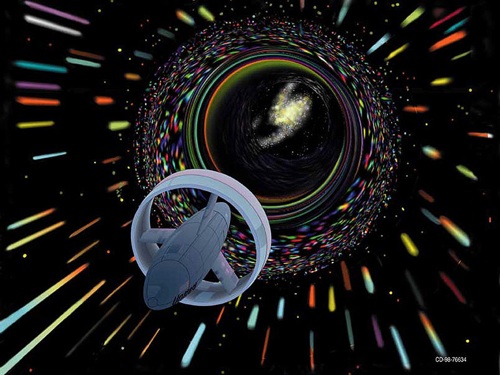
500px-Wormhole_travel_as_envisioned_by_Les_Bossinas_for_NASA

Himangsu S. Pal*

* Correspondence: Himangsu S. Pal. E-Mail: sekharpal1946@rediffmail.com

ABSTRACT 

Scientists have shown how the total matter-energy content of the universe has always remained zero. If the universe appeared out of nothing, initially there was no space, time, matter and energy. However, we are not satisfied with this explanation and want to know how the total space-time content of the universe has always remained zero. Otherwise, scientists will have to explain as to whence appeared the extra residual space-time that was not already there at the beginning.

Key Words: Universe, nothing, substance, space, time, energy, matter, gravity.

When scientists say that the universe can simply come out of nothing without any divine intervention, they think of the universe in terms of its energy content only. In the book ‘The Grand Design’, page 281, scientist Stephen Hawking has written that bodies like stars or black holes cannot just appear out of nothing, but a whole universe can.1 The message is very clear from this: The total energy of a whole universe is zero and that is why it can come out of nothing; but stars or black holes will fail to do so, because their total energy is not zero. But universe means not only its energy; universe means its space-time as well. So if we now apply the same logic to space-time as well, then we can say that the total space-time of a whole universe must also always have to be zero, because in that case only a whole universe can appear out of nothing. Here my question is: How does the total space-time of an ever-expanding universe always remain zero?

As the universe appeared out of nothing, so initially there was no space, time, matter and energy. Scientists have successfully shown how the total matter-energy content of the universe has always remained zero. But we are not satisfied with that explanation, we want something more. We also want to know how the total space-time content of the universe has always remained zero. And it should always remain zero if the universe has actually appeared out of nothing. Otherwise scientists will have to explain as to whence appeared the extra residual space-time that was not already there at the beginning.

If stars or black holes cannot appear out of nothing simply because their total energy is not zero, then can a whole universe appear out of nothing if its total space-time is not zero?

The last question above will further boil down to this one: Do the physicists think that energy cannot just appear out of nothing, but space-time can, supposing that the total space-time of the present universe is not zero? Scientific GOD Journal | November 2015 | Volume 6 | Issue 10 | pp. 655-657 Pal, H. S., The Problem with the Universe from Nothing (Part II) 

ISSN: 2153-831X Scientific GOD Journal Published by Scientific GOD, Inc. http://www.SciGOD.com

656

Or, do they think that like life, mind and consciousness, space and time are also emergent entities only, and therefore, not directly coming from big bang nothing?

Something can appear out of nothing provided that the totality of that something always remains zero. Actually anything can come out of nothing if this condition is fulfilled. This is the principle which some scientists have relied upon when they have proposed that our universe could have arisen out of nothing due to a quantum energy fluctuation in a void. They have found that the total energy of the universe is exactly zero. The total energy being zero, the total matter will also be zero due to matter-energy equivalence. If the total matter as well as the total energy of the universe is zero, then why should they have to come from anything at all? They could have come from nothing as well. So these scientists have proposed that our universe has simply appeared out of nothing. But when they have proposed this theory, they remained totally oblivious of the fact that universe means not only its matter and energy, universe means its space-time as well. So, if the universe has actually appeared out of nothing, then just like matter and energy, space-time also has appeared out of that primordial nothing. So like matter and energy, the total space-time also should always remain zero.

However, if it is the case that space-time has not directly appeared out of nothing, then the total space-time need not have to be zero. No sane person on this earth will ever say that the total number of human beings in this universe must always have to be zero, because no sane person believes that human beings have directly appeared out of nothing. However if ‘x’ has directly appeared out of nothing, then logic and common sense dictates that the totality of that ‘x’ must always have to be zero.

Here it may be objected that there is a law of conservation of matter and energy in science, but that there is no such conservation law for space-time. So there is no violation of conservation law if nothing generates so much of space-time. Even if it is conceded that this is a valid objection – here I must say that I do not think so – it can still be pointed out that there is one more reason that can be given as to why the total space-time of the universe should always remain zero. This reason we find in Einstein’s general theory of relativity. As per GTR space, time and matter are so interlinked that there cannot be any space-time without matter. Similarly there cannot be any matter without space-time. If there cannot be any space and time without matter, then the total matter of the universe being zero, the total space-time of the universe should also always be zero. So we can say that GTR alone gives us sufficient reason to conclude that if the total matter of the universe always remains zero, then the total space-time of the universe should also always remain zero. Here the question becomes quite irrelevant as to whether the universe has originated from something, or from nothing.

So from GTR we come to know that the total space-time of an ever-expanding universe should always remain zero, but we do not know yet how it does actually remain zero.

If science cannot give any satisfactory answer to this question, then the naturalistic world-view of modern science will prove to be inadequate for explaining the real world. Scientific GOD Journal | November 2015 | Volume 6 | Issue 10 | pp. 655-657 Pal, H. S., The Problem with the Universe from Nothing (Part II) 

ISSN: 2153-831X Scientific GOD Journal Published by Scientific GOD, Inc. http://www.SciGOD.com

657

Reference 

1. S. Hawking & L. Mlodinow (2012), The Grand Design, pg. 281 (Bantam Books: New York).

Fascism

This week we have witnessed a phenomenal act of social movement-making in an era when many, myself included, have wondered if meaningful change in the U.S. still possible.

Some of that worry is about aging, I’m sure. As you get older and the people around you get older you are inclined to wonder if the kids can ever be as alright as the kids you were.

We overstate our youthful courageousness. Then, because we are wily from age, we defend that overstatement by understating the courage of the youth who displace us. That may be natural. But when a cross-campus coalition of student-athletes and student-citizens at the University of Missouri organized to force the retirement of the college president (and future “transition” of the university system chancellor) they did something remarkable.

These young people took on the growing, well-paid, powerful administrative class in corporate higher education and actually won a concession.

We can debate whether the concessions these students won are material enough for the hard-core Marxists, too symbolic for the crusty pragmatists, or replicable enough for the devout organizers. But we who believe in democracy as verb instead of noun should relish the moment.

We should also defend the moment against the inevitable media contortions.

Almost immediately the Mizzou student actions became a battleground over the first amendment, media and fascism when at a rally some protestors formed a human shield to block a photographer from campus media from recording the protestors.

Granted, my social media feed is heavily weighted towards media folks but you would have thought this moment was Tienneman Square for the media caterwauling. More than a handful of editors, reporters, and mainstream media organizations condemned the Mizzou students as spoiled, anti-democratic, ridiculous, and enemies to their own cause.

David Simon, a writer who was once a journalist, went further.

He told me (and Roxane Gay, a brilliant writer who can speak for herself) over an hours-long diatribe on Twitter that the Mizzou students were fascists in “intent”, the photographer was the real hero of recent events, and that these were the moments on the slippery slope to the decline of American democracy.

Fascism means something.

He also intimated that I lack intellectual rigor to engage with him about fascism or anything really.

I’ll respect his right to be protected from my undisciplined intellectual inquiry.

I want David Simon to have a safe space.

The rest of you aren’t so lucky.

First, let me put as fine a point on my position as possible.


The press is not a rational objective actor.

The press shapes as much as it documents.

All press benefits as much from social change as it benefits from the status quo. That means the press, especially corporate media, is always serving two masters.

The press has rights but so do persons and sometimes we define those rights by working through the moments when they clash.

This is a heavy moment for those clashes. The moment’s heaviness deserves attention because context matters to intellectual rigor, if not hyperbolic hand-waving.

The Moment For Movement-Making

The Mizzou student-activists are organizing in a moment of public, private and State surveillance unlike any ever before seen in modern history in a wealthy imperialist nation where a huge part of our conspicuous consumption is surveilling ourselves as a status symbol.

They are organizing within the most corporate driven era of higher education in the history of the United States with all that entails for curtailing citizen-building at the expense of making markets and more consumers.

These students were organizing against the major capital interests that can now purchase unprecedented access to politicians in a massive police apparatus that has virtually unchecked privilege to target, surveill, detain and murder in a media culture controlled by many of the same capital interests.

This moment requires a level of sophistication that I doubt even my elder cohort can quite grasp. This is not the 1960s. It isn’t even the 1980s.

Social media allowed Mizzou students to attract the requisite public attention for successful social action. But, media both social and traditional (and increasingly that’s a false distinction but it still means something discursively so roll with it) can bring as much harm as it can good given the political economy in which we all live.

The first amendment protects the press against censure but it does not delimit the democratic action of those the press covers.

All due respect to the man who gave the world Stringer Bell but what we saw at that student rally was democracy in action, not fascism.

Fascism means something more than a thing one does not like.

Fascism means a system of social organization that concentrates power and doesn’t just discourage dissent but organizes the State against it.

I don’t like to literalize metaphors for the most part. I like creative license. I use it from time to time with various degrees of success. Denying writers metaphors is cheap way to become a demagogue.

But sometimes the material reality subsumes creative licence and the moment at Missouri is one such moment.

It’s not just that the moment is important. It’s not just that the students are still very much in danger for doing something important. It is that hand-waving about a fascist state can confuse us about what making democracy looks like.


Democracy Is Messy

Historical narratives about Great Men can be a trap.

These narratives are important but they also have the benefit of hindsight. They can make events seem pre-determined. The actors in them appear uniquely gifted to bring about social change. Resistors always seem weak because we know from the outset that they lose.

These stories, which we love, can lull us into thinking that social change is polite when historically and presently it is anything but. Still, we clamor for polite protests that follow imaginary rulebooks for Democracy 101.

The complaints from well-meaning people around Ferguson were about the same as those around the March on Washington as those around Reconstruction.

Very few people want to be actual fascists or actual racists but they don’t want to be late for work or awakened by sirens either. So, people say in various ways, could protestors stay off of residential streets after 7 PM and during rush hour traffic and also not make the buses in Birmingham late or unprofitable because people rely on those jobs and maybe too if the students at Mizzou could just write a nice letter and be grateful for their scholarships.

Mizzou students may have seen that historical narrative because they resisted its traps. It’s the trap that leads the media to cover those well-meaning people in Ferguson like they covered them in Birmingham like they covered them throughout Reconstruction – as well-meaning harmless folks who just believe in rules.

The Media Is Complicit And Mizzou Students Knew It

The media rarely calls people racists.

Even when people’s fetish for rules over justice makes them complicit in extra-judicial murder of black men, women and children.

Even when these well-meaning harmless folks only want the “rules” of biological superiority of whiteness to prevail in policy-making and bell curves about the scientific inferiority of brown people to justify resource provisions for everything from schools to prisons the media rarely calls this racism.

Sociologist Bonilla-Silva talks about a U.S. culture where there is miraculously racism but no racists. He interviews people, across race and class, and finds that they can talk about aspects of racism but have a multitude of narratives that makes no one complicit really.

And the media – at least the mainstream media – by and large follows suit.

I’ve asked some of those same people on my media-heavy social media before if their outlets have style guides about when they will or will not use “racism” or “racist” in reporting.

The gist seems to be that the media relies on the “objective” rationality of its reporters to make that call. Perhaps in a diverse media industry this would lead to sparkling debates about what constitutes racism when publishing. In that alternate universe one might expect to see “racism” show-up as much as it’s many euphemisms (“racial issues” etc.).

The “No-Racists” Feedback Loop

Of course, media outlets don’t reflect the U.S. population as much as they reflect the demographic make-up of the nation’s power elite.

Just thirteen percent of newsroom employers are “minorities” defined here as broadly as possible to include anyone non-white basically. The figures are smaller when you break that category up by race. The numbers are slightly higher in television news at 22 percent but again that’s for every non-white category.

One way to look at an important axis of power in how news is shaped by the taken-for-granted editorial norms is to consider the diversity among media shot-callers. The Pew Research Center finds that with news directors you approach racial parity in a handful of large media markets but only 13 percent for the rest of the many newsrooms across the country. Again, newspapers are worse than television with just ten percent of those supervisors being a “minority”.

Digital media was supposed to blow this wide open. Greater access might fix that pipeline problem of minority journalism grads not finding that all-important first media job. So far, the National Association of Black Journalists are unimpressed with the reality: digital newsrooms do not seem to be building better pipelines than traditional media.

This only matters, of course, if you think diverse persons is in any way related to diversity of ideas. I’ll concede that’s debatable even as I admit that I think, with some margin of error, it’s the most efficient first step.

As it stands, most media people come from the same socio-economic background. They share a racial identity (white). And, they are often produced by closed of social networks and elite institutions. It is no wonder that they tend to share ideas about when something does or does not earn the label “racism”.

As one reporter told me, they rely on other people – their subjects – to call something racist. Given the research that shows that people also rarely call anything racist, even when acknowledging racism, we end up in a divine feedback loop: people see racism but no racists and media will only report on what people say is racist.

The feedback loop can feel like a noose when you are organizing against the very racism people might agree exists but that no one will name.

How do you describe why someone would draw a swastika in feces on a college wall if we preclude the discussion of racism as an act with actors?

How can you organize around acts of racism to do the work that well-meaning folk don’t do when we can call something fascist but can’t call anything racist?

That’s the media climate the Missouri students were navigating. They chose to do what social movement organizations almost always do: They tried to control their message.

Mizzou student organizers used social media because it allows some of that control, granting access to media organizations on their terms and sometimes denying it altogether.

They did this knowing that sensationalist headlines are used to generate revenue and sometimes the algorithmically driven choices can malign as much as they can report.

They did this knowing that the media may not have a great record with labeling racism as such but it does have a record of using the mugshots of black criminal defendants at higher rates than do those of white criminal defendants.

They did this in a media culture that can be the disinfectant but that has also historically been the infection. Given this, the rhetoric got heated.

But, we saw the video of the student photographer at the Missouri rally. Somehow ideas circulated. They may not have circulated for profit, but they circulated. And the police weren’t marshaled to remove the photographer, as would happen in a fascist state.

As a result of all of this, many of us now know a bit more about the machinery of modern organizing in our culture.

That’s how the democratic sausage is made and this week it was made by a group of young people whose safety, well-being and accomplishments trump creative license and metaphor.

tressiemc22's avatartressiemc

This week we have witnessed a phenomenal act of social movement-making in an era when many, myself included, have wondered if meaningful change in the U.S. still possible.

Some of that worry is about aging, I’m sure. As you get older and the people around you get older you are inclined to wonder if the kids can ever be as alright as the kids you were.

We overstate our youthful courageousness. Then, because we are wily from age, we defend that overstatement by understating the courage of the youth who displace us. That may be natural. But when a cross-campus coalition of student-athletes and student-citizens at the University of Missouri organized to force the retirement of the college president (and future “transition” of the university system chancellor) they did something remarkable.

These young people took on the growing, well-paid, powerful administrative class in corporate higher education and actually won a…

View original post 1,880 more words

Islam and Religion

tumblr_mppp5vb7iq1qiz36go1_500

At best, any religion will be an effective vehicle for mystical revelation and an organ of charity and community. Confusing mystical revelation with civil law and science is malicious and regressive. Apples should not be used to comment on oranges.

For any religion or creed to have any value or dignity, it must be chosen freely. If forced or enforced, the exercise is mental slavery and extortion. Islam, in particular, calls for harsh punishment against anyone who leaves the faith. This threat is anathema to mystical insight.

My advice to any and all so-called Muslims: forget the Koran and Hadith, drop the label and threat of Islam and just read Sufi poetry. The mystical seed which should be revealed by Islam can better be found in Sufi writings. In fact, Allah has given you a heart and a mind, the finest instruments in the known universe, and they are all that is needed.

Dogma is for suckers and schmucks. The very best things in life cannot be uttered or described, this is why silence is golden and even the wisest axioms are silver; once spoken, once formulated into language, silver mixed with dross.

Proudly wearing the label of any faith is an admission of bigotry.Trading the ability to change one’s mind for the illusion of safety in the herd is not progressive or self-interested or altruistic. Accepting wholesale one blanket explanation of the universe (often from the stone age) and never questioning this explanation is a behavior that retards progress, thought and growth. This retardation harms the individual and the group.

There’s been a strange idea floating around popular culture for some time: You can believe whatever you want to believe. Have you heard this? Does this sound accurate to you? You can believe whatever you want to believe. This is obviously NOT so, no matter how sweetly it sounds to our ears. You cannot believe that fire will not harm you. You cannot believe that acting like an asshole will have no consequences. You can’t believe that praying for food is the same nutritional value as eating food. Okay, sure, you can believe whatever you want to believe if you don’t care about living and thriving on this planet with other people. If that’s not important to you, all the other people and living here in peace, then yes, you can believe whatever you want.

“Oh, so you’re going to tell me what I can and can’t believe?” the believer might say in righteous indignation.

Not me. Have you not already abdicated your right to choose? I merely remind you that you have the right to choose what you believe, and to change your mind, although you’ve given up that right. You silly Jew, Muslim, Christian, Buddhist, Jain, Baha’i or Scientologist.

People are just people, the world over, so drop the pretense of specialness. And whatever violence you are engaged in or support, stop using the lame excuse of your religion or nationality and just admit it: violence stems from simple human viciousness and ignorance. Honestly own your brutality and stop dressing it up in holy or patriotic garments. Any insistence that violence is righteous only shows desperation to hide immaturity and willful ignorance.

The question you dare not answer, dear believer, is why. Why do you believe such and such? This question is not about any twisted line of reasoning, this is about benefit. What do you get out of your profession of belief? What does it do for you? Honest answers to these questions may lead to a sudden Recto-cranial-ectomy. Side effects include momentary dizziness, better posture and improved respiration and perception. Life is much easier without your head up your ass.

Many seem to think than morality is impossible without religion. Not at all. Only by relinquishing dogma, only by stepping through and past all religions, is Morality possible. Only the free choice has a chance of being the moral choice. Be free.

The Cosmology of Nick Land: Bataille, Gnosticism, and Contemporary Physics

S.C. Hickman's avatarThe Dark Forest: Literature, Philosophy, and Digital Arts

a_thrones of pleroma 4

We are so deeply mired in our philosophies as to have evolved nothing better than a sordid version of the void: nothingness. – Emile Cioran

Bataille seems to me far less an intellectual predicament than a sexual and religious one… – Nick Land

Contemporary Cosmology

As we approach Halloween I began thinking of current philosophical and poetic thought on the hidden world of things. Reading an article on NASA recently the authors reminded me how little we know about the universe. What little we know describes a universe in which most of the matter and energy that makes it up is invisible to both technology and the human equation, invisible to our senses, a ruin in the fabric of time. The stuff that we see around us in the universe: the stars, galaxies, suns, planets, etc. are made of baryonic matter which accounts for only 4.6 percent of the known…

View original post 7,018 more words

Set a goal before your eyes

by Will Tiggs

Will Tigs's avatarHomo est Machina

landscape-with-an-archer-1991

Set a goal before your eyes.
Stretch your wings and reach the skies.
Countless times fall down and rise.
Set a goal before your eyes.

Leave all fears and doubts behind.
With clenched teeth work hard and grind.
Only these few things keep in mind –
Leave all fears and doubts behind.

Dare to walk the path you choose.
Fear not any bumps or bruise.
Before you win, you have to lose.
Dare to walk the path you choose

Never let your head hang down.
Be a king and wear your crown.
In your dreams immerse and drown
Never let your head hang down.

For this life you have been made
Do not stand in the dark and shade.
There is no reason to be afraid.
For this life you have been made.

*Painting “Landscape with an Archer” by David Ligare, 1991.

View original post

THE SUCCUBUS

Ken Finton's avatarKenneth Harper Finton

by Kenneth Harper Finton


She must have come out of the dark of the night, for I awoke one morning and simply found that she was there. Did I wake at all, or did I dream her into my life?

Whether a dream or a mystical succubus, she haunts me to this day. My loins ached for her. As I remember, her parents had been old-time friends of my parents. They stopped for a day to catch up on time that had been lost for a dozen years.

A lassie named Cassie, a vision of grace and elegance. Her very name was a rhyme that rolled off my hungry lips. Had I known where she went I would have crashed the gates of hell to find her, but she came and left like a storm that bent my soul in the winds. Could she still be lazing in the sun…

View original post 803 more words

Van Morrison – in The Days Before Rock ‘n’ Roll!

‘Turn it up! Turn up your Rad-io!’ (Van Morrison – ‘Caravan’)

‘We were the War children – born 1945 ….’ (Van Morrison – ‘Wild Children’)

‘I can get your station when I need rejuvenation … Wavelength you never let me down’ (Van Morrison – ‘Wavelength’)

‘… I like Morrison because I know that his work comes from the same level as my own poetry – the level of daydreaming; that he’s out to annihilate ego; that he’s after the same,’nothingness’ as Kavanagh was after ….’ (Paul Durcan)

Van Morrison is an only child. A child alone much of the time by inclination and perhaps vocation. A soul born to dream, to live in dreams and to birth those dreams in songs and singing – dreaming in God.

As a boy growing up in East Belfast he was close to the sea and the countryside. From his house, beyond his bedroom, he could hear voices echoing over the Beechie River and imagine the mist swathed shipyard towers looming out of the night as the foghorns guided ships safely home.

His head, heart and spirit opened up and welcomed dreams and intimations of an immortal world coexisting with the mortal world. Walking down Hyndford Street to leafy Cyprus Avenue he could be transported so that he was both thrillingly outside himself and strangely never so completely himself.

Dreaming those young man’s dreams he found sustenance for his creative imagination in the sights and sounds of his home city, its hinterland, and in sounds closer to home emanating from the radio and the HMV record player. The radio and the record player would become almost sacred objects.

The sounds they produced would enter deep into his consciousness, his soul; sounds he could never forget, sounds he would store as treasure and draw on for decades – fusing them through the mysterious alchemy of art into extraordinarily beautiful and affecting visions of his own.

And these visions have their genesis in the days before Rock ‘n’ Roll. The days of post war austerity. Days which could seem monochrome, mundane and stultifyingly metronomic. Days when a dreaming boy hunched close to the radio and the record player in search of a rainbow for his soul.

Together with fellow Irishman and fellow dreamer, poet Paul Durcan, he would dramatise those dreaming days in a song, ‘In The Days Before Rock ‘n’ Roll’ – a song which would catalogue some of the signposts of those dreams in a performance which has something of the hyper real, time slipping, giddy character of a waking dream. A performance which has me laughing out loud and punching the air with Joy as he hymns the stations and the musicians that called to him – that called his own unique voice into being.

‘In the Days’ is a dream that’s shot through with good humour, strangeness and charm. A dream that flows like a pure mountain stream strong enough to cut through stone yet gentle enough to dip your hand in. A stream you would surely want to let the goldfish go into!

A dream brought to vivid life over four days in the studio by an intimate quartet – Paul Durcan as the inspired/crazed narrator, Dave Early on drums, Steve Pearce on bass with Van Morrison on animating spirit, piano and vocals.

The sleeve notes tell me the song last 8 minutes and 13 seconds but that only records how long it lasts the first time you hear it – for once you’ve heard it it will be playing in your imagination and in your dreams for the rest of your life. Come aboard!

A Listeners guide:

Paul Durcan:

Paul Durcan is a maverick Irish poet who has been writing poems which fizz with emotional and literary energy for as long as Van has been writing songs which fizz with spiritual and musical energy. Durcan’s poetry speaks in an urgent conversational tone about almost every aspect of life not excluding the political, the sexual and the spiritual.

Reading a Durcan collection is to be taken on a thrilling literary roller coaster ride which will have you laughing and gasping as well as exhilarated and emotionally pummelled. He is a performance poet on the page as well as the stage addressing his audience as friends and fellow campfire sitters as he examines the crazy world we live in. He seems to me to be wholly mad and wholly sane simultaneously – ideal territory for a poet to occupy.

Who is Justin? Just a name plucked out of the air for its sound, its comparative rarity in a world awash with Jims and Georges and Pauls? Probably we will never know who this, ‘gentler than a man’ man was. Just a thought but it strikes me as not insignificant that an Irish poet from the latter half of the twentieth century would use a name which happens to be the little know second name of the greatest Irish poet of that era: Seamus Justin Heaney!

The Wireless Knobs/Telefunken

Vintage radios such as those made by the Telefunken Company in Berlin were gorgeously tactile objects. Radios, humming with valve power and gleaming with polished wood, bakelite and glass, softly lit, took pride of place in our homes in the days before Televisions took up their imperial dominance in our living rooms. No point and shoot remotes then! Radios were switched on and off and tuned to stations using knobs that clunked satisfyingly into position and dials that you set spinning to call up and capture sounds from distant lands beamed in from the ionosphere.

The very air crackled with possibility as you waited for the signal to settle as you settled down to laugh along your favourite comedians, sing along with your favourite singers, gasp at the heroics of your favourite detective or be amazed by a discovery as the spinning dial led you into imaginative territory you had never dreamed existed.

Radios conjured up dreams, created communities of interest and painted pictures that seared into our memories. Radio, despite all the technological developments of the last few decades remains the dreamers ideal companion. Tune in!

‘I am searching for … Luxembourg, Athlone, Budapest, AFN, Hilversum, Helvetia …’

One of the great pleasures of vintage radio was discovering what programmes were made by exotically named radio stations broadcasting from places which often had to be looked up on an atlas to see where they were! Not knowing what you might find and be introduced to was exciting and expanded our cultural horizons.

I’ll take spinning the dial over preset culture any day of the week: only listening to what you already know you like narrows your horizons and precludes the revolutionary discoveries that open up new worlds.

As you scanned the stations on the radio dial even reciting their names became a form of litany – clearly recognised above by Paul Durcan who has a genius for incantatory recitation.

Luxembourg:

Radio Luxembourg had a very powerful signal (on 208 metres Medium Wave) which washed tidally over the British Isles bringing many young people their first regular exposure to those new fangled musics their parents just knew were no good for them. Luxembourg, in contrast to the BBC, was a commercial station which meant it was happy to devote whole programmes to showcasing the new releases from record labels such as Capitol and Phillips.

On Saturdays at 8pm in 1956 (when Van was aged 11) you could listen to, ‘Jamboree’ – described as two hours of non-stop, action packed radio featuring ‘Teenage Jury’ and American disc-jockey Alan Freed with an excerpt from his world changing show, ‘Rock ‘n’ Roll’.

Athlone:

Athlone is a historic Irish town on the shores of the River Shannon. From the 1930s to the 1970s the principal transmitter for Irish radio was located in Athlone and the Irish national radio station came to be known on radio dials all over the world as Athlone. The fledgling Irish state was keen to promote native culture with Irish sports and traditional music being prominently featured.

Athlone is also the birthplace of the great Irish tenor Count John McCormack whose golden voice resounded all over the globe in the first half of the twentieth century. Like Van he had a voice that was able to express the normally inexpressible – a voice that could send shivers through the soul.

AFN (American Forces Network)

One of the spin-offs from the presence of GIs in Europe as a result of WW2 and the ensuing cold war was AFN whose broadcasts of American music could be listened to by Europeans hungry for the jazz and blues based music which was so hard to find anywhere else. Being near an American military base was a boon both for the likely strength of the signal and the possibility that personnel from the base might have records never seen in domestic stores.

Lester Piggott:

Lester Piggott (‘The long fellow’) was, as my Dad would have told you, the greatest horse racing jockey who ever lived. He won England’s premier race, The Epsom Derby, an almost unbelievable 9 times from 1954 as a teenager with, ‘Never Say Die’ through to 1983 when he won with, ‘Teenoso’. Lester Piggott became an almost mythical figure not just in the world of the turf but in the folklore of the nation.

Children and grandmothers who never opened a racing page in their lives would go into a bookmakers on the day of a classic race and simply say, ‘I’ll have five shillings on whatever Lester is riding!’ And, very, very often that turned out to be a very smart bet for no one was a better judge of what horse to ride than Lester Piggott and no one more capable of riding a race with ice cool expertise to ensure victory. Lester was a close mouthed man with a very dry sense of humour – he had no time for the hoopla of celebrity. He he lived to win horse races and he spoke horse with a fluency that’s probably never been matched.

Fats, Elvis, Sonny, Lightning, Muddy, John Lee!, Ray Charles:The High Priest! The Killer: Jerry Lee Lewis, Little Richard.

Van Morrison was extraordinarily fortunate to be the son of a father who had lived in Detroit and who had a fabled collection of blues and Rhythm & Blues records young Van could immerse his thirsty soul in. As he says he heard Muddy Waters and Blind Lemon on the street where he was born. Leadbelly became his guiding spirit. A spirit he has remained true to over five decades and more of music making.

The radio brought to him and millions of others the original Rock ‘n’ Roll creators – the revolutionaries whose legacy will live for ever. The greater the distance we are from those giants of the 1950s the greater their genius is clear. They were the guides and spirits who befriended us – who turned on the coloured lights for whole generations. Their genius is lovingly celebrated in the roll call here to form an honours board of immortality.

There can be no doubt that Van Morrison has joined that company.

As the song fades back into the ether a transported Paul Durcan says:

‘We certainly got a lot of beautiful things in there Van’.

Truer words were never spoken.

Thom Hickey's avatarThe Immortal Jukebox

‘Turn it up! Turn up your Rad-io!’ (Van Morrison – ‘Caravan’)

‘We were the War children – born 1945 ….’ (Van Morrison – ‘Wild Children’)

‘I can get your station when I need rejuvenation … Wavelength you never let me down’ (Van Morrison – ‘Wavelength’)

‘… I like Morrison because I know that his work comes from the same level as my own poetry – the level of daydreaming; that he’s out to annihilate ego; that he’s after the same,’nothingness’ as Kavanagh was after ….’ (Paul Durcan)

Van Morrison is an only child. A child alone much of the time by inclination and perhaps vocation. A soul born to dream, to live in dreams and to birth those dreams in songs and singing – dreaming in God.

As a boy growing up in East Belfast he was close to the sea and the countryside. From his house, beyond his bedroom…

View original post 1,743 more words

Virtual and Sometime Friends ( Really Careless Talk!)

philipparees's avatarINVOLUTION: Science and God: Reality Redefined

Virtual and Sometime Friends ( Really Careless Talk!)

I have taken a long silence in the past weeks. Many loose threads are now waving at me to be woven into some kind of order. Having briefed the court case and found the book judged ‘not guilty’ I was bereft of purpose. Bereft also of much conviction that anything else I could say would have the value that justified saying it.

Some of those threads. Casual Observations, all.

• Blogging.

Unlike cooking which presents the necessity at least once daily, there is no appetite for a blog that is reflective, philosophically reflective, or too argumentative, or too long. Guilty as charged m’lud. I have perhaps twelve faithful friends who read and comment, and some at extravagant length. That is most warming and I can answer at equal length and never write anything else. This might discourage others who prefer to mwah…

View original post 792 more words

Lost Love Lyrics

midimike's avatarMidiMike

*Please see previous post if you are interested in the story behind why I wrote this song. *

Lost Love”   86 bpm  © MSK 6-2004

We’d been together just a little while

Each day melted into the other.

Daylight through the evenings we danced,

Completely consumed by one another.

As life went on our love got stronger.

My friends thought that it would never last.

I know all things come to an end.

Just didn’t think it would be so fast.

It’s been a long number of years now gone

How many more I don’t really know.

Everyday I try to say good bye,

but For some reason I just can’t let you go.

And he said, ‘son, if ignorance is bliss,

You must be a very happy man’.

Memories of your Lost Love might never go away,

But everyone else you love can.

Father and son, we were…

View original post 144 more words