HARRISON BERGERON

uw95X.jpg

by Kurt Vonnegut, Jr.

THE YEAR WAS 2081, and everybody was finally equal. They weren’t only equal before God and the law. They were equal every which way. Nobody was smarter than anybody else. Nobody was better looking than anybody else. Nobody was stronger or quicker than anybody else. All this equality was due to the 211th, 212th, and 213th Amendments to the Constitution, and to the unceasing vigilance of agents of the United States Handicapper General.

Some things about living still weren’t quite right, though. April for instance, still drove people crazy by not being springtime. And it was in that clammy month that the H-G men took George and Hazel Bergeron’s fourteen-year-old son, Harrison, away.

It was tragic, all right, but George and Hazel couldn’t think about it very hard. Hazel had a perfectly average intelligence, which meant she couldn’t think about anything except in short bursts. And George, while his intelligence was way above normal, had a little mental handicap radio in his ear. He was required by law to wear it at all times. It was tuned to a government transmitter. Every twenty seconds or so, the transmitter would send out some sharp noise to keep people like George from taking unfair advantage of their brains.

George and Hazel were watching television. There were tears on Hazel’s cheeks, but she’d forgotten for the moment what they were about.

On the television screen were ballerinas.

A buzzer sounded in George’s head. His thoughts fled in panic, like bandits from a burglar alarm. “That was a real pretty dance, that dance they just did,” said Hazel.

“Huh” said George.

“That dance–it was nice,” said Hazel.

“Yup,” said George. He tried to think a little about the ballerinas. They weren’t really very good-no better than anybody else would have been, anyway. They were burdened with sashweights and bags of birdshot, and their faces were masked, so that no one, seeing a free and graceful gesture or a pretty face, would feel like something the cat drug in. George was toying with the vague notion that maybe dancers shouldn’t be handicapped. But he didn’t get very far with it before another noise in his ear radio scattered his thoughts.

George winced. So did two out of the eight ballerinas.

Hazel saw him wince. Having no mental handicap herself, she had to ask George what the latest sound had been.

“Sounded like somebody hitting a milk bottle with a ball peen hammer,” said George.

“I’d think it would be real interesting, hearing all the different sounds,” said Hazel a little envious.

“All the things they think up.”

“Um,” said George.

“Only, if I was Handicapper General, you know what I would do?” said Hazel. Hazel, as a matter of fact, bore a strong resemblance to the Handicapper General, a woman named Diana Moon Glampers. “If I was Diana Moon Glampers,” said Hazel, “I’d have chimes on Sunday-just chimes. Kind of in honor of religion.”

“I could think, if it was just chimes,” said George.

“Well-maybe make ’em real loud,” said Hazel. “I think I’d make a good Handicapper General.”

“Good as anybody else,” said George.

“Who knows better then I do what normal is?” said Hazel.

“Right,” said George. He began to think glimmeringly about his abnormal son who was now in jail, about Harrison, but a twenty-one-gun salute in his head stopped that.

“Boy!” said Hazel, “that was a doozy, wasn’t it?”

It was such a doozy that George was white and trembling, and tears stood on the rims of his red eyes. Two of of the eight ballerinas had collapsed to the studio floor, were holding their temples.

“All of a sudden you look so tired,” said Hazel. “Why don’t you stretch out on the sofa, so’s you can rest your handicap bag on the pillows, honeybunch.” She was referring to the forty-seven pounds of birdshot in a canvas bag, which was padlocked around George’s neck. “Go on and rest the bag for a little while,” she said. “I don’t care if you’re not equal to me for a while.”

George weighed the bag with his hands. “I don’t mind it,” he said. “I don’t notice it any more. It’s just a part of me.”

“You been so tired lately–kind of wore out,” said Hazel. “If there was just some way we could make a little hole in the bottom of the bag, and just take out a few of them lead balls. Just a few.”

“Two years in prison and two thousand dollars fine for every ball I took out,” said George. “I don’t call that a bargain.”

“If you could just take a few out when you came home from work,” said Hazel. “I mean-you don’t compete with anybody around here. You just set around.”

“If I tried to get away with it,” said George, “then other people’d get away with it-and pretty soon we’d be right back to the dark ages again, with everybody competing against everybody else. You wouldn’t like that, would you?”

“I’d hate it,” said Hazel.

“There you are,” said George. The minute people start cheating on laws, what do you think happens to society?”

If Hazel hadn’t been able to come up with an answer to this question, George couldn’t have supplied one. A siren was going off in his head.

“Reckon it’d fall all apart,” said Hazel.

“What would?” said George blankly.

“Society,” said Hazel uncertainly. “Wasn’t that what you just said?

“Who knows?” said George.

The television program was suddenly interrupted for a news bulletin. It wasn’t clear at first as to what the bulletin was about, since the announcer, like all announcers, had a serious speech impediment. For about half a minute, and in a state of high excitement, the announcer tried to say, “Ladies and Gentlemen.”

He finally gave up, handed the bulletin to a ballerina to read.

“That’s all right-” Hazel said of the announcer, “he tried. That’s the big thing. He tried to do the best he could with what God gave him. He should get a nice raise for trying so hard.”

“Ladies and Gentlemen,” said the ballerina, reading the bulletin. She must have been extraordinarily beautiful, because the mask she wore was hideous. And it was easy to see that she was the strongest and most graceful of all the dancers, for her handicap bags were as big as those worn by two-hundred pound men.

And she had to apologize at once for her voice, which was a very unfair voice for a woman to use. Her voice was a warm, luminous, timeless melody. “Excuse me-” she said, and she began again, making her voice absolutely uncompetitive.

“Harrison Bergeron, age fourteen,” she said in a grackle squawk, “has just escaped from jail, where he was held on suspicion of plotting to overthrow the government. He is a genius and an athlete, is under-handicapped, and should be regarded as extremely dangerous.”

A police photograph of Harrison Bergeron was flashed on the screen-upside down, then sideways, upside down again, then right side up. The picture showed the full length of Harrison against a background calibrated in feet and inches. He was exactly seven feet tall.

The rest of Harrison’s appearance was Halloween and hardware. Nobody had ever born heavier handicaps. He had outgrown hindrances faster than the H-G men could think them up. Instead of a little ear radio for a mental handicap, he wore a tremendous pair of earphones, and spectacles with thick wavy lenses. The spectacles were intended to make him not only half blind, but to give him whanging headaches besides.

Scrap metal was hung all over him. Ordinarily, there was a certain symmetry, a military neatness to the handicaps issued to strong people, but Harrison looked like a walking junkyard. In the race of life, Harrison carried three hundred pounds.

And to offset his good looks, the H-G men required that he wear at all times a red rubber ball for a nose, keep his eyebrows shaved off, and cover his even white teeth with black caps at snaggle-tooth random.

“If you see this boy,” said the ballerina, “do–I repeat, do not–try to reason with him.” There was the shriek of a door being torn from its hinges.

Screams and barking cries of consternation came from the television set. The photograph of Harrison Bergeron on the screen jumped again and again, as though dancing to the tune of an earthquake.

George Bergeron correctly identified the earthquake, and well he might have – for many was the time his own home had danced to the same crashing tune. “My God-” said George, “that must be Harrison!”

The realization was blasted from his mind instantly by the sound of an automobile collision in his head.

When George could open his eyes again, the photograph of Harrison was gone. A living, breathing Harrison filled the screen.

Clanking, clownish, and huge, Harrison stood – in the center of the studio. The knob of the uprooted studio door was still in his hand. Ballerinas, technicians, musicians, and announcers cowered on their knees before him, expecting to die.

“I am the Emperor!” cried Harrison. “Do you hear? I am the Emperor! Everybody must do what I say at once!” He stamped his foot and the studio shook.

“Even as I stand here” he bellowed, “crippled, hobbled, sickened – I am a greater ruler than any man who ever lived! Now watch me become what I can become!”

Harrison tore the straps of his handicap harness like wet tissue paper, tore straps guaranteed to support five thousand pounds.

Harrison’s scrap-iron handicaps crashed to the floor.

Harrison thrust his thumbs under the bar of the padlock that secured his head harness. The bar snapped like celery. Harrison smashed his headphones and spectacles against the wall.

He flung away his rubber-ball nose, revealed a man that would have awed Thor, the god of thunder.

“I shall now select my Empress!” he said, looking down on the cowering people. “Let the first woman who dares rise to her feet claim her mate and her throne!”

A moment passed, and then a ballerina arose, swaying like a willow.

Harrison plucked the mental handicap from her ear, snapped off her physical handicaps with marvelous delicacy. Last of all he removed her mask.

She was blindingly beautiful.

“Now-” said Harrison, taking her hand, “shall we show the people the meaning of the word dance? Music!” he commanded.

The musicians scrambled back into their chairs, and Harrison stripped them of their handicaps, too. “Play your best,” he told them, “and I’ll make you barons and dukes and earls.”

The music began. It was normal at first-cheap, silly, false. But Harrison snatched two musicians from their chairs, waved them like batons as he sang the music as he wanted it played. He slammed them back into their chairs.

The music began again and was much improved.

Harrison and his Empress merely listened to the music for a while-listened gravely, as though synchronizing their heartbeats with it.

They shifted their weights to their toes.

Harrison placed his big hands on the girls tiny waist, letting her sense the weightlessness that would soon be hers.

And then, in an explosion of joy and grace, into the air they sprang!

Not only were the laws of the land abandoned, but the law of gravity and the laws of motion as well.

They reeled, whirled, swiveled, flounced, capered, gamboled, and spun.

They leaped like deer on the moon.

The studio ceiling was thirty feet high, but each leap brought the dancers nearer to it. It became their obvious intention to kiss the ceiling. They kissed it.

And then, neutraling gravity with love and pure will, they remained suspended in air inches below the ceiling, and they kissed each other for a long, long time.

It was then that Diana Moon Glampers, the Handicapper General, came into the studio with a double-barreled ten-gauge shotgun. She fired twice, and the Emperor and the Empress were dead before they hit the floor.

Diana Moon Glampers loaded the gun again. She aimed it at the musicians and told them they had ten seconds to get their handicaps back on.

It was then that the Bergerons’ television tube burned out.

Hazel turned to comment about the blackout to George. But George had gone out into the kitchen for a can of beer.

George came back in with the beer, paused while a handicap signal shook him up. And then he sat down again. “You been crying” he said to Hazel.

“Yup,” she said.

“What about?” he said.

“I forget,” she said. “Something real sad on television.”

“What was it?” he said.

“It’s all kind of mixed up in my mind,” said Hazel.

“Forget sad things,” said George.

“I always do,” said Hazel.

“That’s my girl,” said George. He winced. There was the sound of a rivetting gun in his head.

“Gee – I could tell that one was a doozy,” said Hazel.

“You can say that again,” said George.

“Gee-” said Hazel, “I could tell that one was a doozy.”


Harrison Bergeron” is a satirical and dystopian science-fiction short story written by Kurt Vonnegut and first published in October 1961. Originally published in The Magazine of Fantasy and Science Fiction, the story was republished in the author’s Welcome to the Monkey House collection in 1968.

I SEE YOU EVERY DAY

by Iain Cambridge


5124

Iain Cambridge

I moved to this area of North London about six months ago after my job with the Law firm, ‘Hixson and May’ fell through when Mr. Hixson was found to be in position of information that was not attained in an entirely legal way. This discovery resulted in the liquidation of the company and the redundancy of six of the junior lawyers in its employ – myself being one of them.

The small amount of savings I had put aside, coupled with the generous redundancy package given as part of the insurance taken out by the, much more astute, Mr. May, gave me the freedom to take a year off from gainful employment, and also helped me put down the deposit I needed for the two-bedroom flat owned by an elderly couple who had rented it out previously as extra income for their retirement.

It wasn’t the Ritz hotel, but it was warm and comfortable and afforded good views of the surrounding area, including the local park as seen from the kitchen window, and it was from here that I first encountered the young woman I came to know later as August Rain.

Everyday, at around 5.30pm she would walk her dog, a golden retriever I believe the breed to be, along the footpath that ran around the lake.

From the moment I saw her I was captivated.
August Rains’ appearance shunned any image of what society demanded as perfect. She was short, plump and wore an assortment of brightly coloured summer dresses that would cling to parts of her that other, less confident women, would hide away from the world. This, along with the oversized sunglasses she habitually wore against the gaze of the warm mid-summer sun that set low in the horizon, added to her charm.

As she walked she happily chatted away to her companion, seemingly about this and that, almost as if he were a person in his own right. Occasionally she would stop and sit on the park bench and looked out over the pond.

At these times I would fancy that she was looking directly at me, for the bench was situated in such a way that it faced my kitchen window.

This fancy would come to inspire a world created of my imaginings, bringing to life images and stories of which we played the lead roles.

Forged by destiny — a couple in love

I would wait for her to notice the odd looking man gazing at her from afar and to be intrigued by him to such an extent that she would look over the top of her sunglasses and smile, beckoning him over to join her on her walk, and to maybe be a part of her life.

Such fancies kept me happy for a while, but the more my imaginary world grew, the more my heart ached for her, until I decided that I would give fate and fancy a helping hand, for it was folly of me to expect her to notice me from so far away. So I went into the park and walked the same path as she, only in the opposite direction. My plan was to smile at her as we passed, and hopefully she would return it with one of her own, and maybe our story would begin with a simple – hello.

It was on a Friday evening when I made my first attempt to gain her attention, and with my heart in my mouth I began my casual stroll in the direction that I knew she would approach from.

I bought a newspaper from the local shop, as an aid to nonchalance, for this would be the reason I had taken this route, strolling with an air of someone merely enjoying the balmy summer evening. As I walked towards her my heart began to beat faster, for she seemed more beautiful than she first appeared to me from my window so far away.

Everything about her was perfect.

Her dark, rich red hair bounced along with every step she took and her usual attire of summer dresses showed the world that she was confident and comfortable in her own skin. Her voice, that I could now hear, was soft as she spoke to her canine companion, seemingly about her day, the smell of the flowers and of how the sun felt so warm on her face.

Such a perfect face.images

As we passed I looked up and smiled at her – a smile that was not returned. My knees actually sagged a little at this silent rebuttal, shocked at the realisation of the apparent yawning gap between my fantasies and what was shown to me as reality. I sat on the bench where she sometimes rested and watched her carry on by, taking with her my hopes and dreams.

Dreams of which seemed to fade with her into the glare of the setting sun.

Maybe she hadn’t noticed me.

I sat for a while as I tried to re-kindle this small ember of hope that still burned within my breast. Was I being so foolish as to let my imaginary world crumble because the focus of that world had not returned my smile?

Yes I was.

Tomorrow I would try again, and maybe this time I would say hello.

But tomorrow came and went, only to produce another unrequited smile, coupled with the loss of my nerve to speak to her.

The tomorrows stacked up until they amounted to weeks with nothing to show but a mute smile and an aching heart.

The weekends obviously had other plans for Ms. Rain, as she never seemed to appear on these days, but I had formed the habit of buying a newspaper everyday from the small shop at the entrance to the park, and so I continued this habit, stopping only at the bench that faced my kitchen window in order to watch the world go by – a world that seemed oblivious and uncaring at my loneliness.

I had woken up early on one such Sunday morning and so I decided to fetch my paper before breakfast. As the start of the day seemed quite clement, I stopped at my usual resting place. I found myself half –heatedly reading the news as I soaked up the early morning rays of this hot summers day, and as I read I heard the familiar voice belonging to the object of my obsession.

I froze.

I had not seen her on the weekends as she had a different pattern from the rest of the week, and it appeared that my love for her had been so blind as to assume that she walked her dog at the same time everyday.

As she approached I realised that her sudden appearance had not given me enough time to ‘nonchalantly’ get up and walk towards her, and so I remained seated and satisfied myself with just watching her walk on by.

But she did no such thing.

Instead she sat herself at the opposite end of the bench.

My heart was beating so hard that I feared it would leap from my chest.

From past experience I knew that she would only rest for about five minutes or so before continuing on her way. I had to end my torment by finding out, one way or another, if this woman who had captivated my heart so, would engage me in conversation.

I cleared my throat, at which point she turned towards me.

“Hello” she said, “what a lovely warm morning. I shall miss the summer, wont you”

Her voice took my breath away, so much so that I stammered my reply.

“I-I will indeed miss”

“Rain” she said, “August Rain – how do you do Mr?”

“Ritchmond – Albert Richmond”

I proffered my hand but Ms. Rain did not reciprocate, causing me to awkwardly retract it.

“You walk this way everyday Mr. Richmond”

It was a statement rather than a question.

“I do,” I said.

“Yes, Sammy and I come here every day too, just as a bit of exercise”

“Sammy? – Oh, that must be this young man here” I said, and with that I moved a little closer in order to pet her dog. In doing so I noticed how sweet she smelt. Her perfume was as the summer flowers that grew like an infestation all around us.

She laughed and easy laugh at my poor attempt at humour.

“Not so young now, are you old man”

She reached down and petted him, and with that our hands briefly touched. I quickly snatched my hand away with instant regret at my haste and at the message it possibly sent.

“Do you live or work around here?” she said, appearing not to notice my apparent reluctance to our physical contact.

“I live across the way – just opposite the park actually”

August Rain smiled.

“What a wonderful view you must have”.

“Oh yes” I said, “most beautiful”

The conversation paused a little, a gap that she filled with a sigh, as if she were imagining what I saw from my window. Never realising that the beauty I spoke of was hers.

“I feel we are so lucky to have such a small slice of paradise as this”

Her comment was wistful and seemed to be addressed to the world in general, and not just for my benefit. A warm breeze chose that moment to play with the trestles of her hair. It moved easily as it danced with the wind, and I marvelled at how this simple action of something so mundane could enrapture me so. She herself seemed to be lost in the moment and my foolish whimsy imagined a connection between the two of us. After a while she brought herself back to the present and turned her attention to her dog.

“Are you ready to finish our walk old boy?” she said. Sammy looked up with obedience in his happy face, at which point she turned to me.

“It was very nice to meet you Mr. Richmond – Albert,” she said as she stood up.

“And I you” I replied.

“I hope you enjoy the rest of your day”

And with that she began to walk away.

I stood also, and stole myself — reaching down inside for the courage I needed to tell her how I felt, how much I had fallen, and how much my heart beat for her.

“Miss Rain” I called.

She turned to face me once again.

“August, please”

I smiled,

“August – our paths have crossed for the past few weeks, and I must confess that this was not an accident”

A look of confusion crossed her face, but before she could voice any concern I plunged on with my confession.

“You stated that my view of the park must be one of beauty, and indeed you are correct, for the view I have seen for the past few months is of you. I see you everyday August, but I fear that you do not see me”

With this she smiled.

She took a step closer to me and removed her sunglasses so that I could see her eyes for the first time.

They were pale.

Unmoving.

“I have not seen you, or anything else for that matter since I was six years old – but this doesn’t mean that you have gone un-noticed to me”

I didn’t know what to say.

I stood silent as this revelation sunk in with all the new feelings that came with it. I looked at Sammy and noticed, for the first time, that he was wearing a harness – how had I not seen this?

My silence must have sent the wrong message, because as a result of this lack of response, August Rain put her glasses back on.

“Do not fret Albert – you are not the first to react this way”, and with that she sadly turned away. Calling over her shoulder she added,

“It was good to meet you Mr. Richmond”

My future was dissolving in front of me, and my world was becoming a colder place in spite of the warm summer sun.

“You may not be able to see me – but I still see you”

The words left my lips – blurted out like some lovesick teenager.

Awkward and clumsy.

She stopped in her tracks.

I hurried over and faced her once more.

“What do I have to do to make you see me?” I asked.

August put her hand to my face.

“I see you everyday,” she said, “The sound of you slowing your step as we pass one another.

The smell of your aftershave.

The crinkle of your newspaper.

The sound of you stopping after we pass, and the imagining that you stare after me – watching me leave and hoping that we meet again.

All these things are visible to me – and to Sammy, who slows his walk in order to prolong our meeting. He knows more than you think”

I placed my hand over hers.

“Then let this clumsy fool start again” I said, “My name is Albert Richmond, and I am in love with you Miss August Rain – and my love is blind”


THE END


– See more at: https://scriggler.com/DetailPost/Story/16082#sthash.rsQTlfoC.dpuf


Iain has appeared in Helios four previous times:

https://heliosliterature.com/2015/10/23/the-love-you-take/

https://heliosliterature.com/2015/05/27/from-what-side-do-we-echo/

https://heliosliterature.com/2015/04/21/one-size-fits-all/

https://heliosliterature.com/2015/04/21/one-size-fits-all/


Iain also writes under the name Dimpra Kaleem. Two of his books listed are listed below. Many are free for the reading.

51R0t25y+HL._SX407_BO1,204,203,200_

http://www.amazon.co.uk/All-eggs-one-basket-FANTASY-ebook/dp/B014P2J6Q2/ref=sr_1_162/276-5876614-7539944?s=books&ie=UTF8&qid=1442477760&sr=1-162

51k70nuW-8L._SX407_BO1,204,203,200_


http://www.amazon.co.uk/Destiny-Sails-COLLECTION-SHORT-STORIESebook/dp/B0116V9PCU/ref=pd_rhf_se_p_img_5?ie=UTF8&refRID=08S7AA53VHMJFRC6VV6A

Drew Pearson

http://educationforum.ipbhost.com/index.php?showtopic=15588pearson-drew3

Drew Pearson, Columnist

Andrew Russell “Drew” Pearson was one of the best-known American columnists of his day, noted for his syndicated newspaper column “Washington Merry-Go-Round,” in which he attacked various public persons.  Wikipedia
BornDecember 13, 1897, Evanston, IL
DiedSeptember 1, 1969, Washington, D.C.

[KHF notes: I read Drew Pearson’s column regularly in the Dayton Daily News when I was a teenager. Some may never have heard about him and the power he had in Washington.]

Drew Pearson and the Assassination of JFK

by John Simkin

John Simkin's Photo

Posted 03 March 2010 – 08:47 AM

Drew Pearson was America’s leading investigative journalist in 1963. However, as far as I can see, little has been written about his thoughts on the assassination of John Kennedy.

First of all I want to look at his record.

In 1929 Drew Pearson became Washington correspondent of the Baltimore Sun. Three years later he joined the Scripps-Howard syndicate, United Features. His Merry-Go-Round column was published in newspapers all over the United States. He soon established himself as an anti-corruption journalist. His politics came from his religious beliefs – he was a Quaker.

Pearson was a strong supporter of Franklin D. Roosevelt and his New Deal program. He also upset more conservative editors when he advocated United States involvement in the struggle against fascism in Europe. Pearson’s articles were often censored and so in 1941 he switched to the more liberal The Washington Post.

During the Second World War Pearson created a great deal of controversy when he took up the case of John Gates, a member of the American Communist Party, who was not allowed to take part in the D-Day landings. Gates later pointed out: “Newspaper columnist Drew Pearson published an account of my case… Syndicated coast-to-coast, the column meant well but it contained all kinds of unauthorized, secret military information – the name of my battalion, the fact that it had been alerted for overseas, my letter to the President and his reply, and the officers’ affidavits. As a result of this violation of military secrecy, the date for the outfit going overseas was postponed, the order restoring me to my battalion was countermanded and I was out of it for good. It seems that some of my friends, a bit overzealous in my cause, had given Pearson all this information, thinking the publicity would do me good.”

Pearson also became a radio broadcaster. He soon became one of America’s most popular radio personalities. After the war he was an enthusiastic supporter of the United Nations and helped to organize the Friendship Train project in 1947. The train travelled coast-to-coast collecting gifts of food for those people in Europe still suffering from the consequences of the war.

In 1947 Jack Anderson became Pearson’s assistant. Anderson had worked for the Office of Strategic Services (OSS) in China in the Second World War. This included working with Paul Helliwell, John K. Singlaub, Ray S. Cline, Richard Helms, E. Howard Hunt, Mitchell WerBell, Robert Emmett Johnson and Lucien Conein. Others working in China at that time included Tommy Corcoran, Whiting Willauer and William Pawley. I am convinced that Anderson was also working for the OSS that became the CIA in 1947.

Over the next few years Anderson was able to use his contacts that he had developed in the OSS to help Pearson with his stories. One of Anderson’s first stories concerned the dispute between Howard Hughes, the owner of Trans World Airlines and Owen Brewster, chairman of the Senate War Investigating Committee. Hughes claimed that Brewster was being paid by Pan American World Airways (Pan Am) to persuade the United States government to set up an official worldwide monopoly under its control. Part of this plan was to force all existing American carriers with overseas operations to close down or merge with Pan Am. As the owner of Trans World Airlines, Hughes posed a serious threat to this plan. Hughes claimed that Brewster had approached him and suggested he merge Trans World with Pan Am. Pearson and Anderson began a campaign against Brewster. They reported that Pan Am had provided Bewster with free flights to Hobe Sound, Florida, where he stayed free of charge at the holiday home of Pan Am Vice President Sam Pryor. As a result of this campaign Bewster lost his seat in Congress.

In the late 1940s Anderson became friendly with Joseph McCarthy. As he pointed out in his autobiography, Confessions of a Muckraker, “Joe McCarthy… was a pal of mine, irresponsible to be sure, but a fellow bachelor of vast amiability and an excellent source of inside dope on the Hill.” McCarthy began supplying Anderson with stories about suspected communists in government. Pearson refused to publish these stories as he was very suspicious of the motives of people like McCarthy. In fact, in 1948, Pearson began investigating J. Parnell Thomas, the Chairman of the House of Un-American Activities Committee. It was not long before Thomas’ secretary, Helen Campbell, began providing information about his illegal activities. On 4th August, 1948, Pearson published the story that Thomas had been putting friends on his congressional payroll. They did no work but in return shared their salaries with Thomas.

Called before a grand jury, J. Parnell Thomas availed himself to the 1st Amendment, a strategy that he had been unwilling to accept when dealing with the Hollywood Ten. Indicted on charges of conspiracy to defraud the government, Thomas was found guilty and sentenced to 18 months in prison and forced to pay a $10,000 fine. Two of his fellow inmates in Danbury Federal Correctional Institution were Lester Cole and Ring Lardner Jr. who were serving terms as a result of refusing to testify in front of Thomas and the House of Un-American Activities Committee.

In 1949 Pearson criticised the Secretary of Defence, James Forrestal, for his conservative views on foreign policy. He told Jack Anderson that he believed Forrestal was “the most dangerous man in America” and claimed that if he was not removed from office he would “cause another world war”. Pearson also suggested that Forrestal was guilty of corruption. Pearson was blamed when Forrestal committed suicide on 22nd May 1949. One journalist, Westbrook Pegler, wrote: “For months, Drew Pearson… hounded Jim Forrestal with dirty aspersions and insinuations, until, at last, exhausted and his nerves unstrung, one of the finest servants that the Republic ever had died of suicide.”

Drew Pearson also began investigating General Douglas MacArthur. In December, 1949, Anderson got hold of a top-secret cable from MacArthur to the Joint Chiefs of Staff, expressing his disagreement with President Harry S. Truman concerning Chaing Kai-shek. On 22nd December, 1949, Pearson published the story that: “General MacArthur has sent a triple-urgent cable urging that Formosa be occupied by U.S. troops.” Pearson argued that MacArthur was “trying to dictate U.S. foreign policy in the Far East”.

Harry S. Truman and Dean Acheson, the Secretary of State, told MacArthur to limit the war to Korea. MacArthur disagreed, favoring an attack on Chinese forces. Unwilling to accept the views of Truman and Dean Acheson, MacArthur began to make inflammatory statements indicating his disagreements with the United States government.

MacArthur gained support from right-wing members of the Senate such as Joe McCarthy who led the attack on Truman’s administration: “With half a million Communists in Korea killing American men, Acheson says, ‘Now let’s be calm, let’s do nothing’. It is like advising a man whose family is being killed not to take hasty action for fear he might alienate the affection of the murders.”

On 7th October, 1950, Douglas MacArthur launched an invasion of North Korea by the end of the month had reached the Yalu River, close to the frontier of China. On 20th November, Pearson wrote in his column that the Chinese were following a strategy that was “sucking our troops into a trap.” Three days later the Chinese Army launched an attack on MacArthur’s army. North Korean forces took Seoul in January 1951. Two months later, Harry S. Truman removed MacArthur from his command of the United Nations forces in Korea.

Joe McCarthy continued to provide Jack Anderson with a lot of information. In his autobiography, Confessions of a Muckraker, Anderson pointed out: “At my prompting he (McCarthy) would phone fellow senators to ask what had transpired this morning behind closed doors or what strategy was planned for the morrow. While I listened in on an extension he would pump even a Robert Taft or a William Knowland with the handwritten questions I passed him.”

In return, Anderson provided McCarthy with information about politicians and state officials he suspected of being “communists”. Anderson later recalled that his decision to work with McCarthy “was almost automatic.. for one thing, I owed him; for another, he might be able to flesh out some of our inconclusive material, and if so, I would no doubt get the scoop.” As a result Anderson passed on his file on the presidential aide, David Demarest Lloyd.

On 9th February, 1950, Joe McCarthy made a speech in Salt Lake City where he attacked Dean Acheson, the Secretary of State, as “a pompous diplomat in striped pants”. He claimed that he had a list of 57 people in the State Department that were known to be members of the American Communist Party. McCarthy went on to argue that some of these people were passing secret information to the Soviet Union. He added: “The reason why we find ourselves in a position of impotency is not because the enemy has sent men to invade our shores, but rather because of the traitorous actions of those who have had all the benefits that the wealthiest nation on earth has had to offer – the finest homes, the finest college educations, and the finest jobs in Government we can give.”

The list of names was not a secret and had been in fact published by the Secretary of State in 1946. These people had been identified during a preliminary screening of 3,000 federal employees. Some had been communists but others had been fascists, alcoholics and sexual deviants. As it happens, if McCarthy had been screened, his own drink problems and sexual preferences would have resulted in him being put on the list.

Pearson immediately launched an attack on Joe McCarthy. He pointed out that only three people on the list were State Department officials. He added that when this list was first published four years ago, Gustavo Duran and Mary Jane Keeney had both resigned from the State Department (1946). He added that the third person, John S. Service, had been cleared after a prolonged and careful investigation. Pearson also argued that none of these people had been named were members of the American Communist Party.

Jack Anderson asked Pearson to stop attacking McCarthy: “He is our best source on the Hill.” Pearson replied, “He may be a good source, Jack, but he’s a bad man.”

On 20th February, 1950, Joe McCarthy made a speech in the Senate supporting the allegations he had made in Salt Lake City. This time he did not describe them as “card-carrying communists” because this had been shown to be untrue. Instead he argued that his list were all “loyalty risks”. He also claimed that one of the president’s speech-writers, was a communist. Although he did not name him, he was referring to David Demarest Lloyd, the man that Anderson had provided information on.

Lloyd immediately issued a statement where he defended himself against McCarthy’s charges. President Harry S. Truman not only kept him on but promoted him to the post of Administrative Assistant. Lloyd was indeed innocent of these claims and McCarthy was forced to withdraw these allegations. As Anderson admitted: “At my instigation, then, Lloyd had been done an injustice that was saved from being grevious only by Truman’s steadfastness.”

McCarthy now informed Jack Anderson that he had evidence that Professor Owen Lattimore, director of the Walter Hines Page School of International Relations at Johns Hopkins University, was a Soviet spy. Pearson, who knew Lattimore, and while accepting he held left-wing views, he was convinced he was not a spy. In his speeches, McCarthy referred to Lattimore as “Mr X… the top Russian spy… the key man in a Russian espionage ring.”

On 26th March, 1950, Pearson named Lattimore as McCarthy’s Mr. X. Pearson then went onto defend Lattimore against these charges. McCarthy responded by making a speech in Congress where he admitted: “I fear that in the case of Lattimore I may have perhaps placed too much stress on the question of whether he is a paid espionage agent.”

McCarthy then produced Louis Budenz, the former editor of The Daily Worker. Budenz claimed that Lattimore was a “concealed communist”. However, as Jack Anderson admitted: “Budenz had never met Lattimore; he spoke not from personal observation of him but from what he remembered of what others had told him five, six, seven and thirteen years before.”

Pearson now wrote an article where he showed that Budenz was a serial liar: “Apologists for Budenz minimize this on the ground that Budenz has now reformed. Nevertheless, untruthful statements made regarding his past and refusal to answer questions have a bearing on Budenz’s credibility.” He went on to point out that “all in all, Budenz refused to answer 23 questions on the ground of self-incrimination”.

Owen Lattimore was eventually cleared of the charge that he was a Soviet spy or a secret member of the American Communist Party and like several other victims of McCarthyism, he went to live in Europe and for several years was professor of Chinese studies at Leeds University.

Despite the efforts of Jack Anderson, by the end of June, 1950, Drew Pearson had written more than forty daily columns and a significant percentage of his weekly radio broadcasts, that had been devoted to discrediting the charges made by Joseph McCarthy. He now decided to take on Pearson and he told Anderson: “Jack, I’m going to have to go after your boss. I mean, no holds barred. I figure I’ve already lost his supporters; by going after him, I can pick up his enemies.” McCarthy, when drunk, told Assistant Attorney General Joe Keenan, that he was considering “bumping Pearson off”.

On 15th December, 1950, McCarthy made a speech in Congress where he claimed that Pearson was “the voice of international Communism” and “a Moscow-directed character assassin.” McCarthy added that Pearson was “a prostitute of journalism” and that Pearson “and the Communist Party murdered James Forrestal in just as cold blood as though they had machine-gunned him.”

Over the next two months Joseph McCarthy made seven Senate speeches on Drew Pearson. He called for a “patriotic boycott” of his radio show and as a result, Adam Hats, withdrew as Pearson’s radio sponsor. Although he was able to make a series of short-term arrangements, Pearson was never again able to find a permanent sponsor. Twelve newspapers cancelled their contract with Pearson.

Joe McCarthy and his friends also raised money to help Fred Napoleon Howser, the Attorney General of California, to sue Pearson for $350,000. This involved an incident in 1948 when Pearson accused Howser of consorting with mobsters and of taking a bribe from gambling interests. Help was also given to Father Charles Coughlin, who sued Pearson for $225,000. However, in 1951 the courts ruled that Pearson had not libeled either Howser or Coughlin.

Only the St. Louis Star-Times defended Pearson. As its editorial pointed out: “If Joseph McCarthy can silence a critic named Drew Pearson, simply by smearing him with the brush of Communist association, he can silence any other critic.” However, Pearson did get the support of J. William Fulbright, Wayne Morse, Clinton Anderson, William Benton and Thomas Hennings in the Senate.

In October, 1953, Joe McCarthy began investigating communist infiltration into the military. Attempts were made by McCarthy to discredit Robert T. Stevens, the Secretary of the Army. The president, Dwight Eisenhower, was furious and now realised that it was time to bring an end to McCarthy’s activities.

The United States Army now passed information about McCarthy to journalists who were known to be opposed to him. This included the news that McCarthy and Roy Cohn had abused congressional privilege by trying to prevent David Schine from being drafted. When that failed, it was claimed that Cohn tried to pressurize the Army into granting Schine special privileges. Pearson published the story on 15th December, 1953.

Some figures in the media, such as writers George Seldes and I. F. Stone, and cartoonists, Herb Block and Daniel Fitzpatrick, had fought a long campaign against McCarthy. Other figures in the media, who had for a long time been opposed to McCarthyism, but were frightened to speak out, now began to get the confidence to join the counter-attack. Edward Murrow, the experienced broadcaster, used his television programme, See It Now, on 9th March, 1954, to criticize McCarthy’s methods. Newspaper columnists such as Walter Lippmann also became more open in their attacks on McCarthy.

The senate investigations into the United States Army were televised and this helped to expose the tactics of Joseph McCarthy. One newspaper, the Louisville Courier-Journal, reported that: “In this long, degrading travesty of the democratic process, McCarthy has shown himself to be evil and unmatched in malice.” Leading politicians in both parties, had been embarrassed by McCarthy’s performance and on 2nd December, 1954, a censure motion condemned his conduct by 67 votes to 22.

McCarthy also lost the chairmanship of the Government Committee on Operations of the Senate. He was now without a power base and the media lost interest in his claims of a communist conspiracy. As one journalist, Willard Edwards, pointed out: “Most reporters just refused to file McCarthy stories. And most papers would not have printed them anyway.”

In 1956 Pearson began investigating the relationship between Lyndon B. Johnson and two businessmen, George R. Brown and Herman Brown. Pearson believed that Johnson had arranged for the Texas-based Brown and Root Construction Company to avoid large tax bills. Johnson brought an end to this investigation by offering Pearson a deal. If Pearson dropped his Brown-Root crusade, Johnson would support the presidential ambitions of Estes Kefauver. Pearson accepted and wrote in his diary (16th April, 1956): “This is the first time I’ve ever made a deal like this, and I feel a little unhappy about it. With the Presidency of the United States at stake, maybe it’s justified, maybe not – I don’t know.”

Jack Anderson also helped Pearson investigate stories of corruption inside the administration of President Dwight Eisenhower. They discovered that Eisenhower had received gifts worth more than $500,000 from “big-business well-wishers.” In 1957 Anderson threaten to quit because these stories always appeared under Pearson’s name. Pearson responded by promising him more bylines and pledged to leave the column to him when he died.

Pearson and Anderson began investigating the presidential assistant Sherman Adams. The former governor of New Hampshire, was considered to be a key figure in Eisenhower’s administration. Anderson discovered that Bernard Goldfine, a wealthy industrialist, had given Adams a large number of presents. This included suits, overcoats, alcohol, furnishings and the payment of hotel and resort bills. Anderson eventually found evidence that Adams had twice persuaded the Federal Trade Commission to “ease up its pursuit of Goldfine for putting false labels on the products of his textile plants.”

The story was eventually published in 1958 and Adams was forced to resign from office. However, Jack Anderson was much criticized for the way he carried out his investigation and one of his assistants, Les Whitten, was arrested by the FBI for receiving stolen government documents.

In 1960 Pearson supported Hubert Humphrey in his efforts to become the Democratic Party candidate. However, those campaigning for John F. Kennedy, accused him of being a draft dodger. As a result, when Humphrey dropped out of the race, Pearson switched his support to Lyndon B. Johnson. However, it was Kennedy who eventually got the nomination.

Pearson now supported Kennedy’s attempt to become president. One of the ways he helped his campaign was to investigate the relationship between Howard Hughes and Richard Nixon. Pearson and Anderson discovered that in 1956 the Hughes Tool Company provided a $205,000 loan to Nixon Incorporated, a company run by Richard’s brother, Francis Donald Nixon. The money was never paid back. Soon after the money was paid the Internal Revenue Service (IRS) reversed a previous decision to grant tax-exempt status to the Howard Hughes Medical Institute.

This information was revealed by Pearson and Jack Anderson during the 1960 presidential campaign. Nixon initially denied the loan but later was forced to admit that this money had been given to his brother. It was claimed that this story helped John F. Kennedy defeat Nixon in the election.

Like other political journalists, Pearson and Anderson investigated the death of President John F. Kennedy. Sources close to John McCone and Robert Kennedy claimed that the assassination was linked to the plots against Fidel Castro of Cuba.

In 1966 attempts were made to deport Johnny Roselli as an illegal alien. Roselli moved to Los Angeles where he went into early retirement. It was at this time he told attorney, Edward Morgan: “The last of the sniper teams dispatched by Robert Kennedy in 1963 to assassinate Fidel Castro were captured in Havana. Under torture they broke and confessed to being sponsored by the CIA and the US government. At that point, Castro remarked that, ‘If that was the way President Kennedy wanted it, Cuba could engage in the same tactics’. The result was that Castro infiltrated teams of snipers into the US to kill Kennedy”.

Morgan took the story to Pearson. The story was then passed on to Earl Warren. He did not want anything to do with it and so the information was then passed to the FBI. When they failed to investigate the story Jack Anderson wrote an article entitled “President Johnson is sitting on a political H-bomb” about Roselli’s story. It has been suggested that Roselli started this story at the request of his friends in the Central Intelligence Agency in order to divert attention from the investigation being carried out by Jim Garrison.

In 1968 Jack Anderson and Drew Pearson published The Case Against Congress. The book documented examples of how politicians had “abused their power and priviledge by placing their own interests ahead of those of the American people”. This included the activities of Bobby Baker, James Eastland, Lyndon B. Johnson, Dwight Eisenhower, Hubert Humphrey, Everett Dirksen, Thomas J. Dodd, John McClellan and Clark Clifford.

On 18th July, 1969, Mary Jo Kopechne, died while in the car of Edward Kennedy. Pearson was investigating the case when he died on 1st September. Chalmers Roberts of the Washington Post wrote: “Drew Pearson was a muckraker with a Quaker conscience. In print he sounded fierce; in life he was gentle, even courtly. For thirty-eight years he did more than any man to keep the national capital honest.”

QUEEN ISABELLA, THE SHE-WOLF OF ENGLAND

 by Kenneth Harper Finton

Isabella of Angouleme, queen of king John
Queen Isabella was ripe for romance. She was a passionate woman in her late twenties, a striking beauty with plaited blonde hair. Furthermore, she had endured the loveless marriage with Edward since she was thirteen.Roger de Mortimer, 8th Baron of Wigmore, was serving a life sentence in the Tower. His hair had grown long, his cheeks pale, and his eyes glowed with desperation. One glance at the handsome prisoner was enough to strike romantic interest in Isabella. It is not difficult to believe that the queen, her emotions stirred by the prisoner’s dark eyes, had made an opportunity to see him.On the night of August 1 it was customary for the prison guards to celebrate the feast of St. Peter with food and drink. This time, the drink was drugged by the sub-lieutenant of the guards, Alspaye. When all the guards had fallen into a stupor, Mortimer dug a hole in the side of his cell. Accompanied by Alspaye, Mortimer made his way over the walls with a rope ladder. They rode through the night, pausing only to change horses and sailed directly to the French court where Isabella’s brother, Charles the Fair now reigned.

The next year, after overhauling her wardrobe Isabella sailed for France. A parade through the streets of Paris was held in her honor. She was probably the most beautiful sight the people of Paris had ever seen, her billowing black satin gown spread over a magnificent steed, her white boots firm in the gilded stirrups, her blonde hair flowing free and clasped with bands of jeweled gold. The French proudly cheered and commented on what a fool Edward must be to let such a gem waste away. When she entered her brother’s court, she looked into the eyes of Charles’ guest, Roger de Mortimer. The two fell hopelessly in love at first glance.

It soon was apparent that all was a well laid plan by Isabella. Charles had demanded that Edward come to France to pay homage as his vassal if he were to be allowed to keep Aquitaine and Ponthieu. The Dispensors counseled Edward to stay home, saying it would be unwise of him to leave the kingdom. Isabella had come up with the counter suggestion that she go in his stead, thus making an excuse for her to return to France. Once in France, she refused to return, complaining bitterly of her treatment by Edward and claiming her very life was threatened by Hugh the Dispensor. She wrote her husband and suggested that he confer the title of Duke of Aquitaine upon their son Prince Edward and send him to pay homage to Charles. With the consent of the Dispensors, Prince Edward joined his mother in France.

Meanwhile, in her love affair with Roger de Mortimer, Isabella threw caution to the wind. Her behavior became so indiscreet that one of the bishops that accompanied young Edward to France decided that Edward must know the truth. He stole away and back to England despite Isabella’s attempt to block his departure.

Edward, for his part, handled the situation well. He was told that Mortimer was the reason the queen stayed in France. He wrote letters to Isabella, attempting to persuade her back, but defended his precious Dispensors and made no promise to change. He referred to her enemy, Hugh Dispensor, as his loving Nephew Hugh. “Come back on my terms,” he wrote, “and I will forgive you.”

Finally, with no response from Isabella, Edward sent copies of all the letters he had written to Isabella to both her brother Charles and the pope. The pope was furious over Isabella’s adulterous conduct and demanded of Charles that he send his sister back to Edward or face the excommunication of the entire nation. Charles told his sister that the time had come for her to leave. Robert of Artois came to Isabella in the middle of the night and told her that her brother planned to hand them over to Edward the next day. In the middle of the night the two lovers made their way to Normandy and out of the reach of both kings.

Isabella conducted a campaign through western Europe seeking support for her enterprise. She became the most charming woman the courts of Europe had ever seen, subtly dressed in a new fashion of very full skirts, and tight bodice. Every knight she met seemed to fall in love with her. Her following grew like a rolling snowball. Mor- timer, for his part, followed meekly in the background and the rumors that surrounded the pair began to subside with the queens sudden rise to prominence and discretion.

After a stormy passage over the Channel, Isabella and her small army of mercenaries and foreign knights arrived on English soil. A few young knights set about making a shack for their fair damsel to spend the night. They used some wreckage found on the beach and four carpets. The queen beamed to them a weary smile of gratitude.

55025_edward-ii_mdFor Edward, the question was what to do. He knew that the people of London loved Isabella, yet he expected them to rally to their king. A compromise was reached with the mayor. No foreign troops would be allowed into London, but no Londoner would venture further than a mile from the city limits.


Edward needed more than this. He decided to push further west where he thought the citizens would be more faithful to him. He left the Tower in the hands of Hugh’s wife, Alianore, and left for Bristol. The people of London immediately dropped their stance of neutrality and rallied behind Isabella. The bishop who had brought the news of her affair to the king was dragged through the streets and beheaded. Alianore, fearing for her life, abandoned the tower to the mobs.

For Edward, the question was what to do. He knew that the people of London loved Isabella, yet he expected them to rally to their king. A compromise was reached with the mayor. No foreign troops would be allowed into London, but no Londoner would venture further than a mile from the city limits.

Baron after baron joined Isabella as she marched toward London at the head of her troops. The king found nowhere to hide and none to support him. Bristol was filled with fervor for the queen and they surrendered the castle at once. The senior Dispensor was given over to Isabella. He was taken out and hanged on the spot. After running for several months, the king was caught on November 16 with the sorry remnants of his party, including Hugh the Dispensor. Nephew Hugh was taken to Bristol and surrendered to the queen.

imagesThe queen began her triumphant march to London. Hugh was made to ride a sway- backed, mangy, small horse. He refused to eat or drink and became steadily weaker. Not to be robbed of her revenge the queen halted the procession to try him at Hereford. His sentence read:

“Hugh, all the good people of the kingdom, great and small, rich and poor, by common assent, do award that you are found as a thief and therefore shall be hanged, and are found as a traitor, and therefore shall be drawn and quartered; and that you have been outlawed by the king and by common consent, and returned to the court without warrant, you shall be beheaded; and for that you abetted and procured discord between king and queen, and others of the realm, you shal be embowelled and your bowels burned; and so go to your judgment attainted, wicked traitor.”

Hugh was dressed in a black gown, a crown of nettles placed on his head, and the prescribed sentence was carried out before the queen.

Isabella was welcomed back to London by cheering mobs. Women threw flowers in her path. She was hailed as the savior of England. Edward was summoned and forced to abdicate the throne in favor of his eldest son, Edward III, the fair-haired, handsome son of his mother. Isabella had expected to reign as regent, but her plans were foiled when a council was appointed to rule in her stead. Isabella was bitterly disappointed.

Eventually, Isabella, blinded with her love for Mortimer, was to make some great mistakes. She decided to be regent after all, with or without the consent of counsel. Mortimer rose in position much like Hugh the Dispensor.

Edward was imprisoned, and some months later three men held him down in the middle of the night while another burned his inner organs out with a heated iron. The red-hot iron was inserted through the anus so as not to mark the body and make it appear as though he had died of natural causes. Edward’s screams were heard throughout the castle for many hours. People nearby placed their pillows over their heads to drive away the sickening sounds.

Thus ended the reign of Edward II, King of England, and the life of Hugh the Dispensor.

– From the book FROM TRIBES TO NATIONS, by Kenneth Harper Finton

On Amazon

TRIBES


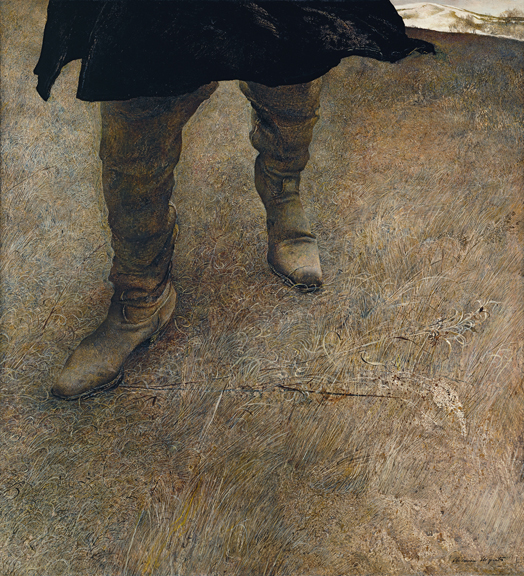
ANDREW AND JAMIE WYTHE

CHRISTINA'S WORLD

CHRISTINA’S WORLD (1948)


The woman crawling through the tawny grass was the artist’s neighbor in Maine, who, crippled by polio, “was limited physically but by no means spiritually.” Wyeth further explained, “The challenge to me was to do justice to her extraordinary conquest of a life which most people would consider hopeless.” He recorded the arid landscape, rural house, and shacks with great detail, painting minute blades of grass, individual strands of hair, and nuances of light and shadow. In this style of painting, known as magic realism, everyday scenes are imbued with poetic mystery.

WYETH, ANDREW AND JAMIE IN THE STUDIO, DENVER, COLORADO

On View through February 7

Hamilton Building – Level 2
Ticketed with member discount.
For tickets, purchase online or call 720-913-0130.

The Denver Art Museum presents a groundbreaking exhibition exploring the art of Andrew Wyeth and his son Jamie. Wyeth: Andrew and Jamie in the Studio is organized by the Denver Art Museum and will feature more than 100 works created in a variety of media, including pen and ink, graphite, charcoal, watercolor, dry brush, tempera, oil, and mixed media.

This exhibition explores the connection between two American artists who shared artistic habits of mind while maintaining their own unique artistic voices. Never before has an exhibition displayed Andrew Wyeth’s and Jamie Wyeth’s work on this scale and in the shared context of their autobiographies, studio practices, and imaginations.

Whether you are new to the work of Andrew and Jamie Wyeth or are familiar with it, this exhibition will allow you to see their art converge and diverge over the years. The common thread that runs through their works as well as the distinctive practices of each will be apparent.

An exhibition catalog, published by the Denver Art Museum in association with Yale University Press, is available in The Shops.


Photo-20160108161858482.jpg

Unknown.jpeg

Jamie-Wyeth-Kleberg_0.jpg

Andrew-Wyeth-Trodden-Weed.jpg

Wyeth_6.jpg


Damnificados by JJ Amaworo Wilson

http://fourthandsycamore.com/2016/01/21/a-review-of-damnificados-by-jj-amaworo-wilson/

by David Nilsen

damnificadosDamnificados: A Novel
Novel by J. J. Amaworo Wilson
3.7/5·Goodreads
Uses magical realism, revolutionary politics, and romantic adventure to bring to life a colorful community of squatters in an imaginary Latin American cityDamnificados is loosely based on the real-life … Google Books
Originally publishedSeptember 1, 2015


JJ Amaworo Wilson’s Damnificados is based on real events, which seems almost incredible until you remember what a truly strange world we live in. These are the facts of the real-life story: In 1990 constuction began on an enormous skyscraper in Caracas, Venezuela, the Centro Financiero Confinanzas (more commonly referred to as the Tower of David). In 1994 Venezuela was hit by a banking crisis and construction on the tower halted, never to be resumed. Beginning in 2007 the half-completed tower, which is the third tallest in the city and the seventh tallest in all of South America, became occupied by homeless squatters, and eventually as many as 2,500 people lived in the building. They rigged up electricity and running water and set up businesses in the building. Contrary to popular perception, the building was far from a war zone. It was a functional city within a city, forgotten people reclaiming a forgotten relic of civilization. In the last year the government has relocated most of these tenants to new housing, and plans are being explored for how best to use the hulking structure. It is unlikely a better use will be found than free housing for a couple thousand homeless people.

Wilson takes this bizarre real-life story and molds it into a compelling fable about the collision between the haves and the have-nots in a fictional South American city. In Damnificados (the Spanish word for victims, most commonly victims of disaster) we follow the efforts of Nacho Morales, the physically disabled leader of a band of homeless outcasts. Nacho is brilliant–he knows a dozen languages and scrapes together a living doing translation work, though he could make far more if he was willing to abandon the ragged families who need him most. He is not willing to do this. He chooses poverty because to do otherwise would be to side with oppression; those with power and money in this city use it only to gain more, regardless of whom they trample in the process.

The book starts with Nacho leading his band of outsiders into the tower. We get our first taste of the book’s use of magical realism when the group discovers the tower’s first floor is currently being occupied by a pack of wolves, and the leader of the pack has two heads. They drug the wolves and relocate them and then begin turning the tower into a home. Nacho starts a school and teaches children and adults to read. Maria, a former beauty queen, starts a salon. A few brothers start a bakery. Nacho uses one of his contacts to get water to the building and has a homeless electrical engineer connect the tower to the city’s electrical grid. Word spreads and more and more homeless families come to the tower. Word also spreads to individuals who don’t like the idea of homeless folks taking over a rich man’s tower for free.

The tower was originally built by a man named Torres (the Spanish word for towers). The land it was built on was once the city’s trash dump, and it was occupied by thousands of poor families who were subsequently displaced when Torres decided to build his tower. He ran out of money and never finished the hulking building, and Nacho feels he is reclaiming land that belongs to the poor by taking over the abandoned structure. The Torres family, disinterested in the tower for decades since construction ceased, feels differently. Violence is threatened and violence is enacted. Prayers are offered and miracles occur. Magical realism plays a significant role in the book, and strange events take place. For the most part these integrate well with the realism of the story, though there are a few times when these feel like deus ex machina that retrieve the novel from a narrative dead end. However, given the parable-like feel of the novel, these never derail our investment in the book.

Wilson’s novel is an invigorating tale about human beings clinging by their fingertips not only to a sustainable way of life, but to their very dignity, and shouting back at the wealthy with what breath they have, proclaiming they will not be ignored or silently pushed aside. The novel is delightfully imaginative and cuttingly insightful. If Gabriel García Márquez wrote a politically-revolutionary novel with dystopian overtones and published it through an indie press, it would be something like this. That is a compliment. Damnificados is engaging, provocative, and wholly original.


David Nilsen is the editor and lead critic for Fourth & Sycamore and works at Greenville Public Library. He is a member of the National Book Critics Circle. You can find more of his writing on his website and follow him on Twitter.

NOW

heart-vs-mind-fighting-28446089

by Michelle Cote


I was at the bottom with

No end in sight.

Mind numbing pain and sorrow

Blocked my vision and stopped my breath,

But then, from a soul sister, in the silence of despair,

Came a glimmering of hope,

A way to stop my ego, to

Reign in my mind.

She brought wise words of knowing,

A knowing and watching, a feeling and seeing.

And as I accepted that seeing and knowing,

the thoughts began to drop away

One by one like autumn leaves.

leaves

There came an absence of words,

A deep stilling of my soul.

Finally a way to be, just be, the only way,

But not quite a total release as I was yet

too weak, too exhausted from my struggle.

Parts of my ego and anger still held on, their grip

Like tentacles wrapped around my heart.

 I wanted to let go, I thought that maybe

the “wanting” was in the way,

But I accepted that soon even the wanting would be

of no consequence, it would drop away on its own and

The anger would stop sneaking up on me,

Grabbing me from behind when I least expected it.

 I know now that my ego and willful mind will not

Let go without a fight.

A fight to remain in charge, to perpetuate their control

And continue deluded behavior.

change ahead


But I have changed, grown,

and can now watch them from a safe distance and

At times even smile at their antics,

But I grow tired of their stubbornness,

their uncooperative nature,

their disdain for what is best for me.

They do not have my best interest at heart.

They have no heart.

Those two are not who I am

and when I am finally in tune to the being that is my true self,

All else will naturally fall away

and I won’t have to “deal” with either of them,

Nothing else will exists but the Now and

There I will happily stay.


Michelle Cotes loves to write poetry. Her poems describe her emotions beautifully. Michelle is in the process of working on two novels. She loves to garden and preserve what she grows by canning and freezing.  She lives in what she describes as  “a very cute little white cottage in the big woods.”

Her poetry can be found at http://heartwordsforpoetry.org  where this poem first appeared. Her poem “My Hope” was recently re-blogged here on Helios.


The Blending of Many

https://joellycameron.wordpress.com/2015/12/28/the-blending-of-many

by Joelly Cameron

images-1

Like snow, you fall around me.
I listen, content to your body breathing,
As we lay covered in flannel.
My fingers caught up in your pectoral curls,
And the way your eyes crinkle when you are content.
I wonder if it is possible to lie between the snowflakes,
And still be warm in this blatant vulnerability?
I have become exposed to this new awareness.This sense of bareness between us.
Yet, I welcome the fall, and the obviousness of you.

We have become like trees, rustling living beings,
That search for things we didn’t know we were looking for,
And aren’t sure that we want.
Like the leftover boxes that still lay on my bedroom floor.
That once contained something we wanted, but maybe outgrew.

Yet, for a time we held tightly to them, because we thought
They were what we needed.


See also https://heliosliterature.com/2015/02/16/castles-in-spain/

 D0fbGYy4_400x400

Joelle Cameron

The Net: The Unabomber, LSD and the Internet


A must see documentary from 2003 that has gone unnoticed by the vast majority. This film explores a broad scope of political and intellectual history from the 1940s through the turn of the century. It addresses the history of the formation of the Internet, the experiments with LSD in an attempt to understand how the mind can be harnessed to develop a new world order without totalitarianism or fascism, and the development of cybernetics as an attempt to merge man and machine into a new species.

From THE WHOLE EARTH CATALOG to the birth of ISIL, this somewhat disjointed film attempts cover and blend the many movements and ideas that have been lying in silent isolation beneath the current of events that have created our individual lifetimes. -KHF


Published on Mar 16, 2012

Full version of Lutz Dammbecks 2003 documentary.
Highest quality on YouTube.

The Net explores the complex back-story of Ted Kaczynski, dubbed by the CIA as the “Unabomber”. An inquiry into the rationale of this notable figure situates him within a late 20th Century web of technology – a system that he grew to oppose. Incorporating a subversive approach to the history of the Internet, the documentary combines speculative travelogue and investigative journalism to trace contrasting counter cultural responses to the cybernetic revolution.

For those who resist these intrusive systems of technological control, the Unabomber has come to symbolize an ultimate figure of refusal. For those that embrace it, as did the early champions of media art like Marshall McLuhan, Nam June Paik, and Stewart Brand, the promises of worldwide networking and instantaneous communication outweighed the perils.

Working through themes of utopianism, anarchism, terrorism, and providing insights on the CIA, LSD, Project MK-ULTRA, Timothy Leary, Ken Kesey and the Merry Pranksters, Dammbeck provides a fascinating view of the wider picture of the most famous neo-luddite.

—Shortened and altered summary originally from Amazon.com


Das Netz: Blotters, Bombers, and Cybernetic Trauma


(In)Stability 

Das Netz is a German documentary directed by Lutz Dammbeck, a strange mosaic of the collision of covert history, scientific development, and popular culture. Ostensibly it’s about the case of the Ted Kaczynski, the brilliant mathematician-turned-“Unabomber” who between the years of 1978 and 1995 engaged in a bombing campaign against industrial civilization. Holed up in remote cabin in the woods near Lincoln, Montana he fashioned weapons that he then mailed to his victims, many culled from the ranks of the “Digerati” – the top-elites of the then-emergent fields of computing and information technology development. While many would be satisfied creating a linear narrative, a documentary snaking through Kaczynski’s life as a mathematical prodigy who lost his mind, Dammbeck choses instead to ask the question of why? Not satisfied with the charge of insanity, the filmmaker strikes out to navigate a twisty terrain in search of causation, something that would explain why an individual who was expected to become one of the leading mathematicians of our time would flee civilization to wage a protracted war against technology – the very force that trajectory of his mathematical fields was propelling forward. In the end, this question becomes a guiding compass in the loosest sense of the word, holding together an unwieldy array of facts and tangents that span decades.

Jim_at_Kaszynski_cabin.jpg

Dammbeck’s journey takes him to the offices of John Brockmann, a notable of the Digerati who cut his teeth in New York City’s avant-garde scene of the early 1960s before becoming the literary agent for many of the top thinkers and leaders in the fields of technoscience. The trail then leads him to Brockman’s close friend Stewart Brand, where we’re treated to an interview with the guru on a cramped houseboat on the California coast. Like Brockman, Brand is one of the Digerati, renowned as the founder of the early online community known as the WELL. He was present at the launch of Wired magazine, the official organ of the delirious Silicon Valley-style capitalism defined by Richard Barbrook and Andy Cameron as the “Californian Ideology.” And like Brockman, Brand emerged from the New York avant-garde, and after filling his mind with the writings of Buckminster Fuller, Norbert Wiener, and Marshall McLuhan, struck out for the West Coast. He joined up then with the author Ken Kesey, who, having recently encountered LSD through the CIA’s notorious MK-ULTRA program, banded together the Merry Pranksters. Brand recounts for the camera his role in setting-up the Prankster’s Acid Tests, where participants were introduced to the drug while immersing themselves in complex, multi-media environments with a psychedelic soundtrack provided by a band called the Warlocks – later to find fame as the Grateful Dead. From this foundation, the archetypal image of the 1960s was born: the hippy counterculture, in full revolt against the Puritan society that their parents hoped to pass down.

5594a.jpg

Das Netz draws our attention to the fact that Kaczynski was teaching mathematics at the University of California at Berkley in 1967, not far from the ground zero of this counterculture at its height. It also draws our attention to Kaczynski’s self-made cabin in the forests of Montana, which was fashioned from plans advertised in the Whole Earth Catalog. The Catalog, in turn, was a publication devised by Stewart Brand as a means to provide tools for the communalist movement – those in the counterculture who sought a ‘back-to-the-land’ lifestyle far removed from despotic urbanism and the overreaching arms of the state. Years later, the communes that so motivated the Whole Earth Catalog would be resurrected online as the WELL, itself an abbreviation for Whole Earth ‘Lectronic Link. For Dammbeck, lurking behind this shifting kaleidoscope of history lurks LSD – first in the hands of CIA, which then seemed to have passed the reigns on to Kesey and the Merry Pranksters.

All this sounds like the making of a great conspiracy theory, which in many respects Das Netz can easily be read as. And indeed, many of these same facts have become fodder a vast multitude of them. But I don’t think that’s the ultimate point of Dammbeck’s documentary. As we watch, the narrative splits fractures and spins, becomes increasingly incoherent in regards to its initial goal. Here’s the Esalen Institute. Here’s the brains behind ARPA, the early creators of the internet. Here’s a play-by-play of the Unabomber’s arrest by FBI agents. Here’s some reflections on Kurt Gödel and his incompleteness theorems, which posits that there will always be true, yet unprovable statements. Like Kaczynski, Gödel suffered from increasingly debilitating paranoia that would, in the end, claim his life. This what Das Netz is really about: paranoia, and the impossibility of avoiding it in our age of complex systems and dizzying array of machines that govern every action in our waking lives. It speaks to the ontological instability that we are all subjected to, in the prefabricated, yet modular, environments crafted for us by the stipulations of non-stop, 24/7 neoliberal capitalism. It foregrounds, without speaking it, that inevitability of solipsism that Baudrillard spent a lifetime probing and diagnosing.

Readers of this blog will have noted the ongoing fascination with cybernetics, in particular its role as the defining governmenality of the neoliberal ideology. This is one of the reasons I find Das Netz so appealing: it’s all there, from Norbert Wiener’s attempts to build anti-aircraft batteries through collapsing man and machine together in the pseudo-metaphor of the servomechanism, to the movement of Wiener and his theories into biology, to the Josiah Macy Jr. Foundation’s Macy Conferences. It was there that cybernetics became articulated as the ideal instrument of liberal governance: a self-steering machine, a literal governor for maintain homeostatic social systems in a state of equilibrium. While Dammbeck doesn’t mention it, it was after these conferences that the CIA begin subsidizing social science seminars around the Western world to promote cybernetics as a unified science, their experts speaking urgently of the need to win out the “cybernetics gap” allegedly forming with the Soviet Union.[1] Maybe we can feel that familiar paranoia creeping in when we consider that the Josiah Macy Jr. Foundation was soon receiving money from the CIA to host a series of seminars, modeled on the Macy Conferences with many of the same participants in tow, to begin studies in LSD.

ABC-LIC-HIS90.jpg

sage

One of the great novels to bring together cybernetics, the 60s, and the encroachment of paranoia is Thomas Pynchon’s The Crying of Lot 49, which may be very well the model for what Dammbeck attempts to carry out in Das Netz. Pynchon’s protagonist, Oedipa Maas, finds herself ensnared in a worldwide conspiracy between two different mail distribution companies, which the novel articulates in terms of cybernetic systems on two levels: the literal level (it’s dealing with communication systems) and the metaphorical level (language drawn from cybernetics and information theory abound). To make matters worse for Maas, however, is that the conspiracy itself might not even exist. Uncertainty lurks at the center of Pynchon’s novel, which like an unstable cybernetic system veers off on a positive feedback loop, far from any sense of linearity. Like the exploding counterculture, she “moves from a uniform, univocal, suburban America to an America characterized by infinite multiplicity, an America where anything can happen and where events can have any number of meanings.”[2] But is this freedom or control? Maas reflects that she finds herself feeling “trapped between the zeros and ones of an enormous computer.”

Pynchon carries the themes of cybernetics and paranoia over to his next novel, Gravity’s Rainbow, which foregrounds many of Norbert Wiener’s primary concerns by focusing much of the plot on missile trajectories and the blurring of flesh with weapons systems in the context of the Second World War. Conspiracies again abound in text, snaking their way through the heart of the conflict as competing interests rush to lay claim to the mysterious “Rocket 00000”. Along the way, readers are treated to scenes of wealthy industrials participating in occult rituals (with dubious outcomes), the dipping of characters into shared hallucinations, and the breakdown of linear perspective in the collapse of Calvinistic deterministic universals in the face of quantum indeterminacy. At one point the character of Edward Pointsman (a Pavlovian psychologist with a penchant for determinism and control) pauses to ask “Suppose we consider the war itself as a laboratory?” Andrew Pickering, in his brilliant analysis of emergence of the cyborg sciences (cybernetics, game theory, systems analysis and the like) in the halls of World War 2’s military-industrial-academic complex, uses this quote as his launching pad. For Pickering, this complex itself is a cyborg system that begins at the intersection of these three dimensions, before spilling out into the social arena.[3]

Das Netz, too, looks at the war as a laboratory, but engages not so much in the careful analysis through STS (science and technology studies) techniques that Pickering privileges, opting instead to probe the hard to discern feedback loops between self and society that cybernetic principles were soon applied to. If the war is a laboratory, it is a laboratory for studying what is inside the human, what makes it tick and move, desire, fall in line or move far from order. Pickering, in later analyses, would unveil that the foundations of wartime cybernetics can be found in attempts to study the brain, particularly when it is in abnormal states: experiencing trauma, hallucination, mystical experience, so on and so forth.[4] For Dammbeck, cybernetics emerges as a direct heir to behavioralism, a conclusion shared by the historian of science of Peter Galison.[5] If a human is like a computer, it is capable of being reprogrammed – or so the postwar cyberneticians believed. The brain is an error-correction mechanism that asses the environment, calculates statistical probability paths for action in that environment, and chooses what appears to be the proper action. Change the environment, shift the nature of the feedback system linking brain to environment, and the human effectively becomes changed.

(Re)Construction 

Dammbeck insists that the Macy Conference participants were motivated by The Authoritarian Personality, a sociological study published in 1950 that carried out statistical measurements of individual outlooks and personality traits in search of the ‘fascist personality’. The work utilized a unit of measure described as the “F Scale” (F for fascist), the application of which the authors of the study hoped to reveal what elements in American society could be altered to avoid a slippery slope into fascism. Buried deep in The Authoritarian Personality are Marxist roots: the study’s key author was Theodore Adorno, the exiled philosopher from the Frankfurt School of Critical Theory, and much the work that informed the development of it was undertaken by the School in Germany years prior. But to suit the conditions of the Cold War and the American values that were to be instilled, these Marxist roots were in fact obfuscated – something most evidenced by the removal of any overt reference to class relations and its impact on individual psychology (the key aspect, perhaps, of Frankfurt School analysis as a whole).

While there seems to be little evidence suggesting a direct relationship between Macy Conferences and The Authoritarian Personality, one of Adorno’s colleagues from the Frankfurt School, psychologist Kurt Lewin, was an avid participant in the Macy Conferences. He was long acquainted with many of its key organizers, having years earlier been a member of the Committee for National Morale (a wartime social science organization/propaganda outfit) with Margaret Mead and Gregory Bateson. The overarching focus of the CNM (which I discuss in my earlier essay Into the Mystic) was to analyze the conditions that led to the rise of fascism in Germany, which was quickly diagnosed as something intrinsic to one-way communication media platforms. The singularity of unilateral communication left the German people fragmented; by extension, multi-directional media would create what they called the “whole person”, one capable of rejecting fascism for an embrace of the “Democratic Personality”. The CNM doesn’t feature in Dammbeck’s narrative, but is the subject of a recent book by Fred Turner titled The Democratic Surround: Multimedia and American Liberalism from World War II to the Psychedelic Sixties.[6]

kaprowwords

Turner traces the ambitions of Mead, Bateson, Lewin, and psychologist Gordon Allport, among other CNM participants, to the creation of what he calls “surrounds” – modular architectural spaces infused with multimedia systems that would allow spectators to play an active role in shaping the experience. This, they felt, would education the individual on his or her relationship to the greater social totality, something necessary for building an open society. As Turner shows, the concept of the surround came to inform the multimedia aesthetics of the New York City avant-garde, from John Cage to his students at Black Mountain College to Andy Warhol and his Exploding Plastic Inevitable. It also became the inadvertent prototype for the “happening” and the “be-in”, the outbreaks of mass spontaneity that defined the 60s countercultural experience. In one illuminating section of the book, he shows how the concept of the surround was deployed by the art troupe USCO to illustrate life inside systems that did not differentiate between machine and man. A young Stewart Brand was a participant in USCO’s mystically-tinged, technological happenings; when he moved to the West Coast and joined Ken Kesey and the Merry Pranksters, he imported the concept straight into the infrastructures of the Acid Tests. The counterculture, the mass exodus from the Fordist disciplinary society, seems to be for Turner the inevitable accident of the social scientist’s attempt to remake the world in the image of American liberalism – just as the turning on of their children’s minds through LSD was the accident of the CIA’s own forays into the world of psychedelic drugs.

“Our humanism is scientific,” wrote communication specialist Lyman Bryson in 1947, “because we believe in the control of social change by intelligence and experience… we shall use social engineering to solve the problem of setting up the conditions of freedom, but not to determine what men shall do with freedom when they get it.”[7] This concept, of defining the parameters of freedom in the service of liberal corporatism, was the over-arching desire of a vast network of social science and communication studies institutions, think-tanks, and study groups bound together by interlocking members and funding bodies. In the early days of the Second World War, this funding was carried out primarily by the Rockefeller Foundation – also the philanthropy behind earlier behavioral psychological research and later cybernetic studies. This funding would continue, with the philanthropy being joined by the Ford Foundation and the CIA. One key institution, for example, was the joint Harvard-MIT Center for International Studies (CENIS), which with Ford Foundation and CIA money and direction would become the hotbed of modernization theory, an approach to foreign policy that saw American liberalism as the highest stage in historical evolution (this perspective would go on to provide the intellectual and policy frameworks for the American excursion into Vietnam).[8] “We later became convinced,” one CENIS member later recounted, “that our strongest psychological weapon was our potential ability to help the nations of the free world achieve political stability by helping them expanded their productivity and their standards of living.”[9]This particular perspective became known described as the promotion of People’s Capitalism, an inversion of Soviet propaganda stylings to describe the Fordist affluent society, the world of washing machines and coca-colas, happy factory workers and family values.

classStruggleGEJun-16-1956

By looking at the swirling menagerie of individuals, institutions, policy papers and academic articles from this time, we glimpse into the heart of the liberal postwar state itself. It is the rhetoric of inclusiveness, stability, harmony and trust – the balancing of interests between states, between races, between the self and society, to achieve an idealized homeostasis (assuming, of course, that this homeostasis took place in the context of Keynesian state capitalism). And yet a dark underbelly laid beneath the surface. American People’s Capitalism was to be everything that fascism was not; almost the entirety of the social scientists’ concerns were motivated by finding a fix-it for the massive error that had created Nazism. While the vast majority singled in on the relationship between media and the structures of society, others went further. Notable here was Dr. Ewen Cameron, a president of the American Psychopathological Association and the World Psychiatric Association, who attributed the Third Reich to cultural, social, biological and racial factor intrinsic to the German people. They were, he argued, naturally aggressive; going further, he soon applied these notions to society as a whole. The conclusion he came to was similar to the mainstream of liberal social scientists – that society had to be properly managed to navigate society – but he differed by asserting the ‘weak’ of society had to phased out by the rigorous application of the behavioral sciences.

In 1943, Cameron received a grant from the Rockefeller Foundation to set up Allen Memorial Institute for Psychiatry at McGill University in Montreal; he became the first director of the institution and went to work establishing a global psychiatric network. By the 1950s his primary focus was schizophrenia; a cure for the ailment, he wagered, could be found by deconstructing the patient’s psyche and reprogramming it from the ground-up. To pursue these ends he subjected unwitting patients to bizarre and increasingly violent experimentations. Subjects were placed in sensory deprivation tanks up to sixteen hours a day, followed by multiple rounds of electroshock therapy. Sometimes they were kept sedated for nearly two months at a time, while at other points their psyches were bombarded with heavy doses of hallucinogenic c drugs – including LSD. This process was called depatterning, described by Cameron as the bringing of the patient to the “desired level of disorganization” capable of disturbing his or her “space-time”. This will ensure, he continues, that the patient will live “in a very narrow segment of space time. All aspects of his memorial function are severely disturbed. He cannot well record what is going on around him. He cannot retrieve data from the past.”[10] At this point, the process of psychic driving was to start. The patients became subjected to endless audio loops whilst under the influence of muscular paralytic drugs and hallucinogens. With their inability to resist exposure to the messages, Cameron believed that he could construct new personalities from the ground up. Through psychic driving a “reorganization of the personality might be brought about without the necessity of resolving conflicts or abreaction or the reliving of past experiments.”[11]

cia_lsd.jpg

Cameron’s work was subsidized by the Rockefeller Foundation, but most of the funds flowed form the Human Ecology Fund; one board member of this organization was Adolf Berle, a Wall Street lawyer who had announced the advent of corporate liberalism with his 1932 book The Modern Corporation and Private Property. Margaret Mead, meanwhile, was another recipient of research grants, as were a host of anthropologists and social scientists, the majority of which were intimately related to wartime and post-war research institutions.[12] The founder of the Human Ecology Fund was a neurologist by the name of Harold Wolff, later to have been recruited in the endeavor by CIA director Allen Dulles as part of the MK-ULTRA program. The Human Ecology Fund as a whole as a well-crafted front organization for the agency, bestowing grants to established researchers such as B.F. Skinner to maintain an air of authenticity.[13] Quite frequently, the recipients of the funding did not know that their research grants were ultimately traceable to the CIA’s coffers, or that their research into psychology was to be instrumentalized to “to develop new techniques of offensive/defensive intelligence use” (to quote Wolff).[14]

Describing the activities of the Human Ecology Fund, Adolf Berle wrote in his personal journal “I am frightened of this one. If the scientists do what they have laid out for themselves, men will become manageable ants.”[15] His words recall directly Norbert Wiener’s great fear for the cybernetic project he helped inaugurate – that it would assist to “organize the fascist ant-state with human material.”[16]

(Un)Certainty

Henry A. Murray was many things: a leading Harvard psychologist, an authority on the works of Herman Melville, and a staunch advocate of World Federalism. He was a student of Alfred North Whitehead, and was close to later countercultural icons like Timothy Leary and Lewis Mumford. His early reflections for measuring personalities would lay the foundation of the methodology used in Adorno’s The Authoritarian Personality. He designed psychological aptitude tests for the OSS during World War 2, and served on the advisory board of the Committee for National Hygiene alongside fellow OSS officer Frank Fremont-Smith – an executive at the Josiah Macy Jr. Foundation and a key organizer of the Macy Conferences. Murray was also close friends with the Committee on National Morale’s Gordon Allport, with whom he founded Harvard’s Department of Social Relations in 1946. There is much existence to suggest that Murray was also entangled in the CIA’s MK-ULTRA network, and that the Department of Social Relations was its key institution on the Harvard campus.

Between 1959 and 1962, Murray carried out a series of strange tests designed to measure the functioning of an individual under extreme stress. While the details remain hazy, the test subjects – exceptionally bright undergraduates – were faced with techniques that Murray had developed in the OSS, and later perfected for the Navy (with the aid of a Rockefeller Foundation grant). “In one part of the experiment, subjects were pressured to respond to questions asked under extreme duress, with bright lights and cameras pointed at them and electrodes attached to their bodies.”[17] At other points, the students were forced to endure “vehement, sweeping and personally abusive” attacks, including having their most cherished ideals rigorously and forcefully deconstructed. While the majority of the participants in Murray’s study have remained anonymous, others have come forward to report PTSD-like symptoms that persisted long after the events. One such test subject was Ted Kaczynski.

Was this the event that drove Kaczynski away from the world of mathematics and science, and into a process of becoming that ended in a small shack in the woods of Montana? It is near impossible to say, but it is the question that lurks at the heart of Das Netz, the small fragile piece that holds the whole historical narrative together. In his interview with Dammbeck, Stewart Brand describes Kaczynski as something of a “countercultural hero” – and indeed, his flight away from industrial civilization in search of pristine nature resembles that of the communalist of the 1960s. Like Kaczynski, they too were all the offspring of an experiment whose outcome seemed certain, but was moored in uncertainty. Perhaps it is that proximity to uncertainty and unknowability that drove Kaczynski to the lengths he went to, to become the Unabomber.

15Foerster-mit-Offz.-.jpg

Dammbeck certainly thinks so. In the most fascinating segment in Das Netz, he arrives at the house of Heinz von Foerster, another cybernetician (and editor of the Macy Conference’s official papers, a task he was recruited for by Margaret Mead) who become a countercultural icon. Von Foerster describes to Dammbeck the philosophies of radical constructivism, taking the logical positivism of early Vienna scientific philosophers to their relativistic extreme. When it comes to physics, he says, the theoretical construct of the “particle” does not exist, and only serves to hide holes in theories. At the end of all things, it is only theories that exist, and each is nothing more than a story told to explain the “origin of the universe.” “And yet, he tells Dammbeck, “All theories are correct because they can all be deduced from other theories. It goes on deducing indefinitely. That’s the good thing about it. You can go on forever.” Dammbeck, in his fascination with Godel’s conclusion of fundamentally unknowability, is obviously enticed with von Foerster’s constructivism, which seems to embody the most exciting aspect of the counterculture’s appropriation of cybernetics: the possibility of endless multiplicity. Unlike Pynchon’s Oedipa Maas (and Kaczynski, for that matter), von Foerster does not find himself lodged in the probability space dictated by the functions of the computer. Dammbeck, in a series of letters, attempts to get Kaczynski to comment on Godel, only to receive a philosophy much akin to von Foerster’s own, but moored deeper in that unavoidable sense of paranoia:

In your last letter you asked me about the mathematician’s imagination. You probably assume that mathematicians always imagine something mathematical. But that’s not true. Experienced mathematicians seldom think of mathematics. Usually they imagine flowers, sunshine, and birds singing in spring. Perhaps now and then they think about women, but they don’t do that very often for they are pure in heart. How is it, you will ask, that mathematicians don’t think of mathematics constantly? I must tell you that mathematicians are not scientists, they are artists… Apart from the most elementary mathematics, like arithmetic or high school algebra, the symbols, formulas, and words of mathematics are have no meaning at all. The entire structure of pure mathematics is a monstrous swindle, simply a game, a reckless prank. You may well ask: ‘Are there no renegades to reveal the truth?’ Yes, of course. But the facts are so incredible that no one takes them seriously. So the secret is in no danger. 

How can one speak truth to power if power is but an abstraction, the oscillation moving through simulation and simulacrum? For Stewart Brand, it was the communalists, and perhaps for Dammbeck, it is Kaczynski. Early in Das Netz he browses an anarchist bookstore in Seattle and finders the published copies of the Unabomber’s Manifesto, sitting alongside Murray Bookchin and Noam Chomsky. The film refracts and images and clips of the famous Battle of Seattle, where thousands of protestors pushed back against the neoliberal system in the form of the World Trade Organization, slips across the screen. We know the usual story: the radical anarchist enclaves full of people like John Zerzan and their role in those protests in 1999, and their interesting primitivist defense of Kaczynski. Beyond this, one might see a reflection of the Unabomber’s cabin being fashioned from suggestions in Brand’s Whole Earth Catalog in the anarchist’s interest in the Manifesto, as if non-linear feedback loops trace themselves out down through the decades. The counterculture had rejected the liberal world system designed by their parents in their laboratories, and these protestors were rejecting the neoliberal world system designed by their own parents – that is, the generation of the counterculture itself.

WTO_protests_in_Seattle_November_30_1999

CA_Battle in Seattle_banner

Throughout Das Netz, we hear news clips playing in the background describing the events of September 11th, and the hunt for Osama Bin Laden. While we’re drawn to make a comparison between Kaczynski and the fighters in the streets of Seattle, we’re to draw yet another to the attacks of al-Qaeda. By the time this had happened, the cybernetic system of governance drawn up in the postwar years had mutated far beyond the expectations of the social scientists. Cybernetics, communication platforms, and social engineering had been a grand bid for rational management, a methodology that allowed states and their citizenry to make decisions in an increasingly complex world. And yet by the end of the 1960s, it was clear that social management could not work in such a linear format. At Ford Foundation-funded spaces like the RAND Corporation and the Center for the Advanced Study of the Behavioral Sciences, these systems became internalized in an idealized form of the individual. Instead of having these systems guide policy, policy was transformed by these theorists of rational choice to create the environmental frameworks where these systems became the individual’s reality. The state’s goal became one of establishing the artificial environment in which self-modulation, in accordance with the flows of the market, would serve as a vast order of self-regulation. By the 1990s, this was the crushing order that the Zapatistas, the Seattle protestors, and the alter-globalization movement tried to push back. By 2000, with the return of the conservatives to office, this world order seemed to be all but absolute – only to fall messily to ground in the collapse of the World Trade Centers – felled by the unexpected offspring of yet another failed experiment.

Here, in 2015, I’m also reminded of ISIS, crawling out of the rubble of Iraq and seizing upon opportunities provided by a failed democratic revolution in Syria. We can see all the social media platforms – these postmodern descendants of the multi-media systems longed for the postwar social scientists – being reverted against the West, the subversion of popular memes and iconography used to shatter the linearity of our consumer society. I’m also reminded, however, of the usage of media in this country to obscure reality for what it is, be it the attacks on immigrants and Muslims by Donald Trumps, or the ongoing climate change denial by a well-greased PR campaign. I’m reminded that a government agency is recorded data from every phone call, text message, email, website visit, and Gmail chat conversation being carried out not only by myself, but possible every person, everywhere. That computer-geek whistleblowers can be chased across the world by a sovereign government bent on keeping its secrets, aided by hacker organizations, is reflection of much our world resembles the world less and resembles more a science-fiction novel. That few seem to honestly care makes it all more perplexing. Looking at this strange, contorted and fragmented whole, the overwhelming weirdness of our times cannot help but trigger that creeping paranoia, that unavoidable solipsism. How could such chaos come from such ambitious design? And how could it possibly be real?

FOX_nsa

[1] On the CIA, the “cybernetics gap”, and the role it played in the early stages of the ARPAnet, see Richard Barbook Imaginary Futures: From Thinking Machines to the Global Village Pluto Press, 2007, pgs. 150-154, 164-168

[2] Lois Tyson Psychological Politics of the American Dream: The Commodification of Subjectivity in Twentieth-Century American Literature Ohio State University, 1994 pg. 102

[3] Andrew Pickering “Cyborg History and the World War 2 Regime” Perspectives on Science, vol. 3, no. 1, 1995

[4] Andrew Pickering The Cybernetic Brain: Sketches of Another Future University of Chicago Press, 2010. For a continued dialogue on the relationship between cybernetics and trauma, see Matteo Pasquinelli (ed.) Alleys of Your Mind: Augmented Intelligence and Its Traumas Centre for Digital Cultures, 2015

[5] Peter Galison “The Ontology of the Enemy: Norbert Wiener and the Cybernetic Vision” Critical Inquiry Vol. 21, No. 1, 1994

[6] Fred Turner The Democratic Surround:  Multimedia & American Liberalism from World War 2 to the Psychedelic Sixties University of Chicago Press, 2013

[7] Ibid, pg. 59

[8] For an excellent history of modernization theory, see Michael E. Latham Modernization as Ideology: American Social Science and Nation Building in the Kennedy Era University of North Carolina Press, 2000. On modernization theory, computer simulation, and the Vietnam War, see Barbrook Imaginary Futures pgs. 221-252

[9] Turner, The Democratic Surround, pg. 232

[10] Ewen Cameron “The Depatterning Treatment of Schizophrenia” Comprehensive Psychiatry Vol 3, No. 2, April, 1962 http://www.naomiklein.org/files/resources/pdfs/depatterning.pdf pg. 3

[11] Quoted in Mary D. Young Encyclopedia of Asylum Therapeutics, 1750s-1950sMcFarland, 2015, pg. 276

[12] David H. Price “Buying a Piece of Anthropology” Anthropology Today Vol. 23, No. 3, 2007 https://wikileaks.org/w/images/AT-june07-Price-PT1.pdf

[13] Ibid.

[14] Michael Otterman American Torture: From the Cold War to Abu Ghraib and BeyondPluto Press, 2007, pg. 24

[15] Quoted in Gerard Colby and Charlotte Dennett Thy Will Be Done: The Conquest of the Amazon: Nelson Rockefeller and Evangelism in the Age of Oil, HarperCollins, 1995, pg. 265

[16] Norbert Wiener The Human Use of Human Beings: Cybernetics and Society Houghton Miffln, 1950

[17] Kirsten G. Studlien “Murray Center Seals Kaczynski Data” The Harvard Crimson July 14th, 2000 http://www.thecrimson.com/article/2000/7/14/murray-center-seals-kaczynski-data-plondon-buried/?page=2