SPECKLED MILK

6f9b0bd7-adc8-463c-8f16-0bf9bc250395

by Bill Yarrow 

THOUGHTS ON WRITING

The first rule of writing is to not add descriptors to things inherently described. A ball need never be described as round because a ball, inherently, is round. Grass need never be described as green because grass naturally is green. Milk need never be described as white because milk normally is white. Adjectives are required only when the object to be described deviates from its inherent self. Thus a lozenge-shaped ball, blue or yellow grass, pink or speckled milk.

No need to say he watched with his eyes or she touched with her hands because we use our eyes to see and we use our hands to touch. If she touched his shoe with her toe, however, that’s a different story.

No one would write, “He sneezed with his nose,” “She danced with her feet,” or “He breathed with his lungs,” but people do write, “She pinched him with her fingers” (or worse, “with her thumb and index finger”) and “He kissed her with his lips.” Why? Let kiss be kiss and pinch be pinch. Over-scrupulous specificity is not a good.

Let the normal be normal and never over explain. He opened the window is sufficient. “He placed two hands on the window pull and lifted upward” or “he grabbed the door handle and pulled it outward” belabors the action and obscures the obvious. If you have something to say, say it directly. He kissed her. He parked the car. He cleaned the toilet. Add a detail only if it is an unexpected detail. He kissed her on the chin. He parked the car on the lawn. He cleaned the toilet in his suit.

Chekhov writes to Gorky: “You understand it at once when I say, ‘The man sat on the grass;’ you understand it because it is clear and makes no demands on the attention. On the other hand, it is not easily understood, and it is difficult for the mind, if I write, ‘A tall, narrow-chested, middle-sized man, with a red beard, sat on the green grass, already trampled by pedestrians, sat silently, shyly, and timidly looked about him.’ That is not immediately grasped by the mind, whereas good writing should be grasped at once—in a second.”

Description should be eloquent and precise, not fevered, not desperate, not consumed by the greed to be foolishly exhaustive and insanely comprehensive.

Consider these lines, both of which come from the William Carlos Williams poem that begins “By the road to the contagious hospital”

 “the reddish / purplish, forked, upstanding, twiggy / stuff of bushes and small trees / with dead, brown leaves under them”—that description is unfocused, desperate, inept.

 “the stiff curl of wild carrot leaf”—now, that description is eloquent, precise, thrillingly good!

Do not double up on words. Use “separated,” not “separated out.” Use “divided, not “divided up.” Use “together,” not “both together.” Use “sat,” not “sat down.” Use “fell,” not “fell down” (unless “down” is used as a preposition and requires an object, e.g. “down the stairs”). Use “lifted,” not “lifted up.”

Never exaggerate. Let words speak for themselves. “Hot,” not “scalding hot.” “Cold,” not “freezing cold.” “Handsome,” not “dashingly handsome.” “I sweated,” not “I sweated bullets.” “I jumped,” not “I jumped out of my skin.” “Red, not “beet red.” Or “blood red.” Or “firehouse red.” (An exaggeration is never far from a cliché.)

Do not add an adverb which does the same work as the verb. No need to say “moaned softly” when “moaned” will do. A moan, by its nature, is soft. No need to say “missed terribly” when “missed” will do. Adding “terribly” dilutes the force of “missed.”

Do not use “so” as an intensifier without using the word “that” to complete the comparison. Not “I was so embarrassed,” but “I was so embarrassed that I could not speak.” If you complete a comparison, make sure you are adding to the original idea rather than merely reiterating the idea. “I was so embarrassed that I turned red” is a reiterative sentence because people who are embarrassed do turn red. Better to say simply, “I was embarrassed” or “I turned red.” One or the other.

If you are going to sin, sin on the side of clarity. Add more words than fewer words. Repeat words if the repetition will help clarify the action or the idea. Consider the shortened form of the sentence from the preceding paragraph: “If you complete a comparison, make sure you are adding to rather than merely reiterating.” Add words for clarity.

Good writing is rhythmic. Prose rhythm may be established in a number of ways. [Note” not “a number of different ways.”] Thus, there are no hard and fast rules regarding word choice, particularly the number of words used. “I showered” and “I took a shower” are both fine ways to express the same idea. Two words are not universally preferable to four words. Choosing always the smallest possible number of words may make writing more difficult to decipher—like reading a telegram. Writing needs to breathe. Repetition is OK. The use of parenthetical elements is OK. The use of parallel phrases is to be encouraged. Triplets are to be admired. Good writing owes allegiance to precision, not constriction.

 Use “sprinted” rather than “ran quickly,” not because “sprinted” is one word rather than two but because it may be the precise word you are looking for.

 Use “reclined” rather than “leaned back,” not because “reclined” is one word rather than two but because it may be the precise word you are looking for.

 Use “contemplated” rather than “thought carefully,” not because “contemplated” is one word rather than two but because it is the precise word you are looking for.

 Use “labored” rather than “worked hard,” not because “labored” is one word rather than two but because it may be the precise word you are looking for.

 Use “glanced” rather than “looked quickly,” not because “glanced” is one word rather than two but because it may be the precise word you are looking for.

 Use “shouted” rather than “called loudly,” not because “shouted” is one word rather than two but because it may be the precise word you are looking for.

But “sprinted,” “reclined,” “contemplated,” “labored,” “glanced,” and “shouted” may not be the precise words you are looking for, so, in that case, don’t use them. Use whatever words you need whenever you need them.

Those people who see style as affectation see everything as affectation.

WE MUST NOT SAY SO
(with apologies to John Berryman)

Milk, friends, is white.
We must not say so.
Swans, friends, are white.
We must not say so.
Grass, friends, is green.
We must not say so.
Birds have two wings.
We must not say so.
River water is wet.
We must not say so.
We clap with our hands.
We must not say so.
The sky above is blue.
We must not say so.

but trucks sputter (or brake)
butter softens (or burns)
the factory closes (or hires)
the soil erodes (or dries up)
lips blister (or tighten)
leaves scatter (or shimmer)
paper cuts sting (or heal)
radiators knock (and hiss)


This essay appeared in Blue Fifth Review: Blue Five Notebook Series (Winter 2016 / 16.1) as “We must Not Say So.”        https://bluefifthreview.wordpress.com/


SEE MORE FROM BILL YARROW ON  HELIOShttps://heliosliterature.com/2014/11/26/processes/

Bill Yarrow is the author of THE LICE OF CHRIST (MadHat Press 2014), INCOMPETENT TRANSLATIONS AND INEPT HAIKU (Cervena Barva Press 2013), POINTED SENTENCES (BlazeVOX 2012), FOURTEEN (Naked Mannekin, 2011), and WRENCH (erbacce-press 2009).


CROSSROADS

by Ricky Hawthorne


woman-standing-red-traffic-light-22129474

Une brève réunion


The traffic light changed from green to red

And there you were

Knowing me, grinning

At my stupefaction

Calling me by name

Running heavily across the traffic

Toward me as if a returning lover

At the climax of a movie


‘John’,  you cried and only then I knew you too

‘My God you look well,

What are we, fifty-five?’

(I play tennis oh, and I have a gym membership)

I head the corporation now you know


‘And smart in that suit;

But surely you were a dustman

The last time I saw you?’

(I went to college, at night, after work)


‘Yes, father’s retired now’


‘Where are you living now?

Never, however did you afford that?’

(Sixteen hour days and sacrifice)


I’ll inherit the house of course

‘And just back from Barbados — A second honeymoon’

(I thought of ours, in Skeggie, and smiled)


And the car and the Cretan Villa…


Then your conversation evaporated

Like a plump dewdrop

Pricked by a sunbeam

From a new star


Yes, these were yours long ago

My patron, my king

And here where all roads meet

We will always measure the distance


So we shook hands

For the first time while

Above us the lights turned green;

You went west, I east

But what I didn’t tell you was

That I’d done it all for you


– See more at: https://scriggler.com/DetailPost/Poetry/20936#sthash.q0iMr5gB.dpuf


6466

Ricky Hawthorne


Bio:  Ricky graduated from Warwick University Coventry, UK, with triple honors in literature, theater and film.
Three screenplays:
Myth – a modern allegory on Middle Eastern Current Events
The Abandoned – A doomed menage a trois straddles the carnage of WWI France
Pottersville  – Xmas Eve and Ricky, redundant, separated and drunk, crashes his car and ends up in Pottersville, the nightmare town from his favorite film
Three teleplays all adapted from his own short stories:
Is This Yours – A cell predicts horse-race winners but what else does it tell?
A Turn of the Wheel – A contradictory SatNav sends its poor driver around the bend
The Bell –  Recuperating in an old cottage Simon gets caught up in its ghastly history
Three Dramas
Ahasuerus –  The Wandering Jew finds himself outside a Concentration Camp in 1943
Lenten Observance – A devout Catholic is torn between family and God when he discovers his autistic son is gay
Litter – An examination of global warming from the inner human psyche

NOW

heart-vs-mind-fighting-28446089

by Michelle Cote


I was at the bottom with

No end in sight.

Mind numbing pain and sorrow

Blocked my vision and stopped my breath,

But then, from a soul sister, in the silence of despair,

Came a glimmering of hope,

A way to stop my ego, to

Reign in my mind.

She brought wise words of knowing,

A knowing and watching, a feeling and seeing.

And as I accepted that seeing and knowing,

the thoughts began to drop away

One by one like autumn leaves.

leaves

There came an absence of words,

A deep stilling of my soul.

Finally a way to be, just be, the only way,

But not quite a total release as I was yet

too weak, too exhausted from my struggle.

Parts of my ego and anger still held on, their grip

Like tentacles wrapped around my heart.

 I wanted to let go, I thought that maybe

the “wanting” was in the way,

But I accepted that soon even the wanting would be

of no consequence, it would drop away on its own and

The anger would stop sneaking up on me,

Grabbing me from behind when I least expected it.

 I know now that my ego and willful mind will not

Let go without a fight.

A fight to remain in charge, to perpetuate their control

And continue deluded behavior.

change ahead


But I have changed, grown,

and can now watch them from a safe distance and

At times even smile at their antics,

But I grow tired of their stubbornness,

their uncooperative nature,

their disdain for what is best for me.

They do not have my best interest at heart.

They have no heart.

Those two are not who I am

and when I am finally in tune to the being that is my true self,

All else will naturally fall away

and I won’t have to “deal” with either of them,

Nothing else will exists but the Now and

There I will happily stay.


Michelle Cotes loves to write poetry. Her poems describe her emotions beautifully. Michelle is in the process of working on two novels. She loves to garden and preserve what she grows by canning and freezing.  She lives in what she describes as  “a very cute little white cottage in the big woods.”

Her poetry can be found at http://heartwordsforpoetry.org  where this poem first appeared. Her poem “My Hope” was recently re-blogged here on Helios.


The Blending of Many

https://joellycameron.wordpress.com/2015/12/28/the-blending-of-many

by Joelly Cameron

images-1

Like snow, you fall around me.
I listen, content to your body breathing,
As we lay covered in flannel.
My fingers caught up in your pectoral curls,
And the way your eyes crinkle when you are content.
I wonder if it is possible to lie between the snowflakes,
And still be warm in this blatant vulnerability?
I have become exposed to this new awareness.This sense of bareness between us.
Yet, I welcome the fall, and the obviousness of you.

We have become like trees, rustling living beings,
That search for things we didn’t know we were looking for,
And aren’t sure that we want.
Like the leftover boxes that still lay on my bedroom floor.
That once contained something we wanted, but maybe outgrew.

Yet, for a time we held tightly to them, because we thought
They were what we needed.


See also https://heliosliterature.com/2015/02/16/castles-in-spain/

 D0fbGYy4_400x400

Joelle Cameron

Audible Hor d’Oeuvres: Two Poems by Eloisa Perez-Lozano

Guest Contributor's avatarFourth and Sycamore

By Eloisa Pérez-Lozano

My Turn to Read

microphone Image credit Jan Mehlich

My concentration begins to wane
during the poet’s last stanza
not because I’m bored
but because I’m next.

My foot taps just a little faster
as I scan the poem, line by line
lingering over certain words
and making mental notes.

I hear my name hang in the air
followed by encouraging claps.
I rise from my chair and try not to trip
as head to the podium.

I look down at my typed-up thoughts
and realize they’re about to come alive
audible hors d’oeuvres for my audience
who waits to sample my soul.

I breathe in deeply, breathe out slowly,
swallow my nerves and fears
about not being worthy to read
and begin.

An Ode to Writing

penIt grabs you, shakes and stuns you
Then soothes, and lulls, caresses
You’re putty in its ink

Every page is packed

View original post 121 more words

Isabelle Stengers’ new book available open access

Jeremy Schmidt's avatarJeremy J Schmidt

Isabelle Stengers’ new book, In Catastrophic Times, is available for free as a .pdf download at this site. Here is a description of the book (which you can also buy in hard copy as well following the link above):

There has been an epochal shift: the possibility of a global climate crisis is now upon us. Pollution, the poison of pesticides, the exhaustion of natural resources, falling water tables, growing social inequalities – these are all problems that can no longer be treated separately. The effects of global warming have a cumulative impact, and it is not a matter of a crisis that will “pass” before everything goes back to “normal.”

Our governments are totally incapable of dealing with the situation. Economic warfare obliges them to stick to the goal of irresponsible, even criminal, economic growth, whatever the cost. It is no surprise that people were so struck…

View original post 32 more words

Anti-Islam Propaganda

Ken Finton's avatarKenneth Harper Finton

12208604_980033425352897_7041136503211647923_n

It is not so much that Islam is a peaceful religion designed to co-exist with others, but outright misrepresentations such as above is making its way around the world. Remember Christians war against Christians and all religions that believe they are the only truth are false ideologies.

Verse by verse, you can see the result of the attempt to make was on Islam. See: http://corpus.quran.com/translation.jsp?chapter=3&verse=85

At the above site you can read seven parallel translations of each verse and see the original Arabic in a word by word translation. This mistranslated propaganda is obviously created to provoke tension and war.

Verse (2:191) – English Translation

As above: “Slay the unbelievers wherever you find them.”

Shakir: And kill them wherever you find them, and drive them out from whence they drove you out, and persecution is severer than slaughter, and do not fight with them at the Sacred Mosque until…

View original post 717 more words

The Universe from Nothing

Scientific GOD Journal | November 2015 | Volume 6 | Issue 10 | pp. 655-657 Pal, H. S., The Problem with the Universe from Nothing (Part II) 

ISSN: 2153-831X Scientific GOD Journal Published by Scientific GOD, Inc. http://www.SciGOD.com

The Problem with the Universe from Nothing (Part II)

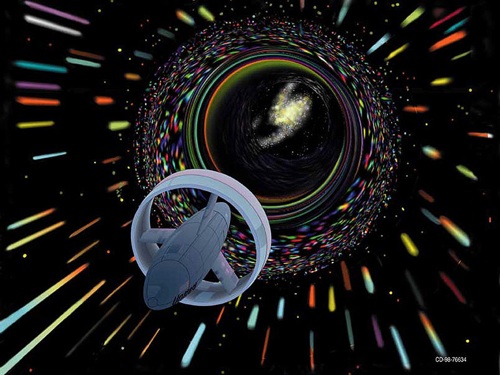
500px-Wormhole_travel_as_envisioned_by_Les_Bossinas_for_NASA

Himangsu S. Pal*

* Correspondence: Himangsu S. Pal. E-Mail: sekharpal1946@rediffmail.com

ABSTRACT 

Scientists have shown how the total matter-energy content of the universe has always remained zero. If the universe appeared out of nothing, initially there was no space, time, matter and energy. However, we are not satisfied with this explanation and want to know how the total space-time content of the universe has always remained zero. Otherwise, scientists will have to explain as to whence appeared the extra residual space-time that was not already there at the beginning.

Key Words: Universe, nothing, substance, space, time, energy, matter, gravity.

When scientists say that the universe can simply come out of nothing without any divine intervention, they think of the universe in terms of its energy content only. In the book ‘The Grand Design’, page 281, scientist Stephen Hawking has written that bodies like stars or black holes cannot just appear out of nothing, but a whole universe can.1 The message is very clear from this: The total energy of a whole universe is zero and that is why it can come out of nothing; but stars or black holes will fail to do so, because their total energy is not zero. But universe means not only its energy; universe means its space-time as well. So if we now apply the same logic to space-time as well, then we can say that the total space-time of a whole universe must also always have to be zero, because in that case only a whole universe can appear out of nothing. Here my question is: How does the total space-time of an ever-expanding universe always remain zero?

As the universe appeared out of nothing, so initially there was no space, time, matter and energy. Scientists have successfully shown how the total matter-energy content of the universe has always remained zero. But we are not satisfied with that explanation, we want something more. We also want to know how the total space-time content of the universe has always remained zero. And it should always remain zero if the universe has actually appeared out of nothing. Otherwise scientists will have to explain as to whence appeared the extra residual space-time that was not already there at the beginning.

If stars or black holes cannot appear out of nothing simply because their total energy is not zero, then can a whole universe appear out of nothing if its total space-time is not zero?

The last question above will further boil down to this one: Do the physicists think that energy cannot just appear out of nothing, but space-time can, supposing that the total space-time of the present universe is not zero? Scientific GOD Journal | November 2015 | Volume 6 | Issue 10 | pp. 655-657 Pal, H. S., The Problem with the Universe from Nothing (Part II) 

ISSN: 2153-831X Scientific GOD Journal Published by Scientific GOD, Inc. http://www.SciGOD.com

656

Or, do they think that like life, mind and consciousness, space and time are also emergent entities only, and therefore, not directly coming from big bang nothing?

Something can appear out of nothing provided that the totality of that something always remains zero. Actually anything can come out of nothing if this condition is fulfilled. This is the principle which some scientists have relied upon when they have proposed that our universe could have arisen out of nothing due to a quantum energy fluctuation in a void. They have found that the total energy of the universe is exactly zero. The total energy being zero, the total matter will also be zero due to matter-energy equivalence. If the total matter as well as the total energy of the universe is zero, then why should they have to come from anything at all? They could have come from nothing as well. So these scientists have proposed that our universe has simply appeared out of nothing. But when they have proposed this theory, they remained totally oblivious of the fact that universe means not only its matter and energy, universe means its space-time as well. So, if the universe has actually appeared out of nothing, then just like matter and energy, space-time also has appeared out of that primordial nothing. So like matter and energy, the total space-time also should always remain zero.

However, if it is the case that space-time has not directly appeared out of nothing, then the total space-time need not have to be zero. No sane person on this earth will ever say that the total number of human beings in this universe must always have to be zero, because no sane person believes that human beings have directly appeared out of nothing. However if ‘x’ has directly appeared out of nothing, then logic and common sense dictates that the totality of that ‘x’ must always have to be zero.

Here it may be objected that there is a law of conservation of matter and energy in science, but that there is no such conservation law for space-time. So there is no violation of conservation law if nothing generates so much of space-time. Even if it is conceded that this is a valid objection – here I must say that I do not think so – it can still be pointed out that there is one more reason that can be given as to why the total space-time of the universe should always remain zero. This reason we find in Einstein’s general theory of relativity. As per GTR space, time and matter are so interlinked that there cannot be any space-time without matter. Similarly there cannot be any matter without space-time. If there cannot be any space and time without matter, then the total matter of the universe being zero, the total space-time of the universe should also always be zero. So we can say that GTR alone gives us sufficient reason to conclude that if the total matter of the universe always remains zero, then the total space-time of the universe should also always remain zero. Here the question becomes quite irrelevant as to whether the universe has originated from something, or from nothing.

So from GTR we come to know that the total space-time of an ever-expanding universe should always remain zero, but we do not know yet how it does actually remain zero.

If science cannot give any satisfactory answer to this question, then the naturalistic world-view of modern science will prove to be inadequate for explaining the real world. Scientific GOD Journal | November 2015 | Volume 6 | Issue 10 | pp. 655-657 Pal, H. S., The Problem with the Universe from Nothing (Part II) 

ISSN: 2153-831X Scientific GOD Journal Published by Scientific GOD, Inc. http://www.SciGOD.com

657

Reference 

1. S. Hawking & L. Mlodinow (2012), The Grand Design, pg. 281 (Bantam Books: New York).

Fascism

This week we have witnessed a phenomenal act of social movement-making in an era when many, myself included, have wondered if meaningful change in the U.S. still possible.

Some of that worry is about aging, I’m sure. As you get older and the people around you get older you are inclined to wonder if the kids can ever be as alright as the kids you were.

We overstate our youthful courageousness. Then, because we are wily from age, we defend that overstatement by understating the courage of the youth who displace us. That may be natural. But when a cross-campus coalition of student-athletes and student-citizens at the University of Missouri organized to force the retirement of the college president (and future “transition” of the university system chancellor) they did something remarkable.

These young people took on the growing, well-paid, powerful administrative class in corporate higher education and actually won a concession.

We can debate whether the concessions these students won are material enough for the hard-core Marxists, too symbolic for the crusty pragmatists, or replicable enough for the devout organizers. But we who believe in democracy as verb instead of noun should relish the moment.

We should also defend the moment against the inevitable media contortions.

Almost immediately the Mizzou student actions became a battleground over the first amendment, media and fascism when at a rally some protestors formed a human shield to block a photographer from campus media from recording the protestors.

Granted, my social media feed is heavily weighted towards media folks but you would have thought this moment was Tienneman Square for the media caterwauling. More than a handful of editors, reporters, and mainstream media organizations condemned the Mizzou students as spoiled, anti-democratic, ridiculous, and enemies to their own cause.

David Simon, a writer who was once a journalist, went further.

He told me (and Roxane Gay, a brilliant writer who can speak for herself) over an hours-long diatribe on Twitter that the Mizzou students were fascists in “intent”, the photographer was the real hero of recent events, and that these were the moments on the slippery slope to the decline of American democracy.

Fascism means something.

He also intimated that I lack intellectual rigor to engage with him about fascism or anything really.

I’ll respect his right to be protected from my undisciplined intellectual inquiry.

I want David Simon to have a safe space.

The rest of you aren’t so lucky.

First, let me put as fine a point on my position as possible.


The press is not a rational objective actor.

The press shapes as much as it documents.

All press benefits as much from social change as it benefits from the status quo. That means the press, especially corporate media, is always serving two masters.

The press has rights but so do persons and sometimes we define those rights by working through the moments when they clash.

This is a heavy moment for those clashes. The moment’s heaviness deserves attention because context matters to intellectual rigor, if not hyperbolic hand-waving.

The Moment For Movement-Making

The Mizzou student-activists are organizing in a moment of public, private and State surveillance unlike any ever before seen in modern history in a wealthy imperialist nation where a huge part of our conspicuous consumption is surveilling ourselves as a status symbol.

They are organizing within the most corporate driven era of higher education in the history of the United States with all that entails for curtailing citizen-building at the expense of making markets and more consumers.

These students were organizing against the major capital interests that can now purchase unprecedented access to politicians in a massive police apparatus that has virtually unchecked privilege to target, surveill, detain and murder in a media culture controlled by many of the same capital interests.

This moment requires a level of sophistication that I doubt even my elder cohort can quite grasp. This is not the 1960s. It isn’t even the 1980s.

Social media allowed Mizzou students to attract the requisite public attention for successful social action. But, media both social and traditional (and increasingly that’s a false distinction but it still means something discursively so roll with it) can bring as much harm as it can good given the political economy in which we all live.

The first amendment protects the press against censure but it does not delimit the democratic action of those the press covers.

All due respect to the man who gave the world Stringer Bell but what we saw at that student rally was democracy in action, not fascism.

Fascism means something more than a thing one does not like.

Fascism means a system of social organization that concentrates power and doesn’t just discourage dissent but organizes the State against it.

I don’t like to literalize metaphors for the most part. I like creative license. I use it from time to time with various degrees of success. Denying writers metaphors is cheap way to become a demagogue.

But sometimes the material reality subsumes creative licence and the moment at Missouri is one such moment.

It’s not just that the moment is important. It’s not just that the students are still very much in danger for doing something important. It is that hand-waving about a fascist state can confuse us about what making democracy looks like.


Democracy Is Messy

Historical narratives about Great Men can be a trap.

These narratives are important but they also have the benefit of hindsight. They can make events seem pre-determined. The actors in them appear uniquely gifted to bring about social change. Resistors always seem weak because we know from the outset that they lose.

These stories, which we love, can lull us into thinking that social change is polite when historically and presently it is anything but. Still, we clamor for polite protests that follow imaginary rulebooks for Democracy 101.

The complaints from well-meaning people around Ferguson were about the same as those around the March on Washington as those around Reconstruction.

Very few people want to be actual fascists or actual racists but they don’t want to be late for work or awakened by sirens either. So, people say in various ways, could protestors stay off of residential streets after 7 PM and during rush hour traffic and also not make the buses in Birmingham late or unprofitable because people rely on those jobs and maybe too if the students at Mizzou could just write a nice letter and be grateful for their scholarships.

Mizzou students may have seen that historical narrative because they resisted its traps. It’s the trap that leads the media to cover those well-meaning people in Ferguson like they covered them in Birmingham like they covered them throughout Reconstruction – as well-meaning harmless folks who just believe in rules.

The Media Is Complicit And Mizzou Students Knew It

The media rarely calls people racists.

Even when people’s fetish for rules over justice makes them complicit in extra-judicial murder of black men, women and children.

Even when these well-meaning harmless folks only want the “rules” of biological superiority of whiteness to prevail in policy-making and bell curves about the scientific inferiority of brown people to justify resource provisions for everything from schools to prisons the media rarely calls this racism.

Sociologist Bonilla-Silva talks about a U.S. culture where there is miraculously racism but no racists. He interviews people, across race and class, and finds that they can talk about aspects of racism but have a multitude of narratives that makes no one complicit really.

And the media – at least the mainstream media – by and large follows suit.

I’ve asked some of those same people on my media-heavy social media before if their outlets have style guides about when they will or will not use “racism” or “racist” in reporting.

The gist seems to be that the media relies on the “objective” rationality of its reporters to make that call. Perhaps in a diverse media industry this would lead to sparkling debates about what constitutes racism when publishing. In that alternate universe one might expect to see “racism” show-up as much as it’s many euphemisms (“racial issues” etc.).

The “No-Racists” Feedback Loop

Of course, media outlets don’t reflect the U.S. population as much as they reflect the demographic make-up of the nation’s power elite.

Just thirteen percent of newsroom employers are “minorities” defined here as broadly as possible to include anyone non-white basically. The figures are smaller when you break that category up by race. The numbers are slightly higher in television news at 22 percent but again that’s for every non-white category.

One way to look at an important axis of power in how news is shaped by the taken-for-granted editorial norms is to consider the diversity among media shot-callers. The Pew Research Center finds that with news directors you approach racial parity in a handful of large media markets but only 13 percent for the rest of the many newsrooms across the country. Again, newspapers are worse than television with just ten percent of those supervisors being a “minority”.

Digital media was supposed to blow this wide open. Greater access might fix that pipeline problem of minority journalism grads not finding that all-important first media job. So far, the National Association of Black Journalists are unimpressed with the reality: digital newsrooms do not seem to be building better pipelines than traditional media.

This only matters, of course, if you think diverse persons is in any way related to diversity of ideas. I’ll concede that’s debatable even as I admit that I think, with some margin of error, it’s the most efficient first step.

As it stands, most media people come from the same socio-economic background. They share a racial identity (white). And, they are often produced by closed of social networks and elite institutions. It is no wonder that they tend to share ideas about when something does or does not earn the label “racism”.

As one reporter told me, they rely on other people – their subjects – to call something racist. Given the research that shows that people also rarely call anything racist, even when acknowledging racism, we end up in a divine feedback loop: people see racism but no racists and media will only report on what people say is racist.

The feedback loop can feel like a noose when you are organizing against the very racism people might agree exists but that no one will name.

How do you describe why someone would draw a swastika in feces on a college wall if we preclude the discussion of racism as an act with actors?

How can you organize around acts of racism to do the work that well-meaning folk don’t do when we can call something fascist but can’t call anything racist?

That’s the media climate the Missouri students were navigating. They chose to do what social movement organizations almost always do: They tried to control their message.

Mizzou student organizers used social media because it allows some of that control, granting access to media organizations on their terms and sometimes denying it altogether.

They did this knowing that sensationalist headlines are used to generate revenue and sometimes the algorithmically driven choices can malign as much as they can report.

They did this knowing that the media may not have a great record with labeling racism as such but it does have a record of using the mugshots of black criminal defendants at higher rates than do those of white criminal defendants.

They did this in a media culture that can be the disinfectant but that has also historically been the infection. Given this, the rhetoric got heated.

But, we saw the video of the student photographer at the Missouri rally. Somehow ideas circulated. They may not have circulated for profit, but they circulated. And the police weren’t marshaled to remove the photographer, as would happen in a fascist state.

As a result of all of this, many of us now know a bit more about the machinery of modern organizing in our culture.

That’s how the democratic sausage is made and this week it was made by a group of young people whose safety, well-being and accomplishments trump creative license and metaphor.

tressiemc22's avatartressiemc

This week we have witnessed a phenomenal act of social movement-making in an era when many, myself included, have wondered if meaningful change in the U.S. still possible.

Some of that worry is about aging, I’m sure. As you get older and the people around you get older you are inclined to wonder if the kids can ever be as alright as the kids you were.

We overstate our youthful courageousness. Then, because we are wily from age, we defend that overstatement by understating the courage of the youth who displace us. That may be natural. But when a cross-campus coalition of student-athletes and student-citizens at the University of Missouri organized to force the retirement of the college president (and future “transition” of the university system chancellor) they did something remarkable.

These young people took on the growing, well-paid, powerful administrative class in corporate higher education and actually won a…

View original post 1,880 more words