TODAY IS FRIDAY

By Ernest Hemingway

“Read anything I write for the pleasure of reading it. Whatever else you find will be the measure of what you brought to the reading.”  -Ernest Hemingway
ffd1e8f0-a0e8-40c7-9fe2-971576945eed http://genius.com/Ernest-hemingway-today-is-friday-annotated

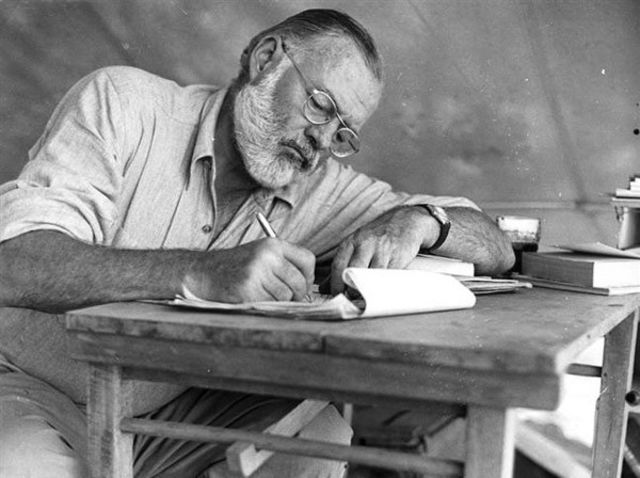
Hemingway’s “Today Is Friday” is about three Roman soldiers at eleven o’clock in the evening still drinking after the crucifixion of Jesus Christ. In his Paris Review interview Hemingway claimed to have written it and two other of his best stories in one day:

INTERVIEWER You once wrote me that the simple circumstances under which various pieces of fiction were written could be instructive. Could you apply this to The Killers—you said that you had written it, Ten Indians, and Today Is Friday in one day…?” HEMINGWAY The stories you mention I wrote in one day in Madrid on May 16 when it snowed out the San Isidro bullfights. First I wrote The Killers, which I’d tried to write before and failed. Then after lunch I got in bed to keep warm and wrote Today Is Friday. I had so much juice I thought maybe I was going crazy and I had about six other stories to write. So I got dressed and walked to Fornos, the old bullfighters’ café, and drank coffee and then came back and wrote Ten Indians. This made me very sad and I drank some brandy and went to sleep. I’d forgotten to eat and one of the waiters brought me up some bacalao and a small steak and fried potatoes and a bottle of Valdepeñas.”

INTERVIEWER

You once wrote me that the simple circumstances under which various pieces of fiction were written could be instructive. Could you apply this to The Killers—you said that you had written it, Ten Indians, and Today Is Friday in one day…?”

HEMINGWAY

The stories you mention I wrote in one day in Madrid on May 16 when it snowed out the San Isidro bullfights. First I wrote The Killers, which I’d tried to write before and failed. Then after lunch I got in bed to keep warm and wrote Today Is Friday. I had so much juice I thought maybe I was going crazy and I had about six other stories to write. So I got dressed and walked to Fornos, the old bullfighters’ café, and drank coffee and then came back and wrote Ten Indians. This made me very sad and I drank some brandy and went to sleep. I’d forgotten to eat and one of the waiters brought me up some bacalao and a small steak and fried potatoes and a bottle of Valdepeñas.”

TODAY IS FRIDAY 

Three Roman soldiers are in a drinking-place at eleven o’clock at

night. There are barrels around the wall. Behind the wooden counter is

a Hebrew wine-seller. The three Roman soldiers are a little cockeyed.

IST SOLDIER You tried the red?

2ND SOLDIER No, I ain’t tried it.

IST SOLDIER You better try it.

2ND SOLDIER All right, George, we’ll have a round of the

red.

HEBREW WINE-SELLER Here you are, gentlemen. You’ll

like that. (He sets down an earthenware pitcher that he has filled

from one of the casks) That’s a nice little wine.

IST SOLDIER Have a drink of it yourself. (He turns to the

third Roman soldier who is leaning on a barrel) What’s the matter

with you?

3RD SOLDIER I got a gut-ache.

2ND SOLDIER You’ve been drinking water.

IST SOLDIER Try some of the red.

3RD SOLDIER I can’t drink the damn stuff. It makes my

gut sour.

IST SOLDIER You been out here too long.

3RD SOLDIER Hell, don’t I know it?

IST SOLDIER Say, George, can’t you give this gentleman

something to fix up his stomach?

HEBREW WINE-SELLER I got it right here.

( The third Roman soldier tastes the cup that the wine-seller has

mixed for him)

3RD SOLDIER Hey, what you put in that, camel chips?

WINE-SELLER You drink that right down, Lootenant.

That’ll fix you up right.

3RD SOLDIER Well, I couldn’t feel any worse.

IST SOLDIER Take a chance on it. George fixed me up fine

the other day.

330 TO-DAY IS FRIDAY

WINE-SELLER You were in bad shape, Lootenant. I know

what fixes up a bad stomach.

( The third Roman soldier drinks the cup down)

3RD SOLDIER Jesus Christ. (He makes a face)

2ND SOLDIER That false alarm!

IST SOLDIER Oh, I don’t know. He was pretty good in

there to-day.

2ND SOLDIER ‘Why didn’t he come down off the cross?

IST SOLDIER He didn’t want to come down off the cross.

That’s not his play.

2ND SOLDIER Show me a guy that doesn’t want to come

down off the cross.

IST SOLDIER Aw, hell, you don’t know anything about it.

Ask George there. Did he want to come down off the cross,

George?

WINE-SELLER I’ll tell you, gentlemen, I wasn’t out there.

It’s a thing I haven’t taken any interest in.

2ND SOLDIER Listen, I seen a lot of them here and

plenty of other places. Any time you show me one that

doesn’t want to get down off the cross when the time comes

when the time comes, I mean I’ll climb right up with him.

IST SOLDIER I thought he was pretty good in there to-day.

3RD SOLDIER He was all right.

2ND SOLDIER You guys don’t know what I’m talking

about. I’m not saying whether he was good or not. What

I mean is, when the times comes. When they first start

nailing him, there isn’t none of them wouldn’t stop it if

they could.

IST SOLDIER Didn’t you follow it, George?

WINE-SELLER No, I didn’t take any interest in it, Loo-

tenant.

IST SOLDIER I was surprised how he acted.

3RD SOLDIER The part I don’t like is the nailing them on.

You kpow, that must get to you pretty bad.

2ND SOLDIER It isn’t that that’s so bad, as when they first

TO-DAY IS FRIDAY 33*

lift ’em up. (He makes a lifting gesture with his two palms

together) When the weight starts to pull on ’em. That’s when

it get’s ’em.

3RD SOLDIER It take some of them pretty bad.

IST SOLDIER Ain’t I seen ’em? I seen plenty of them. I tell

you, he was pretty good in there to-day.

( The second Roman soldier smiles at the Hebrew wine-seller)

2ND SOLDIER You’re a regular Christer, big boy.

IST SOLDIER Sure, go on and kid him. But listen while I

tell you something. He was pretty good in there to-day.

2ND SOLDIER What about some more wine?

( The wine-seller looks up expectantly. The third Roman soldier

is sitting with his head down. He does not look well)

3RD SOLDIER I don’t want any more.

2ND SOLDIER Just for two, George.

( The wine-seller puts out a pitcher of wine, a size smaller than

the last one. He leans forward on the wooden counter)

IST SOLDIER You see his girl?

2ND SOLDIER Wasn’t I standing right by her?

IST SOLDIER She’s a nice-looker.

2ND SOLDIER I knew her before he did. (He winks at the

wine-seller)

IST SOLDIER I used to see her around the town.

2ND SOLDIER She used to have a lot of stuff. He never

brought her no good luck.

IST SOLDIER Oh, he ain’t lucky. But he looked pretty good

to me in there to-day.

2ND SOLDIER What become of his gang?

IST SOLDIER Oh, they faded out. Just the women stuck by

him.

2ND SOLDIER They were a pretty yellow crowd. When

they seen him go up there they didn’t want any of it.

IST SOLDIER The women stuck all right.

332 TO-DAY IS FRIDAY

2ND SOLDIER Sure, they stuck all right.

IST SOLDIER You see me slip the old spear into him?

2ND SOLDIER You’ll get into trouble doing that some day.

IST SOLDIER It was the least I could do for him. I’ll tell

you he looked pretty good to me in there to-day.

HEBREW WINE-SELLER Gentlemen, you know I got to close.

IST SOLDIER We’ll have one more round.

2ND SOLDIER What’s the use? This stuff don’t get you

anywhere. Come on, let’s go.

IST SOLDIER Just another round.

3RD SOLDIER (getting up from the barrel) No, come on. Let’s

go. I feel like hell to-night.

IST SOLDIER Just one more.

2ND SOLDIER No, come on. We’re going to go. Goodnight,

George. Put it on the bill.

WINE-SELLER Good night, gentlemen. (He looks a little

worried) You couldn’t let me have a little something on

account, Lootenant?

2ND SOLDIER What the hell, George ! Wednesday’s pay-day.

WINE-SELLER It’s all right, Lootenant. Good night,

gentlemen.

(The three Roman soldiers go out the door into the street.

Outside in the street)

2ND SOLDIER George is a kike just like all the rest of them.

IST SOLDIER Oh, George is a nice fella.

2ND SOLDIER Everybody’s a nice fella to you to-night.

3RD SOLDIER Come on, let’s go up to the barracks. I feel

like hell to-night.

2ND SOLDIER You been out here too long.

3RD SOLDIER No, it ain’t just that. I feel like hell.

2ND SOLDIER You been out here too long. That’s all.

CURTAIN
GOD, INFINITY AND THE MöBIUS UNIVERSE

by Kenneth Harper Finton ©2015  (03.14.15, 9:26:43)

Beyond the edges of the universe is an infinity of nothingness. In order to understand existence, we need to attempt to understand this infinity. Infinity is not emptiness or space. It has no beginning and no end. In our minds, infinity is a concept, an idea where everything that is probable is possible. In mathematics and literature, infinity is a series of events and ideas, and numbers that have no endings. Mathematics stretches into infinity from the start at zero. There is no end to numbers. They constantly become bigger and bigger.

THE UNIVERSE IS A PLANE 

The universe is flat and shaped by geometric principles according to the latest astronomical observations. That time and space are bent is a fact that is well proven mathematically.

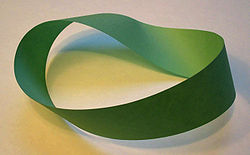
A Möbius strip made with a piece of paper and tape. If an ant were to crawl along the length of this strip, it would return to its starting point having traversed the entire length of the strip (on both sides of the original paper) without ever crossing an edge.

A Möbius strip made with a piece of paper and tape. If an ant were to crawl along the length of this strip, it would return to its starting point having traversed the entire length of the strip (on both sides of the original paper) without ever crossing an edge.

Anything curved on a flat plane (i.e., the universe) will eventually return to its starting point and start the journey again. If the universe is in the form of a möbius strip, as some have come to believe, then it curves back upon itself so that it has no beginning nor end. it repeats itself endlessly. A möbius strip has one boundary. A line drawn on this strip does not cross its point of origin until it has traversed both sides of the paper. In doing this, the line doubles the original size as opposed to a line drawn on a piece of paper not joined with a twist. A good explanation of this is found in the Wikipedia:

http://en.wikipedia.org/wiki/Möbius_strip

infinity

The möbius strip with one twist and pinched in the middle looks like the symbol for infinity. Some believe that our universe is actualized as a möbius strip with a finite number of twists of the vibrating strings in space. It is finite in that by going forward it transverses time and space, turning in a warped circle as it experiences its own starting point. It recurs over and over again, perhaps eternally.

The universe came from nothing; the nothing that formed the being and existence of the universe is the Infinite. That this has to be so is inescapable. People have long argued about the first causes, but nothingness had to come into existence. There is no other logical answer. Infinity is needed to have the Finite. A solitary, non-dual Infinity precedes the yin and yang of existence itself.

The nothing that is beyond the boundary of our universe is Infinity. It both exists and does not exist simultaneously. It has never been actualized because it has no dimension. Nothingness has everything to do with being and existence because everything is made manifest through nothingness. Nothingness is not temporal. It is non-dimensional. The closest we can get to it is to know that it is not a thing at all, but ‘NoThing’.

Nothing actually does exist and it has always been that way.

Duality disappears in the infinity of nothingness. When we realize that nothing really exists, this is not the height of nihilistic thought, but a universal condition that implores understanding. The sentence itself implies that nothing does exist, but that nothing is neither material nor spacial nor a part of time. This discovery does not negate the chemical composition of matter in our actual world but helps to further refine its essence. That nothing exists does not mean that the world is an illusion or organic chemistry cannot help us lead better lives. It means that the world developed from nothing and exists despite its ghostly origin. No matter how you try to rationalize it away, the world had to come from nothing at all because that is the supreme and only reality. Within time, space is filled with virtual energy, not nothingness. We can even tap this source for power and we will probably draw most of our power usage from that source in the future

A TALE OF TWO POINTS

In a single dimension, we have a point. In two dimensions, we have a line and other flat objects that exist on a plane. In three dimensions we have depth by the actualizing of space. In the fourth dimension, we have time by the actualizing of duration in spacetime. Möbius forms are the gateway to the fourth dimension.

[See references to http://en.wikipedia.org/wiki/Holographic_principle at end of article.]

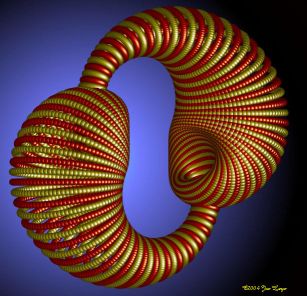
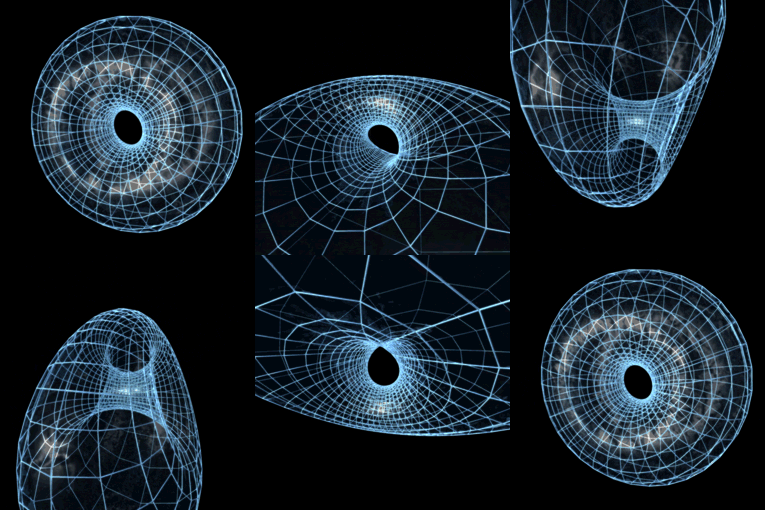
Bonan-Jeener's Klein Surface 2 
Courtesy of Jos Leys

Bonan-Jeener’s Klein Surface 2 
Courtesy of Jos Leys

But what does this have to do with the concept of infinity, which we have determined is beyond time and space? Infinity, in this sense, is non-existence. It is nothing. Nothingness has everything to do with being and existence because it is the source of everything. The actualized world is similar to a holographic projection on the one boundary that separates our actual world from the Infinity of spirit and nothingness. Infinity actualizes the world and universe that we conceive on the plane boundary between our existent universe and the infinity of nothingness.

Upon the closest inspections, there is much nothing in matter. Most of it is space. Of the particles that make up the actualizations of matter, many are waveforms without mass and small particles composed of energy that were originally waves that have been actualized into having mass. There are not really any smallest particles. Waveforms that have no mass are spread completely through space. In quantum physics, this is called vacuum energy.

[See: http://en.wikipedia.org/wiki/Vacuum_energy .]

This phenomenon is a manifestation of infinity within time. This is the lesson we should learn from quantum physics. The universe about us is a ghostly materialization, a projection from the infinity of nothingness. Our physical world can best be understood as information–events and experiences actualized from an infinite pool of possibilities and potentialities.

The connection of the physical world to the unrealized nothingness of infinity is partly explained by the idea of unrealized potential that has never come into being. One part of this physical world has been realized and actualized. We call this the present and the past. It exists in the dimensions of space and time. We imagine it to be the future. The world itself is part of an infinite system that comes from a zero dimension without time and space.

In zero dimension there is not even a point, as points are one dimensional. Infinity simply is. The math patterns which make up our physical world have always existed by necessity. These are the laws that create the patterns and systems that make up our actuality. Those laws and patterns of geometry, like infinity, have no beginning nor end. They did not evolve into laws, but nature followed these mathematical laws. Beginnings and endings are defined by space and time. Since space and time and nature itself follow the forms of a process expressed in mathematical principles, then these principles have to precede existence and are existent in some manner outside of time and space.

How this can be so in something that does not exist is perplexing. What is it that can both not exist and exist at the same moment? Is there something in that nothingness after all? If so, what is it?

You cannot have a finite world without infinity. Yet, infinity has no known plan or purpose, as religions lead us to believe. It has no need for a point because a point is dimensional. Even plans and purposes are human values and ideas. There are both mathematical and communicational uses for a point. In math, it refers to a particular object that cannot be defined in terms of previously defined objects. In communication, it is an idea that you use to try to express a view from information.

That infinity has no point is an expression of both definitions. Further, because this infinity is present in everything (there is no smallest anything), everything is part of infinity. That is all there is. All is nothingness and matter is incidental. Matter simply records events. Events are objects relating to one another. This relating is information. This nothingness is not the God of religions, it is not Void, it is not a master plan. It is another dimension to which we have no access at all because we are in time and space and infinity is not.

Infinity can be pictured as the spirit hidden in the nothingness that is everywhere and present before the universe and world were materialized. It is complete within itself and holds all that is made manifest and actualized. It is the one thing that exists and does not exist simultaneously. That which is actualized is part of infinity itself. The Native American term Great Spirit seems to be a valid expression and description of how infinity is actualized into being. Infinity is an idea.

Although it is a human idea and discovery, it appears and is made manifest without the need for humans at all. Infinity precedes existence itself. Infinity projects nothingness into existence through the actualization of dimensions such as space and time, depth and duration. It should not surprise us then that we are a part of an existence whose most basic substance is simply an idea formed from imagination and built through the accumulation of information. It should not surprise us that we are actualized from the infinite spirit of nothingness. Infinity is timeless and eternal. For infinity, there is only a manifested Now. Time and space are not a concern in a zero dimension. The world and the universe about us are finite and repetitive because of their dimensions, their circular shape and orbits, and the processes that infinity forms for existence to be actualized.

The future is still undetermined and not actualized. It exists in an infinite field of things that can potentially happen and is not realized. Similarly, the past has already been actualized and the record of it exists in the matter in the world we inhabit.

To my way of thinking, we are as eternal as the now. Those experiences that we lived and loved have moved on in time but exist as memories etched in mental processes. Why should death and extinction reign in a universe that only contains the Now? Somewhere, someway, we are missing something. The people we loved and lost still live in our memories. Those things should be able to live on as mental processes in infinity as well. Why should anything be lost in infinity if infinity can hold all that exists or can exist? If energy cannot be created or destroyed, then why should we as living organisms composed of energy be less than energy?

Nothing is lost. Nothing is gained. Why? Because all is nothing, all is spirit, all is unconscious awareness. That is what the world is about: the growing of unconscious matter into organisms and the perceptions of conscious experiences made manifest in myriads of forms and times. Time is the creator and space is the place where worldly existence dwells.

Consciousness is that which observes and experiences this world and makes it actual. Consciousness is eternal in that it too springs directly from the awareness of the Infinity which has no being and is not of time and space.

The Concept of Heaven

The concept of heaven has always been disturbing and very unclear. When we abandon our ideas of heaven, do we gain eternity? Heaven cannot logically be without pain. One cannot live in eternal happiness and still recognize joy. Heaven, as idealized by many, makes no logical sense whatever. It breaks the natural laws that form the basis of our dualistic world. Can you even imagine a man who had dozens of dogs and many wives reunited with all of them in a blissful afterlife? No, heaven would have to be devoid of emotion and dead to logical thinking and imagination.

Infinity, however, can hold all possibilities that can become probable. It can hold endless fields of probabilities and possibilities that can come into existence over endless amounts of time and space. It can hold alternative universes where things evolved differently. It can hold parallel universes that mirror our own.

Our flat universe is just one dimension of many. Like a book laid flat and stacked on the projection screen of time, universes can be viewed as pages of a book, each page holding another dimension, each book telling of a different experience. Deep within our consciousness is the observer who experiences all things. Our lives and times are a product of these observations as we seem to be both the observer and the observed. We are not as limited in time and space as we think ourselves to be. It simply appears to be that way.

Logic is an important component of universal laws. Does this mean that the universe is logical?  Mathematics and logic both testify that this is likely so.

Does this mean that the universe has a plan and a place for everything? No, it does not mean that. People have plans. The universe has occurrences. There is a mighty gulf between the two concepts. Infinity seems to be more an informational library than a creative master or designer. The geometry, the mathematics, and the logic have always been hidden away in the zero dimension. They are rediscovered as we grow in our own understanding.

What fun would it be to spill a huge bag of marbles into the universe and track them all through eternity? What purpose could possibly be shown by the predestination of the course of these simple glass balls? Surprise and wonder are the basic rewards of our existence. Why should it be otherwise?

It is much more likely that the universe is a random experience and that we are the ones who assign an arbitrary value to that which was never meant to be more than a play to occupy the time and space we envision.

The universe is you and me. We are not only a part of the universe, but we are the universe. It is only our self-consciousness and the actuality of our existence that keep us from knowing the reality.

As we were before birth, so will be after death. We sleep without awareness of time and the spirit within us awakens again and again. Time itself is a viewpoint, an experience of actions and reactions within a specific dimension. There are an infinite number of dimensions. And this is a good thing. We all love experience and that is what the universe is all about.

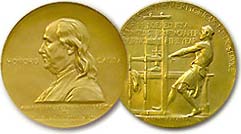
How to Write an Award-Winning Novel starring… The Pulitzer Prize for Fiction

(image via wikimedia)

Originally posted on Dysfunctional Literacy:

In some ways, it’s better to write an award-winning novel than to be a best-selling author.  You might make more money with a best-seller, but in a few years your book could be forgotten, lost in the ash heap of other replaced best-sellers.  On the other hand, if you win an award like the Pulitzer Prize, your book will be on that list forever.  Even if your Pulitzer Prize winning novel isn’t read much after a few decades, the title will still be on the list.  As long as there are literary critics, there will be a Pulitzer, and as long as there’s a Pulitzer, your book title and name will be on that list.

Reading a Pulitzer Prize winning novel isn’t always easy.  In 7th grade I was forced to read The Yearling by Marjorie Rawlings.  Yeesh!  Does anybody read The Yearlinganymore?  Back then, I disliked it, and I haven’t gone back to see if I was wrong to dislike it.  In 9th grade we were forced to read To Kill a Mockingbird, but at least nobody hated it.  If kids hated it, they kept it to themselves.  Even then, students knew it was wrong to hate that book.

As an adult, I read The Killer Angels by Michael Shaara because I went through a Civil War phase (without growing a long beard and dressing up in old musty uniforms).  I read The Shipping News because everybody else in my writers group had read it (but I don’t remember a thing about it).  I recently read The Road by Cormac McCarthy and The Brief Wondrous Life of Oscar Wao by Junot Diaz.

Writing a novel that’s considered for a Pulitzer Prize isn’t easy either.  An author usually has to do more than just tell the story.  An author has to use literary devices that catch readers’ and judges’ attention.  If devices like symbolism and figurative language aren’t enough, authors then have to throw in some literary gimmicks too.  A gimmick is a device that’s easy to do but doesn’t really add anything to the story.

For example, some Pulitzer Prize winning novels (The Road and The Brief Wondrous Life of Oscar Wao) don’t use quotation marks for dialogue.  Maybe leaving out quotation marks makes dialogue more meaningful than dialogue with quotation marks, but I’m not sure.  I’ve always used quotation marks with dialogue.  That’s how I was taught, but I’ve never won a Pulitzer Prize.

The Road also used nameless characters like “the man” and “the boy” (I probably shouldn’t have put them in quotation marks since the book doesn’t use them at all).  Plus, there was a double space between every paragraph, even the one sentence dialogue paragraphs that didn’t have any quotation marks.  I don’t know if The Roadwould have won a Pulitzer if the characters had had names, or if the spaces between paragraphs were normal, or if the author had used quotation marks.  It still probably would have been a good book.

The Brief Wondrous Life of Oscar Wao, along with no quotation marks, used several other literary gimmicks.  The novel had really long sentences with lots of Spanish and Dominican slang thrown in too.  The story was told out of order from several different characters’ points-of-view.  Plus, there were lots of nerd culture references.  Even though I’m a fan of nerd culture references, I thought there were way too many nerd culture references in this book.  Even nerd writers for The Big Bang Theory probably think there were too many nerd culture references inTBWLOOW.  I’m not saying you need to use nerd culture references to win a Pulitzer.  You need to pick a topic and drown your novel in references, like Donna Tartt did with the topic of art in The Goldfinch.

But if you want to emulate a Pulitzer Prize winner for fiction that uses a ton of literary gimmicks, try  A Visit from the Goon Squad by Jennifer Egan.

A Visit from the Goon Squad uses six literary gimmicks (that I noticed):

  1. Telling the story out of order.
  2. Switching points of view (3rdto 1st to 3rd…)
  3. Switching tenses in various segments (past to present to past…)
  4. a chapter of only power point/ flow charts (don’t use an e-reader for this book)
  5. lots of stream-of-consciousness
  6. And the worst gimmick ever… 2ndperson present tense!  I call it the worst gimmick ever because I tried using it in a college writing class, got yelled at by my writing instructor for using it, and then two months later Bright Lights, Big Citybecame a bestseller. Now I’m biased against 2nd person present tense.

At any rate, six literary gimmicks is a lot for one book.  There were so many literary gimmicks, I expected the author to resort to the 1st person present tense narration death scene.  I was wrong.  Instead, she used the 2nd person present tense narration death scene.    I hate being wrong.

Having so many literary gimmicks in one novel makes it look (to me) like the author is trying too hard.  My writing instructor might have declared that using all these gimmicks took away from any merits A Visit from the Goon Squad had as a story.  But he probably would have shut up once he realized the novel won a Pulitzer Prize for Fiction.

*****

What do you think?  Is using so many gimmicks good story-telling, or is it trying too hard?  What other literary gimmicks have you noticed in award-winning novels?  How many literary gimmicks should an author be limited to?  What literary gimmicks do you dislike the most?  If you were limited to one literary gimmick, which one would it be?  If you had a choice, would you rather write a bestselling selling novel or a major award winning novel?

dysfunctional literacy's avatarDysfunctional Literacy

(image via wikimedia) (image via wikimedia)

In some ways, it’s better to write an award-winning novel than to be a best-selling author.  You might make more money with a best-seller, but in a few years your book could be forgotten, lost in the ash heap of other replaced best-sellers.  On the other hand, if you win an award like the Pulitzer Prize, your book will be on that list forever.  Even if your Pulitzer Prize winning novel isn’t read much after a few decades, the title will still be on the list.  As long as there are literary critics, there will be a Pulitzer, and as long as there’s a Pulitzer, your book title and name will be on that list.

Reading a Pulitzer Prize winning novel isn’t always easy.  In 7th grade I was forced to read The Yearling by Marjorie Rawlings.  Yeesh!  Does anybody read The Yearling anymore?  Back then, I disliked…

View original post 860 more words

THE HOUSE THAT JACK BUILT


images


This is the House that Jack Built
by Anonymous  (traditional public domain)

This is the house that Jack built!
This is the malt that lay in the house that Jack built.
This is the rat that ate the malt
That lay in the house that Jack built.

This is the cat that killed the rat
That ate the malt that lay in the house that Jack built.
This is the dog that worried the cat
That killed the rat that ate the malt
That lay in the house that Jack built.

This is the cow with the crumpled horn
That tossed the dog that worried the cat
That killed the rat that ate the malt
That lay in the house that Jack built.

This is the maiden all forlorn
That milked the cow with the crumpled horn
That tossed the dog that worried the cat
That killed the rat that ate the malt
That lay in the house that Jack built.

This is the man all tattered and torn
That kissed the maiden all forlorn
That milked the cow with the crumpled horn
That tossed the dog that worried the cat
That killed the rat that ate the malt
That lay in the house that Jack built.

This is the priest all shaven and shorn
That married the man all tattered and torn
That kissed the maiden all forlorn
That milked the cow with the crumpled horn
That tossed the dog that worried the cat
That killed the rat that ate the malt
That lay in the house that Jack built.

This is the cock that crowed in the morn
That waked the priest all shaven and shorn
That married the man all tattered and torn
That kissed the maiden all forlorn
That milked the cow with the crumpled horn
That tossed the dog that worried the cat
That killed the rat that ate the malt
That lay in the house that Jack built.

This is the farmer sowing his corn
That kept the cock that crowed in the morn
That waked the priest all shaven and shorn
That married the man all tattered and torn
That kissed the maiden all forlorn
That milked the cow with the crumpled horn
That tossed the dog that worried the cat
That killed the rat that ate the malt
That lay in the house that Jack built!


A SOLDIER’S STORY


James_Whitcomb_Riley,_1913,_CincinnatiJames Whitcomb Riley, like Abe Lincoln,  was born in a log cabin. He was born in the heartland of the Indiana farmland near the town of Greenfield eleven years before the American Civil War began.

Poetry was not just an exotic taste in literature in Riley’s day.  It was read by the common men and women of the nation. Poetry offered the reader a form of self-reflection, an expression of  their personal hopes and aspirations. It was printed in of newspapers and read by public speakers.  Poetry served as entertainment for the masses. In Riley’s time, reading poetry was as common as watching television or clicking on Internet websites.  

Riley was known as a humorist and a prankster. One of his pranks may have had the effect of electing William Howard Taft to be President of the United States. President Roosevelt was a friend of Riley’s. A t a famous tea party in Indianapolis, Riley reportedly spiked the punch. The Hoosier Vice President, Charles Warren Fairbanks got tipsy at the party and gained the reputation of being a ‘lush’ during a time of prohibition sentiment. As a result, Fairbanks was passed over as Teddy Roosevelt’s pick for vice president and Taft was picked instead. Taft later succeeded Roosevelt to the Presidency.

Mark Twain ) said James Whitcomb Riley’s “Old Soldier’s Story”  was the funniest story he ever listened to and considered Riley America’s number one humorist.


FOR THE ENTIRE DOCUMENTARY, SEE YOU TUBE:


‘Managing Expectations: Locke on Moral Mediocrity’

Originally posted on Footnotes to plato:

john-locke-portrait

The title for this blog post comes from the name of a lecture I recently attended given by Catherine Wilson as part of the London Lecture Series held by the Royal Institute of Philosophy on the 20th February 2015.

Before I examine and comment on the content of the lecture, I will first include a brief introduction for those not familiar with Locke:

John Locke was among the most famous philosophers and political theorists of the 17th century.  He is often regarded as the founder of a school of thought known as British Empiricism, and he made foundational contributions to moderntheories of limited, liberal government. He was also influential in the areas of theology, religious toleration, and educational theory. In his most important work, the Essay Concerning Human Understanding, Locke set out to offer an analysis of the human mind and its acquisition of knowledge.’ – The Internet Encyclopedia of Philosophy

Locke is well known for his argument that at birth, the mind is a blank slate or ‘tabula rasa’. Indeed Locke defied Cartesian philosophy which postulated that we are born with innate ideas and instead argued that we gain knowledge via experience and sense perception.

In a lecture which was both stimulating and challenging, Catherine Wilson described her aims as being firstly ‘ to show how Locke implicitly rejects the Stoic claim that the philosopher is able to unlearn or staunch emotional responses to events in life and the claim that ideals of virtue as such can be a motive to moral conduct. ‘

She developed this by describing the way in which Locke’s moral philosophy strives towards an account of human nature which is both ‘realistic’ and ‘adequate’ and does not depict reason as superior to feeling.

Wilson outlined her second aim as ‘showing how this shift is associated not only with a moral-theological shift from an emphasis on justice and retribution to ‘sympathy’ and mercy but also with Locke’s aim to secure normativity in the face of the materialistic hypothesis’ .

It is also interesting to consider what influence Locke’s experience as a physician had on his moral philosophy. I particularly enjoyed Wilson’s suggestion that perhaps regularly dissecting brains had some impact on his view that matter is the fundamental substance in nature (materialism). He rejected the Cartesian view that there exists a detachable, incorporeal soul – which can think even when independent of the body – arguing instead that we have no evidence for the existence of incorporeal, cogitative substances.

I personally found the most interesting aspect of this lecture the apparent conflict between Locke’s emphasis on the ‘unique correctness of Christian morality’ and his materialist and empiricist outlook. As Wilson put it ‘despite – indeed because of – his suspicion that we are hedonistic machines, he needs the Christian revelation with its carrot-and-stick approach to defining and cultivating virtue’.
This talk was free and available to the public, you can watch all the lectures held as part of this year’s ‘History of Philosophy’ series here:

http://royalinstitutephilosophy.org/publications/video/philosophical-traditions/

The birds keep singing

JessMichorWrites's avatarJess Writes

What do you do when
The world has lost its charm
But hasn’t shown you its secrets yet?

What do you do when
All food has lost its flavor,
And the spices have lost their zest?
When the thought of the future just doesn’t move you anymore?
And when the satisfaction
Of a day well-lived,
Is just so seldom experienced?

What do you do when the movies seem less real?
And the laughter and tears feel less rich?
When the calmness feels less nourishing,
And the passions feel like they are wiped over
With grey paint?

If you came to this poem
Hoping you’d find an answer,
You better go knocking
On some other
Poor woman’s door.

The birds outside my dirty window keep singing
“Hold tight,”
“Hold tight,”
“The dream will change,”
“The dream will change.”

View original post

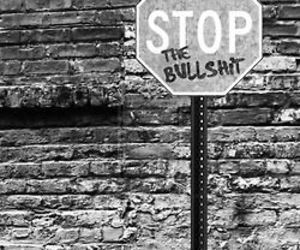
THE ESSENCE OF BULLSHIT

by Kenneth Harper Finton ©2015

superthumb

The results of the polls have come in. We asked which play by Shakespeare was their personal favorite out of:
1) Mephistopheles
2) The Runyon, or
3) The Beggars of Serendip

The overwhelming favorite was Mephistopheles.

Why? It sounds like a Shakespearean title. Never mind that Shakespeare never wrote any of the above.

This is the essence of bullshit. People want others to think they know what they are talking about.

Bullshit (also known as bullcrap and horseshit) is a common slang term meaning nonsense. It is always misleading, false, or disingenuous. The English sometimes call it bullocks.

Bullshit does not have to be completely false. It is often used by notable politicians to convince the public of a point which the politicians themselves know very little about. When an outright lie is inappropriate, bullshit serves to save face and makes the speaker appear to be knowledgeable.

We know the origin of bullshit. It is developed in the intestinal tract of a male bovine. The earliest mention of the slang term was in the Concise Oxford English Dictionary just after the turn of the 20th century.

T.S. Eliot wrote a poem between 1910 and 1916 called “The Triumph of Bullshit,” however the word “bullshit” does not appear in the text of the poem. Eliot never published the poem. It was not published until 1997. [Eliot, T. S. Inventions of the March Hare: Poems 1909-1917 (Harcourt, 1997) ISBN 0-15-100274-6.]

The Bullshit Asymmetry Principle

This scientific principle was formulated in January 2013 by Alberto Brandolini, an Italian programmer. The Bullshit Asymmetry Principle (also known as Brandolini’s Law states that “The amount of energy needed to refute bullshit is an order of magnitude bigger than to produce it.” Brandolini, Alberto. “Bullshit Asymmetry https://twitter.com/. Retrieved 1 March 2015.Retrieved 1 March 2015.

Society, in general,  is overwhelmed with a vast abundance of bullshit. It is hardly possible to step into the street these days without running into vast gobs of it. It is printed on billboards and signs. It has infiltrated our media, influenced our artists, and completely overwhelmed our philosophical thoughts.

The poet wrote:
“The harvesting of dreams
Born in the fields of endeavor
Is like two fish that swim upriver
Against the tides of solitary imagination.
In the portals of time, you will find
Regulations take no prisoners,
Heal no illness and reap no consequence.”

This is all total bullshit. It is far too inherent in much modern poetry.

Harry Frankfurt’s Concept of Bullshit

In his essay On Bullshit (originally written in 1986), philosopher Harry Frankfurt tells us that bullshit is different from an outright lie. The liar, he says, knows about the truth, perhaps even cares about the truth, but deliberately misleads us. However, bullshit itself does not give a whit about the truth. It only seeks to impress us.

In order to lie, Frankfort says, a person must know the truth and falsify it. On the other hand, bullshitters cherry pick reality and make up the facts that suit their purposes.
The anti-science attitudes in modern society is a great breeding ground for total bullshit. With the advent of instant communication, people are expected to have opinions on almost everything when most people do not know their posterior from a pothole.

Gerald Cohen wrote an article called “Deeper into Bullshit.” In this work, he contrasted the kind of bullshit Frankfurt talked about with nonsense discourse that is disguised as being perfectly sensible. Bullshit can be produced either accidentally or deliberately, Cohen writes. While some deliberately produce bullshit, others can also attempt to relate the truth, but produce nonsense by mistake.

A person deceived by bullshit often repeats it without the intention of deceiving others. The results of this are often seen in political platforms and broadcast by the media round the clock.

In our glorious past, not so long ago, bullshit was spread upon the fields to fertilize and nourish the next generation of crops. With the demise of the agricultural society, we have transformed this useful product into something that now only fails to nourish but actually maims our world.

DOES THE UNIVERSE HAVE A BRAIN?

By Kenneth Harper Finton ©2015

brain.universe513

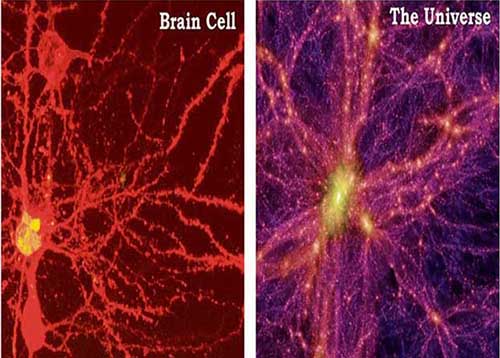
Is the universe itself a brain? They certainly have a similar look in these pictures. That might not prove that it is a brain nor that it has intelligence, yet everything we know about the workings of nature and the universe in general seems to have a masterly and thoughtful aspect about it.

Mathematics are human tools used to calculate facts and events in the natural world, but the math systems themselves seems to work because they uncover pre-existing patterns that follow universal laws and principles. Does that mean that mathematics came first and we humans simply discover the underlying equations? This does appear to be the case.

We view the world emotionally

How we view our world and the universe about us plays an important part in our emotional well being. It is impossible to envision a life without pain and suffering, as these things are natural tools essential to our survival. Without pain, we would not know what was bad for us. Without suffering and loss, we could not value happiness and gains properly.

To get to the actuality – I will not call is truth because we can only paint a local image of what we observe – to attempt to describe our world, we have to get beyond our emotional feelings and throw out the dogmas that our religions and limited visions of how the world really works have created.

Our emotional natures reflect upon our own demise and often creates negative emotions when we think about our temporal stays as existing beings.

I published an article in Helios about the near death experience of a young girl who was certain that she was about to die. She put if his way:

 “… when a vision of absolute nothingness rises before my eyes with the sudden damning conviction that there is nothing after death and our life is but a tiny spark in the midst of eternal meaningless darkness. The thought of such insignificance and meaninglessness is so daunting, and the idea of the world carrying on irrespective of our existence so unbearable, that our mind hurries to close the idea up again, with the result that the vision or realization disappears as soon as it appeared, leaving only the cold clammy feeling of an uncertain dread in its place. The realization of our miniscule existence in the enormous scheme of things can’t fail to be accompanied by a lack of faith in the meaningfulness of our insignificant lives. It’s an idea probed time and again by writers and artists alike, yet it is one that can yield no answers. It causes us to question the nature of existence itself, and the justification behind its repetitive mundane pursuits.”

I remember being a child when Jehovah’s Witnesses came knocking on the door to spread their gospel according to their teachings. They said that “Millions now living will never die.” By this they meant that the world as we knew it was coming to an end  and a new world where death was vanquished for the faithful believers was just around the corner.

In one form or another, that is the message of most of the world’s religions. They offer either a heaven or an altered state of consciousness where death is no longer something to fear or fret about. Because people want to believe this, such religious dogmas take root and are used by organized religion to control the minds, emotions and lives of the believers. The masses want a God of understanding and love who will want to keep their experiences in living memory. They want heaven for continued experience and Nirvana to be more than a rock group.

The question then, is there anything else that can give solace in our emotional quest for everlasting life? Would we even be pleased with an eternal life from which there is no escape from the  essential suffering and loss that is built into existence itself?

Is it necessary  for our life experience to be recorded infinitely or continue eternally for the soul to be happy with its lot? Probably not. We humans forget many things and our memories are often faulty. Some mundane events do not seem to be worth the remembering. Our own experiences disappear into memory and we lose track of the mundane details. In order to save our better experiences for later times we developed writing and drawing pictures and photography.

Is the physical matter that exists and in our world a record of events and actions that have occurred in time and space? It seems obvious that this is so. We reconstruct our history from past events and experiences that left a mark on time and space.

We can experience the reality of this ourselves. Our movements and actions make changes in the outside world that are recorded in memory as events and experience. Actions are recorded in the world outside ourselves as well, as we change our world physically every moment. We ourselves change physically from moment to moment.

A CONTINUING PROCESS OF CONSCIOUS AND UNCONSCIOUS THOUGHT

We can with a minimum of effort reduce and simplify the world enough to show that we exist in a continuing process of conscious and unconscious awareness. This too is obvious by nature of our minds and status as Homo Sapiens.  That this is true of all of nature is my best educated guess.

Giving the attribute of awareness to inanimate and non-living chemicals is a stretch for some people. We equate awareness to higher forms of life and intelligence to those mammals with brains and nervous systems. Yet, most processes are not what we would call conscious processes, but unconscious processes.

Underneath, the unconscious goes about creating process independently of our intellectual understanding. There is a difference between that we consciously know and that which is unconscious process that keeps the intellectual consciousness alive and builds the world itself.

We need to redefine that which we term to be the mind. If the unconscious mind was actually non-conscious or unaware, it could not function with the degree of precision that we observe.

Transmissions of information and transformations of matter into energy and back again take place in the smallest of events from chemical bonding to electromagnetic attractions. To my way of thinking, this can and should be defined as being a mental process, something controlled and actuated by a mind that is obviously different from the human brain. In other words, nature itself thinks and creates without need for the self-awareness. Nature is constantly experimenting with new forms and redesigning the old.  Nature itself is still learning, as there is an infinite amount to learn. The urge to unite and compound, to create new elements for more advanced compounds is nurtured by nature. The instinctive and unconscious desire to be more than we can be by ourselves alone is the driving force behind evolutionary change. This is obvious through the very fact the nature has been producing matter and life for billions of years, long before self-consciousness arose in the form of the human species. Our self-reflective species did not cause the universe to exist. Time and space arrived before human cognition.

The Unconscious Mind

The unconscious mind is much more powerful and capable than our conscious awareness. Procedural knowledge is a set of procedures, instructions, algorithms, and patterns that are capable of being implemented, but these processes are difficult to describe. The world remains very mysterious because of the sheer volume of information that is present in procedural action at any given moment of time.

In more technical terms, waking consciousness must process information serially, while the unconscious brain circuits can process many streams of information in parallel. The unconscious mind handles many tasks simultaneously.

People act in goal-directed and skilled ways without even being aware that they are doing so. Unconscious forms of perceiving and learning had to precede the first steps in human evolution.

Cognitive research has revealed that automatically, and clearly outside of conscious awareness, individuals register and acquire more information than what they can experience through their conscious thoughts. (See Augusto, 2010, for a recent comprehensive survey.)

To me this means that the universe does have a mind. It is a part of the process of conscious awareness that has produced us. I am calling that mind the Infinite for several reasons:

1) We cannot have the finite without an Infinite because something has to have no beginning and no ending, even would it ultimately be a void of nothingness.

2) That within this void of nothingness the world has become actual and finite.

3) That from the beginning of the appearance of time and space, mathematical laws and principles, geometry and rudimentary emotions in the form of prehensions of energy and mass governed the emergence of process including the conscious process. The laws of nature precede nature by necessity. They cannot develop or evolve gradually over time. They are an abstraction that pre-existed before nature. These mathematical laws, principles and geometries preceded the appearance of matter and energy because the elements followed the laws dictating the geometry and physics of the universe. Therefore, these physical laws must have existed first in in a dimension that has no time nor space, no beginnings and no endings because that is the only way they could be made manifest independently. This is the 1st dimension. It is a singularity that must immediately be doubled by its counterpart, the 2nd dimension, to be made manifest. This creates the dual nature of the world.

4) The materials that build the universe, the matter that exists in our physical world, holds a record of events and actions that have occurred in time and space. Our movements and actions make changes in the outside world and are recorded as events and experience. We change our world physically every moment. It is recorded on objects and entities outside our personal selves as well, as we know from moving something or breaking something, or influencing the world about us.

5) Vibrating patterns makes up events and changes from energy to matter leaves a record of its temporal being. Though these events are temporal, they can potentially last eternally because time is a mirage. Frequencies are in time and space, measured wave lengths that vibrate in certain patterns. Though they are manifest in time, time itself is still a mirage. Time and space are dimensions that appear within manifested natures. Manifest nature is the record of thought made actual.

Stereographic_polytope_120cell_faces

All events and objects have frequencies, as they are vibratory in  nature. These frequencies are well named, as they are repetitive motions in waves in a particular time and space. Having entered into time and space, they paint not only a temporal event, but perhaps an Infinite event as well because one is the other.

Infinity is in a dimension without time and space, but time and space are recorded within it. You and I are living proof of that. We can be certain that all time is recorded and stored in the infinite dimension, since infinity has room for all probabilities and is the source of the actualities. The material world shares a common source in the infinite

Particles and waves, the building blocks of matter, are informational packets that only exist in actuality while being in relation to other particles. They must relate to one another to share in the material world.

images

The information in these packets passes into the unconscious mind working to organize and record experience. It is stored in material actualizations before the advent of life forms, as awareness forms conscious entities with different levels of awareness. Among these conscious forms of awareness are the intellectually self-aware forms that we call our ‘personal realities’.

Thought is information connected by electronic impulses. It is sourced and ultimately originates in that dimension where Infinity dwells. This can be called the zero dimension. From zero dimension, there need be no passing of information as it is all contained there eternally. It is the mind and thought that organizes what is brought into being, as particles are not needed to understand the highest dimension (which is also the lowest, being non-dimensional). This is the place from which all information originally springs.

What does this mean and how can it effect our emotional lives? Does any of this impact our fear of death and change?

Perhaps we have lost the idea of heaven but gained the concept of eternity. At any given moment we can learn to manipulate our negative emotions and ease our sense of loss and helplessness by realizing that we live in a pseudo-reality common to all things living and non-living. Our thoughts are neither positive nor negative. We are the ones who give them value by arbitrarily assigning them value. At any moment, we can invoke and still our thoughts to quiet the duality of our existence and peek into the eternal dimension where all of nature is one and divisions are non-existent.

The world of ideas and thoughts is infinite. All things exist in a field of probability that contains all possible actualities. Like a hologram, all pieces of the big picture are contained in the smallest part of the picture. When an action is made, that field of probability collapses upon itself to become an actuality. That actuality is made manifest in nature and the record of it is nothing but a vibrational mirage that is can be observed from infinite points in space and time.

In this manner experience is born in a timeless dimension and brought into the world by interconnected series of events that continue to experience being long before and long after our temporal existences became evident and actual. Ultimately, we are the experience and the experience is eternal.

Memory is a tool of awareness, a process that continually blinks in and out of existence with observation and relationship to other temporal events. Our world and universe is the physical counterpart of an infinite experience that never began and will never end.

Clifford-torus

http://en.wikipedia.org/wiki/Four-dimensional_space#mediaviewer/File:Clifford-torus.gif