REUNION

REUNION

by Kenneth Harper Finton

Who in 1960 could imagine life in 2015? Those who did try  to visualize the future were horrified by the novel 1984 and the dictatorial police state that it portrayed. For the generation that grew up in the shadow of nuclear war, their expectations for their own futures were cloudy and uncertain.

The turn of the each century has aways brought grave change to the American landscape and culture. The year 1700 brought to the world the seeds of revolution against monarchal tyranny and religious repression. 1800 heralded a new spirit of expansion into unknown lands with the promise of greater freedom for all than the world had ever known before. 1900 brought dreams of industrial expansion as the railroads opened up the western regions. Capitalists conceived of factories that could bring a better life to all and great profits for those whose dreams and ambitions could become manifest realities. The year 2000 was greeted with a great mistrust of the technological forces that had so quickly changed our lives.

A fifty-fifth class reunion of the 1960 Greenville High School graduating class was held in August 2015. Back in 1960 we could never have imagined the changes we were subjected to in our lifetimes. 2015 was far away and inconceivable to us. We were the immortals who never died out of necessity. Life had to go forward despite the atomic catastrophe that we believed would certainly envelope us.

It was not that we were unaware that people grow old and people die, that times would change and we would become mature adults. We knew that well and looked forward with hope eternal. We were familiar enough with nature’s ways to know that a potential tragedy lay around every curve in the road. We dimly realized that we were not going to be different from those who long ago had been laid beneath the sod, those whose silent granite and marble tombstones pocked the hills and valleys all over the rural countryside. It was just hard to imagine we too would grow old and gray and our youthful agility would erode––that those lean bellies would enlarge like swollen dough and stick out over our pants. We gave little thought to the fact that our belts would slip down in the front and rise in to the top of our rears like a lopsided tire lying on a steep hill.

Those lovely girls whose hips engaged us and whose bosoms entranced us would put on fifty pounds or more. They would look more like their mothers than we could ever imagine. Those smooth long legs that drove us to distraction would pucker with cellulite. Those gleaming teeth would dim with tobacco and coffee and some pearly whites were lost to time. Often the vacant spaces were not filled with bridges and caps.

My father devoted much of his spare time to cataloging the names in the old church side cemeteries throughout the county. Many a weekend it had fallen upon me to hold a mirror and reflect the light of the sun just to illuminate the faded lettering with shadows that they might be read and the names and dates written on a yellow legal pad. I gave little, if any, thought to the fact that both he and I would lie in similar places one day,

We gathered at the Bistro in downtown Greenville the Friday night before the class reunion. The Bistro belongs to that new breed of higher end bars with several large and luxurious rooms with filtered lighting and perky barmaids that bring drinks upon demand. Nothing of the kind existed in Greenville in 1960. Bars were either small, dark places that smelled of cheap beer and cigarette smoke or clubs with strange names where old men gathered to smoke cigars, drink and curse with fervor until their hearts were content and the tedium of the day was washed away. Today smoking is no longer permitted and cursing is frowned upon.

One by one, old classmates arrived, sometimes in groups of two of three. As they arrived, the others would try to guess who they were, as even five of ten years makes a big difference in appearance when you are older than your allotted three score and ten.

Greenville, Ohio is an historic town, founded in the late 18th century when Indians far outnumbered the European immigrants that came to settle the Ohio wilderness. The residents have always been proud of the fact that the Treaty of Greene Ville was signed there in 1795. The Indians were forced out of their villages and settlements. The treaty highly favored the victors in the Indian Wars and opened the entire Northwest Territory up for settlement by emigrants to the new lands. Greenville’s main street, called Broadway––five or six blocks in length––is comprised of picturesque three-story Victorian buildings that were built from 1870 to 1910. Most of the store fronts have changed dramatically over the years, Some of the Victorian charm was lost with the ideas of modernization that took root from 1950 to 1990. All the storefronts lost their canvas awnings that shaded the shoppers for decades. A Federal-styled bank building went through hideous renovation in an attempt to make it look like a modern and successful place to do business.

Come Saturday night the class of 1960 gathered at the American Legion hall, which has now been relocated to a newly built area  that had previously been next to the old city dump. Now filled with new structures and fresh greenery, the place bore no resemblance at all to what it had been in 1960.

Some of us have already joined our ancestors. Gerry Greendyke never made it home from Viet Nam. Wayne Beasley wrapped the front of his car around a tree shortly after graduation.They say he fell asleep at the wheel. Ralston King caught his pant leg in the drive wheel of a tractor and was turned over and over again until the tractor ran out of fuel and his body was mutilated beyond recognition. Rollie’s death was made even more tragic when his first child was born on the same day the accident happened. Several were lost to cancer and sudden heart failure. A few died of other diseases and traumas. Quite a few still remain out of the class of one hundred and forty. We have since spread all over the nation. I came in from Colorado. Some came from as far as California and Vermont.

The stories of our lives are written on our faces, the history of our diets on our bodies. Facial wrinkles track our concerns over our lives and families, while the corners of the mouths silently recall the sadness and the joys we have experienced.

One finds that as we get older, even high school classmates that we avoided are worth having as friends. Be they pump or skinny, successful or not, rich or poor, professional or working class, these differences no longer matter much over the age of sixty. The need to impress leaves us and the need to share becomes much more important. The men are no longer in competition with the other men for the fair ladies. The fair ladies no longer feel the constant need to impress the men. That is part of the freedom that age brings, the reason why people say with age comes wisdom. Wisdom does not really come with age. Yesterday’s dunce is still dumb. Yesterday’s jocks are simply a memory. Experience might not create wisdom, but it does tell an interesting tale. By the time we get to a fifty-fifth reunion most of the participants are experienced reunion alumni. They have learned to avoid small talk about politics and religion. They have perfected their ritual jokes and stories. They have learned to talk sparingly of their work achievements.

One classmate related a story of his school days. Back in the days before central heat, stores and schools were often heated with basement furnaces. The heat rose to the floors above through large grates in the floor. It did not take long for the pubescent boys to realize that by standing below these grates they could see up the dresses of the women that walked by or stood above them. His story was about how he and his friend spied up the dress of one of their teachers at school, only to be discovered by the teacher herself when she looked down and saw them staring up at her from below. Highly embarrassed, she promptly ordered them to the principal’s office. They thought that their school days were over. Surely, they would be whipped, expelled or worse. But the male principal told them: “I was a boy myself once and I know how it is to be one. This time I am going to overlook it, but I want you boys be on your best behavior and not embarrass  Miss Schwartz by doing that again.” With a sigh of relief they returned to the classroom with a new respect for the principal and a lot more knowledge about their teacher’s choice in underwear.

Older men and women can still be quite sensual and handsome. Older men still show a keen interest in the pretty girls and women. However, the constant urge to copulate does temper with age. As teenagers we wore our hearts on our wrists like watches. Passing women quickly became the subjects of instant fantasies. The simple act of riding down a bumpy road in a car awakened those male hormones that swell the lower extremities as much as the trot of a horse awakens the female libido. As the years go by, the flow of blood in the arteries and veins become more and more restricted with the deposits left by time and diet. That universal signature of maleness––the automatic salute that nature provides in response to the females of our species––can become more difficult to obtain. It can make us feel awkward and inept. We were taught as children to rise when a woman came into the room. The privilege of not rising was reserved for the crippled and the infirm. Not that the older generations become prematurely infirm, but it does seem that nature has provided a release for older males  with a gradual release from the those adolescent passions that plagued us for so many years. Many things that used to make no sense become clear. We understand that bras are singular and panties are plural even though it makes little grammatical sense. It is as it is and that is all.

In past years I made videos of the class reunions. They can be viewed on Vimeo. Here are the links.

https://vimeo.com/57391196 for the 50th GHS reunion

https://vimeo.com/57326400 for 30 Years After, created 25 years ago before high definition TV and home video editing was even feasible.

Into the Mystic: Capitalism and the Structuralization of Spirituality

edmundberger's avatarsynthetic zerØ

images (6)

In his fantastic book The Closed World: Computers and the Politics of Discourse in Cold War America, Paul N. Edwards forwards a quasi-literary reading of the way power and subjectivity operate in the age of the computer, focusing primarily on the lineage running from the Vannevar Bush’s  Office of Scientific Research and Development (OSRD) to the birth of cybernetics and their proliferation during the Macy Conferences to the electronic battlefields of Vietnam, and, finally, to the Reagan administration’s Strategic Defense Initiative – the “Star Wars” program that propelled the growth of Silicon Valley and its corollary Californian Ideology, as well as the globalization of information technology across the 1990s. For Edwards the collision of massive government subsidies and steering of computer research and the geopolitical imperatives of the Cold War – dressed in the rhetoric of “containment” – produced the metaphoric construct for which the book is titled: the…

View original post 10,698 more words

THE WORK OF EDWARD CURTIS

What is a Photogravure?

Photogravure-plate-of-Geronimo

Paul Unks, of Denver, nicknamed Mountain Hawk, explains the craft of printing photogravures: “Developed in the 1850’s, an intaglio photogravure is produced through a complex painstaking hand-made process whereby the original photographic image is etched into a metal plate allowing the plate to hold ink. Then, oil based ink is carefully applied by hand onto the etched plate so that the ink is pushed down into the etched grooves of the plate that range in depth from deep (dark) to shallow (light). Once the printing plate is properly inked, high quality moistened paper is placed on the inked plate and then hand cranked in a press at 10,000 lbs of pressure causing the paper to squeeze down into the grooves of the plate. After the paper fibers have absorbed the ink, the paper is carefully peeled off the plate leaving the image deeply embossed into the paper fibers creating a fine art print that has the subtle detail of a photograph, the velvety texture of an etching and richness of an oil painting.”

The technical difficulties of the photogravure process can seem infinite and insurmountable at times. Ansel Adams remarked, “Photogravure is a most beautiful technique, but I would not recommend anyone do it”.

NOTE: There are only a handful of master printers in the world today who make hand-made photogravure plates and prints. And Mountain Hawk is the only one producing Curtis’ original photographs as he did, as intaglio photogravures, each archival print individually hand-made, one at a time, restoring Curtis’ original fine photographic detail that had previously been lost, to new plates. Using this traditional classic method, Mountain Hawk is faithfully and authentically completing the edition Curtis started, but wasn’t able to finish in his life time.

While in recent decades printers have produced re-strikes from the original plates, many of those plates have been lost, destroyed or damaged, and the ones that are intact are worn from repeated printing.

IMG_2357

Paul Unks at Denver, Colorado exhibit July 2015

Paul Unks, nicknamed Mountain Hawk, has  gone a step further in craftsmanship and quality to produce his photogravures working from an early set of images and using high-resolution photography he has created new copper plates; then, in collaboration with a master print maker, and refining his ink and sourcing a very fine paper—a tissue that is translucent, imparting a wonderful dimensionality to the print—he has produced new photogravures of incomparable quality. Many people have remarked that the sharpness and detail are every bit as good as the best originals. As Curtis himself was able to produce less than half of his intended edition of 500, Paul’s great purpose is to complete the edition with the original artistic standards intended by Curtis—and so in a real sense to fulfill Curtis’s mission. A passionate historian and speaker on Curtis as well as craftsman, Paul is thoroughly devoted to honoring Curtis’s legacy with this truly extraordinary collection.

THE WORK OF EDWARD SHERIFF CURTIS (1868-1952)

Edward Curtis self portrait

Edward Curtis self portrait

Edward Sheriff Curtis (1868-1952) is the most famous photographer of the  American Indian. In 1906, JP Morgan contracted with Curtis to photograph and document native American life throughout the west. The following year the artist began publishing his twenty volume The North American Indian.

The project was driven by passion and urgency; in the introduction to the first volume, Curtis wrote, “The information that is to be gathered … respecting the mode of life of one of the great races of mankind, must be collected at once or the opportunity will be lost.”

The work included folios of photogravures that have become highly treasured and sought after. When Curtis originally sold his images they cost the subscriber $3000 per 20 volume set. Now Curtis’s pictures of the poorest of Americans are sold to the richest of Americans, often bringing $30,000 to $75,000 per image.

A SHORT HISTORY OF EDWARD CURTIS’ LIFE

In 1906, J. P. Morgan provided Curtis with $75,000 to produce a series on Native Americans. This work was to be in 20 text volumes with 1,500 small photogravure illustrations, accompanied by twenty folios with 720 large photogravures. Morgan’s funds were to be disbursed over five years and were earmarked to support only fieldwork for the books not for writing, editing, or production of the volumes. Curtis himself would receive no salary for the project, which was to last more than 20 years. Under the terms of the arrangement, Morgan received the first 25 sets and 500 original prints as his method of repayment.

Geronimo by Edward Curtis

Geronimo by Edward Curtis

222 complete sets were eventually published. Curtis’ goal was not just to photograph, but to document, as much of Native American traditional life as possible before that way of life disappeared.

He wrote in the introduction to his first volume in 1907: “The information that is to be gathered … respecting the mode of life of one of the great races of mankind, must be collected at once or the opportunity will be lost.”

Curtis made over 10,000 wax cylinder recordings of Native American language and music. He took over 40,000 photographic images from over 80 tribes. He recorded tribal lore and history, and he described traditional foods, housing, garments, recreation, ceremonies, and funeral customs. He wrote biographical sketches of tribal leaders, and his material, in most cases, is the only written recorded history although there is still a rich oral tradition that documents history.

Around 1922, Curtis moved to Los Angeles with his daughter Beth, and opened a new photo studio. To earn money he worked as an assistant cameraman for Cecil B. DeMille and was an uncredited assistant cameraman in the 1923 filming of The Ten Commandments. On October 16, 1924 Curtis sold the rights to his ethnographic motion picture In the Land of the Head-Hunters to the American Museum of Natural History. He was paid $1,500 for the master print and the original camera negative. It had cost him over $20,000 to film.

During the years of work on The North American Indian, Curtis was often absent from home for most of the year, leaving his wife Clara to manage the children and the studio by herself. After several years of estrangement, Clara filed for divorce on October 16, 1916. In 1919 she was granted the divorce and received the Curtis’ photographic studio and all of his original camera negatives as her part of the settlement.

THE DESTRUCTION OF THE ORIGINAL GLASS NEGATIVES

In 1927, after returning from Alaska to Seattle with his daughter Beth, he was arrested for failure to pay alimony over the preceding 7 years. The total owed was $4,500, but the charges were dropped. For Christmas of 1927, the family was reunited at daughter Florence’s home in Medford, Oregon. This was the first time since the divorce that Curtis was with all of his children at the same time, and it had been thirteen years since he had seen Katherine.

Most of the Mohaves by Edward Curtis

Mosa of the Mohaves by Edward Curtis

According to some sources Edward went with his daughter, Beth, to the studio and destroyed all of his original glass negatives, rather than have them become the property of his ex-wife, Clara. It is still controversial as to who destroyed them. Clara went on to manage the Curtis studio with her sister, Nellie M. Phillips (1880–?), who was married to Martin Lucus (1880–?). Following the divorce, the two oldest daughters, Beth and Florence, remained in Seattle, living in a boarding house separate from their mother. The youngest daughter, Katherine Curtis lived with Clara in Charleston, Kitsap County, Washington.

In 1928, desperate for cash, Edward sold the rights to his project to J.P Morgan’s son. In 1930 he published the opus-concluding volume of The North American Indian. In total, about 280 sets were sold of his now completed magnum opus. In 1930, his ex-wife, Clara, was still living in Seattle operating the photo studio with their daughter Katherine. His other daughter, Florence Curtis, was still living in Medford, Oregon with her husband Henry Graybill. After Clara died of heart failure in 1932, his daughter Katherine moved to California to be closer to her father and her sister Beth.

LOSS OF RIGHTS TO The North American Indian

Taos Water Girls by Edward Curtis

Taos Water Girls by Edward Curtis

In 1935, the Morgan estate sold the rights and remaining unpublished material to the Charles E. Lauriat Company in Boston for $1,000 plus a percentage of any future royalties. This included 19 complete bound sets of The North American Indian, thousands of individual paper prints, the copper printing plates, and the unbound printed pages. Lauriat bound the remaining loose printed pages and sold them with the completed sets. The remaining material remained untouched in the Lauriat basement in Boston until they were rediscovered in 1972.

On October 19, 1952, at the age of 84, Curtis died of a heart attack in Los Angeles, California in the home of his daughter, Beth. He was buried at Forest Lawn Memorial Park in Glendale, California. His terse obituary appeared in The New York Times on October 20, 1952:

Edward S. Curtis, internationally known authority on the history of the North American Indian, died today at the home of a daughter, Mrs. Beth Magnuson. His age was 84. Mr. Curtis devoted his life to compiling Indian history. His research was done under the patronage of the late financier, J. Pierpont Morgan. The forward for the monumental set of Curtis books was written by President Theodore Roosevelt. Mr. Curtis was also widely known as a photographer.

SOURCES:

http://www.curtisprints.net

https://en.wikipedia.org/wiki/Edward_S._Curtis

TO SEE AVAILABLE PRINTS OF CURTIS’ PHOTOGRAPHS ONLINE GO TO:

http://www.curtisprints.net/gallery.php?gallery=1

http://www.curtisprints.net/gallery.php?gallery=2

Canon de Chelly, Navajo Indians by Edward Curtis

Canon de Chelly, Navajo Indians by Edward Curtis

Two Sioux Cheifts by Edward Curtis

Two Sioux Chiefs by Edward Curtis

Denver 9 News report on the making of Curtis prints by Paul Unks.

http://www.9news.com/story/news/features/2015/07/26/denver-artists-recreates-famous-photographs/30686917/

GREAT SONG LYRICS

http://www.bbc.com/news/magazine-33282745

A Point of View: What’s the secret of writing great song lyrics?

by Adam Gopnik

  • 26 June 2015
  • From the section Magazine
Music score with the words
Having written words for someone else’s music, Adam Gopnik finds there’s a common factor behind all great lyrics, from Mozart opera to Taylor Swift. 

Everyone thinks he can write a song, and now I have. The haunted, wild look you see in the eyes of professional songwriters at cocktail parties rises from the popular idea that any of us, given the chance, can do what they do as well as they do it – the fur earmuffs you see them wearing even on the hottest summer days are there, too, from a desperate attempt not to have to listen to the songs the rest of us write and insist on playing for them. “I think I just feel how everyone feels, that I have three or four really great folk albums in me,” Hannah says complacently on the US television comedy Girls. Everyone thinks that.

But now I have done what all of us amateurs dream of doing – written words to someone’s music and heard it sung. Not a song alone, but an entire work – called (when I am in a puffed up mood) an oratorio, and when I am feeling more modest, a mere song cycle, and when I am feeling more modest still, a concept album, as yet unrecorded. It’s called Sentences, with music by the inspired young composer Nico Muhly, and seeing it premiere a few weeks ago, at the Barbican Centre in London goes high on my list of things I did that made my life matter – like the birth of a child, only with less sweat and better dressed.

The story we told was that of the great computer scientist Alan Turing, and it was sung by the amazing counter-tenor Iestyn Davies – but I won’t detain you with its genesis or my own sense of what in it works and what doesn’t. I will say that I was working on the libretto for the song cycle even as I was also writing the words for a musical comedy, properly so-called, and I discovered that in work meant or dreamed of for the commercial theatre, every syllable gets argued over. Is the emotional logic entirely lucid? In our Barbican-directed oratorio a great deal of indirection and obliquity was welcome. In our age, I’ve decided, the difference between entertainment and art is that in entertainment we expect to do all the work for the audience, while in art we expect the audience to do all the work for us.

But the deeper relation between words and music – the way they land in the listener’s ear, and then her soul – is more complicated than it seems. Music alone is puzzling enough – how it is that the mind makes sound into music and music into meaning is one of the big unanswered questions. No matter how hard we craft them for lucidity and shape and dramatic clarity – and it’s the good faith of the librettist’s art form to do so as elegantly as he can – music and words together exist in the end in an older realm of magic and enchantment, a place where the nursery rhyme and the church hymn and the pop single all meet. They work as spells do – that is, either entirely, or not at all. We sing and the magic door swings open, or it doesn’t, and there’s no explaining it. Three boys from Liverpool sing “She loves you, yeah, yeah yeah ” and the world turns off its axis. Had they sung, as Paul McCartney’s father wanted, “yes, yes, yes”, the old path would not have changed.

The Beatles in concert, 1964

Yeah, yeah. yeah. The Beatles in concert, 1964

The libretto writer, I should add at once, is merely the junior partner in the enterprise – or not even a partner, more like the man who sweeps out the candy wrappers from the theatre floor after the patrons leave. Who now remembers the name of the man who set the text for Handel’s Messiah? Well, it was Charles Jennens. The only libretto writer whose name anyone remembers – other than the great lyricists of the American musical theatre, the sacred law firm of Mercer, Loesser and Hart – is Lorenzo da Ponte, who is my hero. He was Jewish and a priest, and a Venetian and a New Yorker. It’s a sympathetic package, and he wrote for – more than “with” really – wrote for Mozart, the three operas that may well be the height of all artistic creation: The Marriage of Figaro, Cosi Fan Tutte and Don Giovanni.


Lorenzo Da Ponte 1749-1838

Lorenzo da Ponte
  • Born Emanuele Conegliano, to a Jewish family in Venice. converted to Roman Catholicism in 1764 and was baptised with the name Lorenzo da Ponte
  • Ordained as a priest in 1773 but nevertheless fathered two children, and was subsequently banished for 15 years from Venice
  • Moved to Vienna where he scored Mozart’s best-known Italian operas – The Marriage of Figaro (1786), Don Giovanni (1787) and Cosi Fan Tutte (1790)
  • Later moved to London and then the US where he ran a grocery store, gave Italian lessons and was eventually appointed professor of Italian literature at Columbia College

If the aliens arrived on earth from Neptune and asked me “what should we go out to see first that you humans have made?”, I think I would say Cosi Fan Tutte. (Though I also think I would add “Oh – and watch Cary Grant in North By Northwest” – but then the aliens would say, “Yeah: we saw that already on Neptune. Everybody in the galaxy has seen North By Northwest.”)

But a single touch of contrivance spoils it all. Any time we feel the authors creating coincidence or engineering emotion, making melodrama rather than musical drama – shoving incidents around rather than exploring character in collision with itself or another – we rebel inside. In Cosi Fan Tutte we accept the convention of disguised Albanians. But we accept it because Mozart writes his most sublime music for the silliest parts. If it sounded cute, we would rebel against it. That “yeah, yeah, yeah” mattered because it was exactly what such a boy would actually say to a friend about a girl. The smirk, or the hack’s weary knowing devices, are both enemies of enchantment and, without enchantment, music and words together mean nothing.

A 2009 production of Mozart's Cosi Fan Tutte, performed at the Salzburg Festival

A 2009 production of Mozart’s Cosi Fan Tutte, performed at the Salzburg Festiva

Music is so emotionally overwhelming that it pushes the discursive and explanatory roles of language aside – and it is part of the job of the libretto writer to get out of its way. Even in Handel’s Messiah we recall lyrical fragments more than whole stanzas. “Unto us a child is born, “How beautiful are the feet…” “All we, like sheep”. When we think through our experience of our favourite oratorios, our most important pop songs, our favourite operas, they are almost always the experience of a forceful fragment – three or four words – “How beautiful are the feet”, or “Shake it off”.

It is a mysterious, semi-physical response, in which the audience does as much work as the artists. It works or it doesn’t. Small fragments of sound and sense strike our hearts as shrapnel strikes our skin. They lodge and wound us, independent of their intended trajectory. The audience responds or it doesn’t. The audience is less like a crew of supercilious analysts and more like a magnet set to one pole or the other. If the pole is right, the audience is drawn irresistibly to the sound on stage. If it isn’t, no amount of seduction or intelligence can draw them in, any more than a physical magnet can be made to adhere to metal by good will or affection. Sung words belong more fully to the world of ritual and routine, of incantation and mother’s murmurings, than to the fully lucid and well-lit world of argument. The words work or they don’t.

Sigrid Thornton in an australian production of A Little Night Music, 2009

Sondheim’s “Send In The Clowns” is sung by Desiree (Sigrid Thornton) in this 2009 production of A Little Night Music.

The one thing I have learned through the process is this – our minds make meaning out of music by not making too much meaning out of it. One learns as a librettist to tiptoe to the edge of argument, and then back off to the limbo-land of implication and indirection. The most popular lyric of Stephen Sondheim is, after all, the most offhand – a rueful farewell, but exactly to whom or exactly why we don’t always know. I hear the producer or the scriptwriter asking “Send in the clowns? Shouldn’t it be call off the clowns?” But in the clowns must come for reasons only clowns and composers know.

I have not learned why music matters most – but I have learned a great deal about the power of voices, the limits of language to insist and its power to invoke, and about the mysterious magnetism that passes between an audience and its art. Above all, I have learned that musicians are a superior race. We are lucky to share this planet – or any other – with them.

  • Adam Gopnik has lived in Paris and wrote the book Paris to the Moon

A Point of View is usually broadcast on Fridays on Radio 4 at 20:50 BST and repeated Sundays 08:50 BST

THOUGHT

by Kenneth Harper Finton ©2015

A UNIFIED THEORY OF BEING

“A human being is part of the whole called by us universe, a part limited in time and space. We experience ourselves, our thoughts and feelings as something separate from the rest. A kind of optical delusion of consciousness. This delusion is a kind of prison for us, restricting us to our personal desires and to affection for a few persons nearest to us. Our task must be to free ourselves from the prison by widening our circle of compassion to embrace all living creatures and the whole of nature in its beauty…We shall require a substantially new manner of thinking if mankind is to survive.” – Albert Einstein

220px-Thought_bubble.svg

THOUGHTS

Unconscious thought needs no brain to advertise its presence.

Thought brings to light a spark, impulsive waves that creates space

and burns its way through time to start the clock of matter.

All matter thinks, as all movement is preceded by thought.

All life thinks, as life is thought made manifest in form.

All of nature thinks, as all of nature is ruled by physical laws.

We see it in the movement of the wind,

We see it in the birthing of desire,

We see it in the crackling of a fire.

Even the cosmos is a living, breathing being

that looks endlessly to propagate and create

and sifts through infinity itself to find its better half.

Our self-centered, self-reflecting species has come to believe that we are the only thing that thinks. Despite the fact that plants seek the sun and tendrils wind their way up and down, despite the fact that insects show intelligence and microbes show awareness, our limited definition of thought has hidden the truth of the world from us. We have equated our brains with our intelligence and our nervous system with our thoughts. It has not occurred to us that thought precedes essence, that the spark of thought ignited the entire big bang that we theorized made the universe itself.

All movement is preceded by thought. It is thought that causes movement. Without movement we can have no space nor time, nor existence. We can experience the truth of this statement within our own selves. In order to do something, we must first contemplate and think about it–even if the thought is unconscious thought.

What is thought?

The word thought comes from Old English þoht, or geþoht, from stem of þencan “to conceive of in the mind, consider.” [Harper, Douglas. “Etymology of Though.” Online Etymology Dictionary.]

Noesis (n.)

1820, from Greek noesis “intelligence, thought,” from noein “to have mental perception,” from noos “mind, thought.”

Mind (n.)

late 12c., from Old English gemynd “memory, remembrance, state of being remembered; thought, purpose; conscious mind, intellect, intention,” Proto-Germanic *ga-mundiz (cognates: Gothic muns “thought,” munan “to think;” Old Norse minni “mind;” German Minne (archaic) “love,” originally “memory, loving memory”), from PIE root *men- (1) “think, remember, have one’s mind aroused,” with derivatives referring to qualities of mind or states of thought (cognates: Sanskrit matih “thought,” munih “sage, seer;” Greek memona “I yearn,” mania “madness,” mantis “one who divines, prophet, seer;” Latin mens “mind, understanding, reason,” memini “I remember,” mentio “remembrance;” Lithuanian mintis “thought, idea,” Old Church Slavonic mineti “to believe, think,” Russian pamjat “memory”), meaning “mental faculty” is mid-14c. “Memory,” one of the oldest senses, now is almost obsolete except in old expressions such as bear in mind, call to mind. Mind’s eye “remembrance” is early 15c. Phrase time out of mind is attested from early 15c. To pay no mind “disregard” is recorded from 1916, American English dialect. To have half a mind to “to have one’s mind half made up to (do something)” is recorded from 1726. Mind-reading is from 1882.

Thought has been linked with the mind since the beginning of language and human communications. Consciousness is also related to the mind, as consciousness is the state of being aware of one’s own existence.

Our physicists envision a singular spot of infinitely dense particles with indescribable temperatures where all particle once congregated in unfathomable density before exploding in the big bang.

Have we failed to comprehend that it was the spark of thought that preceded the observed reality of existence and started the interconnected chains of experience that became our universe.

Experience

[ik-speer-ee-uh ns]

noun

1.   a particular instance of personally encountering or undergoing something:

2.   the process or fact of personally observing, encountering, or undergoing something:

3.    the observing, encountering, or undergoing of things generally as they occur in the course of time:

4.    knowledge or practical wisdom gained from what one has observed, encountered, or undergone:

5.    Philosophy. the totality of the cognitions given by perception; all that is perceived, understood, and remembered.

Prehension

[The term “prehension” indicates that the perceiver actually incorporates aspects of the perceived thing into itself. The term is meant to indicate a kind of perception that can be conscious or unconscious, applying to people as well as electrons.]

The march of time and space begins with prehensions of attraction and repulsion as elemental waves and particles recognize themselves and react. The reality of our world is not made of fundamental bits of matter that exist independently of one another as many believe. Reality is composed of the intermingled and entangled chains of events that make up experience.

These prehensions are felt in the most elemental of particles and waves. Particles and waves are the palpable recorded experience of thought in different states of energy and organization.

Awareness: the basis of existence

noun: awareness; plural noun: awarenesses

  1. knowledge or perception of a situation or fact.

Awareness precedes perceptions or perceptions would not exist.

In order to have prehensions and conceptions, we must have an awareness that can recognize these senses. We prove this in our own existence. If we did not have a both a conscious and an unconscious mind, we would know nothing and be nothing.

per·cep·tion

pərˈsepSH(ə)n/

noun

noun: perception; plural noun: perceptions

  1. the ability to see, hear, or become aware of something through the senses.

It is that original awareness, the primal state, that creates the process of consciousness. If it were not be present, there would be no registry or history of existence at all. The process of consciousness is the history of existence. We continually concoct existence out of nothing in every frame of time that we create.

Awareness is the precursor of consciousness. Consciousness is not a thing, but a process of self-objectification that constantly creates the world anew each moment. Through thought, awareness becomes conscious and organizes matter into being.

noun: consciousness

  1. the state of being awake and aware of one’s surroundings.
  • the awareness or perception of something by a person.plural noun: consciousnesses
  • the fact of awareness by the mind of itself and the world.

When contemplating infinity and the universe, there is no way to escape the concept of God. That which existed before anything and after anything, even though it be nothing, is still another concept for God. Nothing is, of course, no thing. God is not a thing as well. An empty void has no existence without a world in which to place it. Even a spirit in a world outside of time and space would need a materialized world for any material form of reality to exist. God and the world not only co-exist, but they ARE one another.

Primal awareness can be termed God. Not the God-king or God-the-Father who in his divinity imposes his will and plans upon the world, but the creator of completely free and random conceptions and experiences of unlimited potentiality.

We can describe the world as not only a work-in-progress, but a record of historical events and experiences where thoughts were made manifest and tangible by actions, recorded by the bricks and mortar of matter, and re-interpreted by the mind to formulate experience from contiguous and entangled events.

This primal awareness dwells outside of time and space. It is of another dimension that has no beginning nor end. This awareness is infinite, yet responsible for the existence of the finite. It is beyond self, beyond time and space, yet produces not only the act of consciousness, but describes and brings to being a forever changing universe of unlimited potential.

Because they are in a dimension beyond time, elemental particles like quarks exist and do not exist simultaneously. That is why they can be entangled in different times and space.  They are not in time and space until matter is created from energy. Their duration in time is temporal but their essence is eternal. Matter is the temporal recording media of experience, where events are stored and formed into experiences.

Eternal awareness, through consciousness and thought, creates the world and all the experience held within. This awareness is within us as well as without us because it is the foundation of being and the source of all things present, past and future.

It is correct to say that the world is awareness and it is correct to say that awareness is the world.  It is correct to say that awareness is God and it is correct to say that God is awareness. It is correct to say that the world is God and it is correct to say that God is the world. It is correct to say that we are the world and it is correct to say that the world is us. It is correct to say God is us and it is correct to say that we are God.

With the awareness of motion come the prehensions that precede feelings. Although awareness is outside of all things, all things exist within it by necessity because it is the foundation of all things. Awareness only exists in the now because the now, being an eternal moment, is the only time that has ever existed. All of time and space exist in the now eternally.

Per·cep·tion

noun: perception; plural noun: perceptions

  1. the ability to see, hear, or become aware of something through the senses.

Perceptions are feelings that have come to consciousness and made self aware.

Feel·ing

noun

noun: feeling; plural noun: feelings

  1. the capacity to experience the sense of touch. The sensation of touching or being touched by a particular thing.

The most elementary of things experiences the sense of touch or it would not react to or be influenced by another. Without a rudimentary sense of self, an object would never know or be influenced by another. This sense need not be intellectual, but as simple as gravitational attraction and repulsion.

All is of the mind.

Perceptions are coded into matter with chemical compounds made from elemental particles and waves, then stored, and organized into related conceptions by thought. This is the process of experience.

Thought is the eternal spark that interprets the electrical pulses and links chemical changes.

Actions are organized thoughts made manifest, as thought becomes material by recording temporal changes upon material particles and chemicals. It constantly changes the universe within us and around us.

It is all a part of an eternal process where fundamental awareness  creates and projects experience so that the world as we know it might exist and continue in this existential experience. Existence is a process, not a goal nor an end.

The external world is composed of sound and light, mediums that are in essence vibratory. The elements themselves are not solid, but composed of matter whose ultimate material nature is also vibratory.

In its purest state, virgin awareness is void of experience and thought. It is void of space and time and particles and waves. Thought is the spark that creates all matter and all space and all time. All existence is made of realized thoughts and unrealized thoughts that are the basis of future history.

Thought created the history of existence. Realized thoughts actually change the substance of matter. Matter itself is the record of thought having passed through points in space and time and imprinted the record of its passage on particles and elements, creating temporal events that become recorded experiences.

“I want to know how God created this world. I am not interested in this or that phenomenon, in the spectrum of this or that element. I want to know His thoughts; the rest are details.” – Albert Einstein

Einstein also said:

“Reality is merely an illusion, albeit a very persistent one.”


NOTHING

CRITICAL THEORY, HUMAN EXTINCTION AND ORIGINAL SIN


by Katherine

http://zebraturnedtiger.com/2015/02/09/critical-theory-human-extinction-and-original-sin/

Who tkitty-lionhe hell starts a serious reflection on critical theory with a quote from a Mel Gibson movie? Why, that would be me! Read on, if you dare:

“And a Man sat alone, drenched deep in sadness. And all the animals drew near to him and said, “We do not like to see you so sad. Ask us for whatever you wish and you shall have it.” The Man said, “I want to have good sight.” The vulture replied, “You shall have mine.” The Man said, “I want to be strong.” The jaguar said, “You shall be strong like me.” Then the Man said, “I long to know the secrets of the earth.” The serpent replied, “I will show them to you.” And so it went with all the animals. And when the Man had all the gifts that they could give, he left. Then the owl said to the other animals, “Now the Man knows much, he’ll be able to do many things. Suddenly I am afraid.” The deer said, “The Man has all that he needs. Now his sadness will stop.” But the owl replied, “No. I saw a hole in the Man, deep like a hunger he will never fill. It is what makes him sad and what makes him want. He will go on taking and taking, until one day the World will say, ‘I am no more and I have nothing left to give.”

-Tribal Elder in Apocalypto

In my short and painful lifetime, I’ve seen far more than my share of the death and destruction that Man’s “hole” has wrought upon the animals and the planet. So when I hear academic philosophers turning their attention to the possible extinction of humanity…see, for example, Claire Colebrook’s “Death of the PostHuman: Essays on Extinction,” I feel like I have something to say. Even though I’m not academically “qualified,” I am more than personally qualified, after losing my family to various terminal illnesses, and struggling with my own. I know what it feels like to question whether human existence is worthwhile, and that should be qualification enough.

I don’t think I’m the only one in this boat. It seems these days that everyone who pays attention to the world outside their immediate personal circles has a feeling that something is going to happen… something vaguely apprehended, something yet to be decided…something maybe apocalyptic or tragic, something maybe transcendental and defining. But our guts are screaming that business as usual is not forever.

We humans are the first instantaneously, globally interconnected species in the history of the planet. And we instinctively know that this is an incredibly brief instant, even though it feels deceptively like an eternity. We live in a limbo of global industrial capital overlaid with exotic virtual realities of all species–“social” media, financial ghost gamblers, MMORPGs and the celebrity theater.

And we fear its inevitable demise, yet we also dread its continuation.

Many of us secretly wish our treadmill-grinding homeostasis would end in some glamorous apocalypse and relieve us of our ennui (or is “limbo” a better word)? Yet we equally fear the apocalypse because, how much does it hurt just to lose our smartphones for a day, much less to lose safe water supplies, shelter or a life-sustaining prescription?

The thorn of industrial civilization is in our hearts, not our sides. The system can’t continue as it is–it must either mutate and accelerate or collapse–yet either option feels intolerable: a sense of existential horror, in the case of acceleration, or terror, for collapse.

Never before, even as hunter-gatherers, have we Homo Sapiens been so directly confronted with our unclothed nature. For postmodern man, stripped by efficient communication of the fedoras and greatcoats that covered his animal body, there is no more speculation…

Communism doesn’t work.

Living like sages and fools in the streets of San Francisco gave us drug addiction and sex scandals, not peace love and freedom.

And even freedom itself is likely an illusion generated by our brains, if we take neuroscience seriously.

There is absolutely no ideology, institution, or infrastructure untainted by the tragic evolutionary imperative to survive, procreate, and eliminate the competition at all costs. And the most expensive cost: the blood sacrifice of our own descendants and our own future selves.

Most disturbing in all this is that despite our very real human beauty, famously described by Robert Ardrey as “risen apes,” our unique self-awareness lets us look upon our defects and aspire to change them. The basic law of nature rules that those non-risen apes among us (also known as psychopaths) are certain to rise to power in the Psychopathocene Age, leaving us in a game-theory nightmare from which there is no escape, or at least no intentional exit.

If we humans escape our predicament in good health, it will likely be some tragic stroke of luck, an accidental deluge of death and suffering for many people and communities; a painful “market correction,” literally or figuratively, in the near term future.

And in the midst of this, which we all know consciously or otherwise, academia’s credentialed experts stand up and try to tell us how we should feel and think about ourselves.

Humanism

This intellectual disease called “critical theory” probably began much earlier, but let’s for convenience sake start with humanism, the doctrine that replaced Nietzsche’s dead God. Humans, said the humanists, are what is most important. We must define our own meaning, said Camus and Sartre, in an indifferent universe; or with Beckett, we must carry on heroically to our inevitable tragic end. (I actually have a weakness for Beckett; for a magnificently indescribable cinematic take on his approach to life, see Hungarian director Bela Tarr’s The Turin Horse.)

In either case, for the humanist it is our lived, individual experience, and not our lives’ socially ascribed or linguistically constructed “meaning,” that matters. Each human being is uniquely responsible for her decisions, and possesses an inalienable set of dignities that define her as human: free will, rights, the social contract, and ethics.

Antihumanism

But humanism, like theism before it, fell under the weight of its own contradictions. After the failure of the global “isms” that our grandparents trusted to deliver humanity to its Edenic potential–communism, fascism, nationalism, capitalism–we reluctantly accepted that there would always be sexism, racism, classism, misery and poverty. Once we failed to lift minorities out of their disenfranchisement, we realized that no individual is self-determining, but instead a product of both nature and nurture, and most of all, he is not even really an “individual.” We are inextricable and even indistinguishable from our contexts and the systemic defects of our societies.

And we also saw, as scandals beset every single institution we could possibly hope to exemplify the virtues of humanity–first capitalism, next government and the media, then medicine, then religion, and now even science and academia–that there are no human virtues left–at least not in human institutions.

So in reaction, the new crop of theorist-priests, the postmodernists, turned to antihumanism. Antihumanism promised to do for humanism what humanism did for theism. It acknowledged that humanity is flawed, contingent and contextual, not self-defining and individually sovereign. It learned from the insights of the animal rights and civil rights movement, and the discipline of ethology, that there was and never could be any set of virtues by which one could define “humanity.” More problematically, by my assessment, antihumanism proposed that lived experience could not be the primary site of critical engagement, because experience is always already constructed through theory.

But what of critical theory, and philosophy as a whole? If we can’t trust any institution, can we trust academic humans’ ability to self-assess? Strange things have come to pass after antihumanism. They are strange because they are so unexpectedly familiar.

Beyond Antihumanism

A new crop of “post-antihumanists” like Colebrook are extending the genealogy of the humanists and antihumanists before them. They realize that antihumanism is deluded by hidden anthropocentrism. The diverse, context-bound world of both human and non-human actors that antihumanists imagine is yet still determined by a human-bounded theoretical or cognitive structure. Antihumanists still project of human values–illusions of unity, connection, stability, subjectivity–onto the nonhuman universe.

Belief in Original Sin as the Motivation for Critical Theory

So yet again, like Adam and Eve, we fall, except we fall not from a garden, but down giant stairs.

Our book of original sins writes itself page after page into an all-too-short eternity as trees are cut down for its printing. Philosophers and theorists have changed their job description from the “lovers of truth” to the atheist theologians of original sin, each one vying to find the Sin of Life more original, more necessary or inevitable than the theorist before.

We fell from theism, to humanism, to antihumanism, and now to post-antihumanism. What of it? Can this end? Should it? Should anyone even care about critical theory, philosophy, or any of the humanities at all? Maybe we should just lose ourselves, damn our progeny, in the ancient frenzy to strive and survive?

My feeble attempt to answer this seemingly intractable question hinges on the crucial issues of lived experience, self-perception, and the human desire for change.

Before I turn to these three issues, I’ll make a short point about the problem of anthropocentrism: it’s not as simple as it seems. The problem is not only these antihumanist thinkers who inappropriately project “human” qualities to nonhuman entities. There is also the opposite and more complicated problem that humans assume that such projected qualities are, in fact, uniquely human. What I am suggesting is that anthropocentrism may be a different animal than we suspected. Ask a respected ethologist such as Robert Sapolsky and you will find that these “human” qualities which we “mistakenly” project onto animals are in fact not unique to humans. We’re not so special after all–not even in a bad way.

“Humanity” is likely to be a continuum, not a discrete state.

As to what we should substitute for critical theory, I suggest an ethos based on the findings of neuroscience, and most crucially, a basic compassion for *consciousness*, rather than “life,” in any form (which I will address in a different essay.)

The Hope That Feeds Extinction

Returning again to the issues of lived experience, self-determination and the desire for change, it may be that the endless book of original sin may only stop writing itself once we move beyond “subverting,” “retheorizing” or “criticizing” our biases, and return instead to lived experience.

But as Heraclitus said, we cannot step in the same river twice. I don’t propose we resurrect the old cry of “Lived, Unmediated Experience”–we should not forget the original insight that lived experience is inevitably intertwined with ideology. But instead of responding by “working on” that ideology to approach some “correct” configuration, I suggest that we recognize, counterintuitively, that it is the desire for change itself, whether ideological or experiential, which traps humans on the one-way down elevator into Godless original sin, and feeds our endless self-condemnation. How can we ever be free of Yahweh if we insist on sitting in judgment of ourselves?

More ironically, if we were to admit that there is something “fallen” about humans, our brains or behavior, or if we were to propose something apely about us that is not adequately risen, then whatever it is, it must have also arisen from the human desire for change, just as the endless self-condemnation of critical theory arose from our desire for change.

Our original sin is not our desire for knowledge, but our dissatisfaction with what we learn.

This brings us back to lived experience. Our neocortex guarantees that lived human experience will almost invariably be metaphorically mediated. Yet it is hard to deny that this mediation lies on a continuum, just as humanity lies on a continuum between humans, monkeys and dogs. An intellectually disabled adult who can only comprehend basic survival has more unmediated experiences than a crusader for a cause who is willing to defy his bodily drive for survival in service of ideology.

I would make an educated guess that the more neocortically mediated our lived experience, the more we desire change. And is it not exactly the self-aware critical theorists, who recognize this mediation most, who most desire change?

So instead of blindly accepting the neocortical mediation and seeking to work with it (ie, change it to some ideal configuration), maybe we should simply give up, and overthrow the tyranny of the prefrontal cortex. Academics laugh at saints and sages like Ramana Maharshi, who told us to simply surrender, and surrender completely: “Surrender is complete only when you reach the stage ‘‘Thou art all’ and ‘Thy will be done’”

In practice, this would mean that we construct Taoism from the Cartesian and Kantian blocks of Western logic: that we do philosophy, as Wittgenstein suggested, to free ourselves from philosophy. But let us not make Wittgenstein’s mistake and limit ourselves to language. Change-hungry philosophy hides in images, in relationships, in desire, and its greatest concentration is in hope, our hope for change.

One charge against this approach is that it could open us to a morally indefensible inaction. This is a valid criticism on the individual, specific level–but activists, this is not a message to stop fighting! If we must act, and we must, to relieve suffering is paramount.

But on the existential and civilizational level, if we truly understand that we never had a choice, and if we wake up, look at the big picture, and see that it was only ever *action*, never *inaction*, that got us into this global human predicament in the first place, then things look very different.

My White Flag is Raised

So, as a personal veteran of death, existential horror, and extreme trauma, I propose a different change… the rejection of change. The one thing we heirs of the Western mind have never tried, since first Pandora spoke–the rejection of hope. I hope to write non-theory that gives our overloaded brains a break. We must allow ourselves to at last stop hoping and fighting, stop making sense, stop comparing, calculating and integrating, and surrender unreservedly to what appears. To accept death.

Wouldn’t it be beautiful if we could forget original sin and learn to celebrate destruction as well as creation? What would be so wrong if we let humanity grow old gracefully in peace and nostalgic reflection, rather than drown in extinction anxiety and disappointed self-castigation? If Oswald Spengler was right to compare civilizations to organisms, then the death of a civilization–or even the death of humanity itself–is not shameful or sinful. It is no more tragic than the death of a great king. Let us die with a dignity that befits our achievements. Doom without gloom.

Let’s Learn from our Ancestors

An elder of a hunter-gatherer tribe would not curse herself for dying. Unlike us moderns, she would not frantically search to stave off her death; instead she would rest, accept and remember. Maybe we, as a species, can do the same. After all, we had no real say in our destiny.

As for me, I say yes! I will remember fondly, rest and celebrate, free from guilt, sin, or judgment. I will celebrate and bear witness to the wondrous story of both risen and non-risen apes, of mammals and reptiles, plants and even the bacteria that made me sick, and I will witness the witnessing stars that always shined above us and will continue to shine long after we are gone.

I will tend the last crowning blossom of the sinless risen ape, the one that shall only appear when it has confronted its own mortality. This is what Hegel meant when he wrote, “The owl of Minerva spreads its wings only with the falling of the dusk.” Only in death do we earn the freedom to theorize without criticism. As a dying man returns to infancy, I will return humanity, in my blind human brain, to that universal mythological time before humans’ hearts became sucking voids of sin.

And how? It’s very simple and peaceful. It happened only after I’d lost all existential hope: as soon as I abandoned the fight for hope, life’s magic returned. Maybe the same is true for us on a broader level: once we abandon hope, all the other demons of Pandora’s box will return to their proper place and we will be at last free of original sin and the critic who assigned it to us, whether he be of godly, human or cosmological origin.


FOR THE LOVE OF ROBERT BURNS

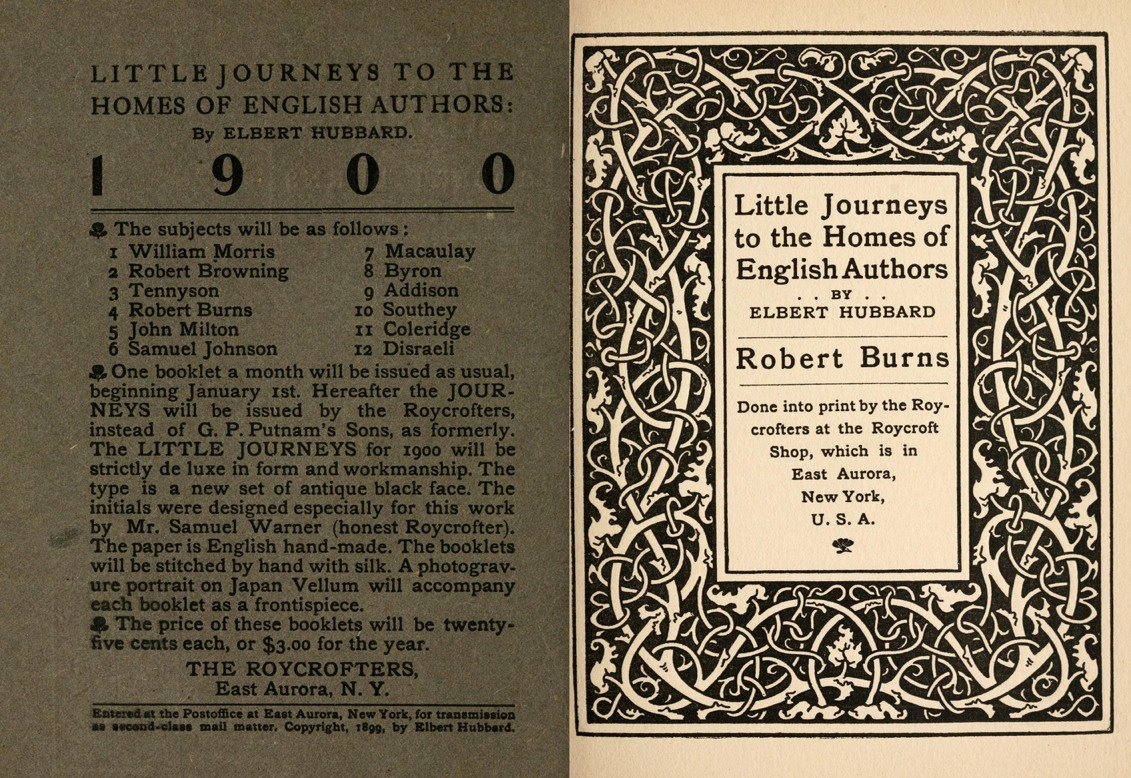
From my own copies of the Roycrofter Press issues from 1900

The earliest 20th-century exposé on love and relationships between men and women. One of the most insightful essays you will ever read.

Robert Burns by Elbert Hubbard
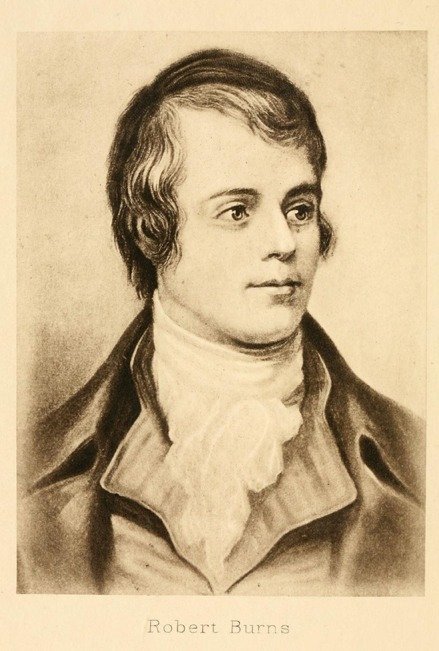
FinderScreenSnapz002

Elbert Hubbard In “Little Journeys to the Homes of English Authors.”

FinderScreenSnapz003

TO JEANNIE

Come, let me take thee to my breast,

And pledge we ne’er shall sunder;

And I shall spurn, as vilest dust,

The warld’s wealth and grandeur.

And do I hear my Jeannie own

That equal transports move her?

I ask for dearest life, alone,

That I may live to love her.

Thus in my arms, wi’ a’ thy charms,

I clasp my countless treasure;

I’ll seek nae mair o’ heaven to share

Than sic a moment’s pleasure.

And by thy een, sae bonnie blue,

I swear I’m thine for ever:

And on thy lips I seal my vow,

And break it shall I never.

Robert Burns

The business of Robert Burns was love-making. All love is good, but some kinds of love are better than others. Through Burns’ penchant for falling in love we have his songs.

A Burns bibliography is simply a record of his love-affairs, and the spasms of repentance that followed his lapses are made manifest in religious verse.

Poetry is the very earliest form of literature, and is the natural expression of a person in love; and I suppose we might as well admit the fact at once that without love there would be no poetry.

Poetry is the bill and coo of sex. All poets are lovers, and all lovers, either actual or potential, are poets. Potential poets are the people who read poetry; and so without lovers the poet would never have a market for his wares.

If you have ceased to be moved by religious emotion; if your spirit is no longer exalted by music, and you do not linger over certain lines of poetry, it is because the love-instinct in your heart has withered to ashes of roses. It is idle to imagine Bobby Burns as a staid member of the Kirk; had he been so, there would now be no Bobby Burns. The literary ebullition of Robert Burns (he himself has told us) began shortly after he had reached the age of indiscretion; and the occasion was his being paired in the hayfield, according to the Scottish custom, with a bonnie lassie. This custom of pairing still endures, and is what the students of sociology call an expeditious move. The Scotch are great economists—the greatest in the world. Adam Smith, the father of the science of economics, was a Scotchman; and Draper, author of “A History of Civilization,” flatly declares that Adam Smith’s “Wealth of Nations” has influenced the people of Earth for good more than any other book ever written—save none.

The Scotch are great conservators of energy.

But they all make hay while the sun shines, and count it joy. Liberties are allowed during haying-time that otherwise would be declared scandalous; during haying-time the Kirk waives her censor’s right, and priest and people mingle joyously. Wives are not jealous during hay-harvest, and husbands never faultfinding, because they each get even by allowing a mutual license. In Scotland during haying-time every married man works alongside of some other man’s wife. To the psychologist it is somewhat curious how the desire for propriety is overridden by a stronger desire—the desire for the shilling. The Scotch farmer says, “Anything to get the hay in”—and by loosening a bit the strict bands of social custom, the hay is harvested.

In the hay-harvest the law of natural selection holds; partners are often arranged for weeks in advance; and trysts continue year after year. Old lovers meet, touch hands in friendly scuffle for a fork, drink from the same jug, recline at noon and eat lunch in the shade of a friendly stack, and talk to heart’s content, sweetening the labor of the long summer day.

Of course this joyousness of the haying-time is not wholly monopolized by the Scotch. Haven’t you seen the jolly haying parties in Southern Germany, France, Switzerland and the Tyrol? How the bright costumes of the men and the jaunty attire of the women gleam in the glad sunshine!

But the practise of pairing is carried to a degree of perfection in Scotland that I have not noticed elsewhere. Surely it is a great economic scheme! It is like that invention of a Connecticut man, which utilizes the ebb and flow of the ocean-tides to turn a gristmill.

And it seems queer that no one has ever attempted to utilize the waste of dynamic force involved in the maintenance of the Company Sofa.

In Ayrshire, I have started out with a haying party of twenty—ten men and ten women—at six o’clock in the morning and worked until six at night. I never worked so hard, nor did so much. All day long there was a fire of jokes and jolly gibes, interspersed with song, while beneath all ran a gentle hum of confidential interchange of thought. The man who owned the field was there to direct our efforts and urge us on in well-doing by merry raillery, threat, and joyous rivalry.

The point I make is this—we did the work. Take heed, ye Captains of Industry, and note this truth, that where men and women work together under right influences, much good is accomplished, and the work is pleasurable. Of course there are vinegar-faced philosophers who say that the Scotch custom of pairing young men and maidens in the hayfield is not without its effect on esoterics, also on vital statistics; and I’m willing to admit there may be danger in the scheme. But life is a dangerous business anyway—few indeed get out of it alive!

Burns succeeded in his love-making and succeeded in poetry, but at everything else he was a failure. He failed as a farmer, a father, a friend, in society, as a husband, and in business.

From his twenty-third year his days were passed in sinning and repenting.

Poetry and love-making should be carried on with caution: they form a terrific tax on life’s forces. Most poets die young, not because the gods especially love them, but because life is a bank-account, and to wipe out your balance is to have your checks protested. The excesses of youth are drafts payable at maturity. Chatterton dead at eighteen, Keats at twenty-six, Shelley at thirty-three, Byron at thirty-six, Poe at forty, and Burns at thirty-seven, are the rule. When drafts made by the men mentioned became due, there was no balance to their credit and Charon beckoned.

Most life-insurance companies now ask the applicant this question, “Do you write poetry to excess?” Shakespeare, to be sure, clung to life until he was fifty-three, but this seems to be the limit. Dickens and Thackeray, their candles well burned out, also died under sixty. Of course, I know that Browning, Tennyson, Morris and Bryant lived to a fair old age, but this was on borrowed time, for in the early life of each there was a hiatus of from ten to eighteen years, when the men never wrote a line, nor touched a drop of anything, bravely eschewing all honey from Hymettus. Then the four men last named were all happily married, and married life is favorable to longevity, but not to poetry. As a rule only single men, or those unhappily mated, make love and write poetry. Men happily married make money, cultivate content, and evolve an aldermanic front; but love and poetry are symptoms of unrest. Thus is Emerson’s proposition partially proven, that in life all things are bought and must be paid for with a price—even success and happiness.

Burns once explained to Doctor Moore that the first fine, careless rapture of his song was awakened into being when he was sixteen years old, by “a bonnie sweet sonsie lass” whom we now know as “Handsome Nell.” Her other name to us is vapor, and history is silent as to her life-pilgrimage. Whether she lived to realize that she had first given voice to one of the great singers of earth—of this we are also ignorant. She was one year younger than Burns, and little more than a child when she and Bobby lagged behind the troop of tired haymakers, and walked home, hand in hand, in the gloaming. Here is one of the stanzas addressed to “Handsome Nell”:

“She dresses all so clean and neat,

Both decent and genteel,

And then there’s something in her gait

Makes any dress look weel.”

And how could Nell then ever guess why her cheeks burned scarlet, and why she was so sorry when haying-time was over? She was sweet, innocent, artless, and their love was very natural, tender, innocent. It’s a pity that all loves can not remain in just that idyllic, milkmaid stage, where the girls and boys awaken in the early morning with the birds, and hasten forth barefoot across the dewy fields to find the cows. But love never tarries. Love is progressive; it can not stand still. I have heard of the “passiveness” of woman’s love, but the passive woman is only one who does not love—she merely consents to have affection lavished upon her. When I hear of a passive woman, I always think of the befuddled sailor who once saw one of those dummy dress-frames, all duly clothed in flaming bombazine (I think it was bombazine) in front of a clothing establishment. The sailor, mistaking the dummy for a near and dear lady friend, embraced the wire apparatus and imprinted a resounding smack on the chaste plaster-of-Paris cheek. Meeting the sure-enough lady shortly after, he upbraided her for her cold passivity on the occasion named.

A passive woman—one who consents to be loved—should seek occupation among those worthy firms who warrant a fit in ready-made gowns, or money refunded.

Love is progressive—it hastens onward like the brook hurrying to the sea. They say that love is blind: love may be short-sighted, or inclined to strabismus, or may see things out of their true proportion, magnifying pleasant little ways into seraphic virtues, but love is not really blind—the bandage is never so tight but that it can peep. The only kind of love that is really blind and deaf is Platonic love. Platonic love hasn’t the slightest idea where it is going, and so there are surprises and shocks in store for it. The other kind, with eyes wide open, is better. I know a man who has tried both. Love is progressive. All things that live should progress. To stand still is to retreat, and to retreat is death. Love dies, of course. All things die, or become something else. And often they become something else by dying. Behold the eternal Paradox! The love that evolves into a higher form is the better kind. Nature is intent on evolution, yet of the myriads of spores that cover earth, most of them are doomed to death; and of the countless rays sent out by the sun, the number that fall athwart this planet are infinitesimal. Edward Carpenter calls attention to the fact that disappointed love—that is, love that is “lost”—often affects the individual for the highest good. But the real fact is, nothing is ever lost. Love in its essence is a spiritual emotion, and its office seems to be an interchange of thought and feeling; but often thwarted in its object, it becomes general, transforms itself into sympathy, and embracing a world, goes out to and blesses all mankind.

Very, very rare is the couple that has the sense and poise to allow passion just enough mulberry-leaves, so it will spin a beautiful silken thread, out of which a Jacob’s ladder can be constructed, reaching to the Infinite. Most lovers in the end wear love to a fringe, and there remains no ladder with angels ascending and descending—not even a dream of a ladder. Instead of the silken ladder on which one can mount to Heaven, there is usually a dark, dank road to Nowhere, over which is thrown a package of letters and trinkets, all fastened round with a white ribbon, tied in a lover’s knot. The many loves of Robert Burns all ended in a black jumping-off place, and before he had reached high noon, he tossed over the last bundle of white-ribboned missives and tumbled in after them. The life of Burns is a tragedy, through which are interspersed sparkling scenes of gaiety, as if to retrieve the depth of bitterness that would otherwise be unbearable. Go ask Mary Morison, Highland Mary, Agnes McLehose, Betty Alison, and Jean Armour!

The poems of Robert Burns fall easily into four divisions.

First, those written while he was warmly wooing the object of his affection.

Second, those written after he had won her.

Third, those written when he had failed to win her.

Fourth, those written when he felt it his duty to write, and really had nothing to say.

The first-named were written because he could not help it, and are, for the most part, rarely excellent. They are joyous, rapturous, sprightly, dancing, and filled with references to sky, clouds, trees, fruit, grain, birds and flowers. Birds and flowers, by the way, are peculiarly lovers’ properties. The song and the plumage of birds, and the color and perfume of flowers are all distinctly sex manifestations. Robert Burns sang his songs just as the bird wings and sings, and for the same reason. Sex holds first place in the thought of Nature; and sex in the minds of men and women holds a much larger place than most of us are willing to admit. All religious emotion and all art are born of the sex instinct.

Burns’ poems of the second variety, written after he had won her, are touched with religious emotion, or filled with vain regret and deep remorse, as the case may be, all owing to the quality and kind of success achieved, and the influence of the Dog-Star.

Burns wrote several deeply religious poems. Now, men are very seldom really religious and contrite, except after an excess. Following a debauch a man signs the pledge, vows chastity, writes fervently of asceticism and the need of living in the spirit and not in the senses. Good pictures show best on a dark back-ground. Men talk most about things they do not possess.

“The Cotter’s Saturday Night,” perhaps the most quoted of any of Burns’ poems, is plainly the result of a terrible tip to t’ other side. Bobby had gone so far in the direction of Venusburg that he resolved on getting back, and living thereafter a staid and proper life.

In order to reform you must have an ideal, and the ideal of Burns, on the occasion of having exhausted all capacity for sin, is embodied in the “Saturday Night.” It is all a beautiful dream. The real Scottish cotter is quite another kind of person. The religion of the live cotter is well seasoned with fear, malevolence and absurd dogmatism. The amount of love, patience, excellence and priggishness shown in “The Cotter’s Saturday Night” never existed, except in a poet’s imagination. In stanza Number Ten of that particular poem is a bit of unconscious autobiography that might as well ha’ been omitted; but in letting it stand, Burns was loyal to the thought that surged through his brain.

People who are not scientific in their speech often speak of the birds as being happy. My opinion is that birds are not any more happy than men—probably not as much so. Many birds, like the English sparrow and the blue jay, quarrel all day long. Come to think of it, I believe that man is happier than the birds. He has a sense of remorse, and this suggests reformation, and from the idea of reformation comes the picturing of an ideal. This exercise of the imagination is pleasure, for indeed there is a certain satisfaction in every form of exercise of the faculties. There is a certain pleasure in pain: for pain is never all pain. And sin surely is not wholly bad, if through it we pass into a higher life—the life of the spirit.

Anything is better than the Dead Sea of neutral nothingness, wherein a man merely avoids sin by doing nothing and being nothing. The stirring of the imagination by sorrow for sin, sometimes causes the soul to wing a far-reaching upward flight.

Asceticism is often only a form of sensuality: the man finds satisfaction in overcoming the flesh. And wherever you find asceticism you find potential passion—a smoldering volcano held in check by a devotion to duty; and a gratification is oft found in fidelity.

The moral and religious poems of Burns were written in a desire to work off a fit of depression, and make amends for folly. They are sincere and often very excellent. Great preachers have often been great sinners, and the sermons that have moved men most are often a direct recoil from sin on the part of the preacher. Remorse finds play in preaching repentance. When a man talks much about a virtue, be sure that he is clutching for it. Temperance fanatics are men with a taste for strong drink, trying hard to keep sober. The moral and religious poems of Robert Burns are not equal to his love-songs. The love-songs are free, natural, untrammeled and unrestrained; while his religious poems have a vein of rotten warp running through them in the way of affectation and pretense. From this I infer that sin is natural, and remorse partially so. In Burns’ moral poems the author tries to win back the favor of respectable people, which he had forfeited. In them there is a violence of direction; and all violence of direction—all endeavors to please and placate certain people—is fatal to an artist. You must work to please only yourself.

Work to please yourself and you develop and strengthen the artistic conscience. Cling to that and it shall be your mentor in times of doubt: you need no other. There are writers who would scorn to write a muddy line, and would hate themselves for a year and a day should they dilute their honest thought with the platitudes of the fear-ridden. Be yourself and speak your mind today, though it contradict all you have said before. And above all, in art, work to please yourself—that Other Self that stands over and behind you, looking over your shoulder, watching your every act, word and deed—knowing your every thought. Michelangelo would not paint a picture on order. “I have a critic who is more exacting than you,” said Meissonier—”it is my Other Self.”

Rosa Bonheur painted pictures just to please her Other Self, and never gave a thought to any one else, nor wanted to think of any one else, and having painted to please herself, she made her appeal to the great Common Heart of humanity—the tender, the noble, the receptive, the earnest, the sympathetic, the lovable. That is why Rosa Bonheur stands first among women artists of all time: she worked to please her Other Self.

That is the reason Rembrandt, who lived at the same time Shakespeare lived, is today without a rival in portraiture. He had the courage to make an enemy. When at work he never thought of any one but his Other Self, and so he infused soul into every canvas. The limpid eyes look down into yours from the walls and tell of love, pity, earnestness and deep sincerity. Man, like Deity, creates in his own image, and when he portrays some one else, he pictures himself, too—this provided his work is Art. If it is but an imitation of something seen somewhere, or done by some one else, to please a patron with money, no breath of life has been breathed into its nostrils, and it is nothing, save possibly dead perfection—no more.

Is it easy to please your Other Self? Try it for a day. Begin tomorrow morning and say: “This day I will live as becomes a man. I will be filled with good-cheer and courage. I will do what is right; I will work for the highest; I will put soul into every hand-grasp, every smile, every expression—into all my work. I will live to satisfy my Other Self.”

Do you think it is easy? Try it for a day.

Robert Burns wrote some deathless lines—lines written out of the freshness of his heart, simply to please himself, with no furtive eye on Dumfries, Edinburgh, the Kirk, or the Unco Guid of Ayrshire; and these are the lines that have given him his place in the world of letters.

The other day I was made glad by finding that John Burroughs, Poet and Prophet, says that the male thrush sings to please himself, out of pure delight; and pleasing himself, he pleases his mate. “The female,” says Burroughs, “is always pleased with a male that is pleased with himself.”

The various controversial poems (granting for argument’s sake that controversy is poetic) were written when Burns was smarting under the sense of defeat. These show a sharp insight into the heart of things, and a lively wit, but are not sufficient foundation on which to build a reputation. Ali Baba can do as well. Considering the fact that twice as many people make pilgrimages to the grave of Burns as visit the dust of Shakespeare, and that his poems are on the shelves of every library, his name now needs no defense. The ores are very seldom found pure, and if even the work of Deity is composite, why should we be surprised that man, His creature, should express himself in a varying scale of excellence!

There was nothing of Jack Falstaff about Francis Schlatter, whose whitened bones were found amid the alkali dust of the desert, a few years ago—dead in an endeavor to do without meat and drink for forty days.

Schlatter purported, and believed, that he was the reincarnation of the Messiah. Letters were sent to him, addressed simply, “Jesus Christ, Denver, Colorado,” and he walked up to the General-Delivery window and asked for them with a confidence, we are told, that relieved the postmaster of a grave responsibility.

Schlatter was no mere ordinary pretender, working on the superstitions of shallow-pated people. He lived up to his belief—took no money, avoided notoriety when he could; and the proof of his sincerity lies in the fact that he died a victim to it.

Herbert Spencer has said all about the Messianic Instinct that there is to say, save this—the Messianic Instinct first had its germ in the heart of a woman. Every woman dreams of the coming of the Ideal Man—the man who will give her protection, even to giving up his life for her, and vouchsafe peace to her soul. I am told by a noted Bishop of the Catholic Church that many women who become nuns are prompted to take their vows solely through the occasion of an unrequited love. They become the bride of the Church and find their highest joy in following the will of Christ. He is their only Spouse and Master.

The terms of endearment one hears at prayer-meetings, “Blessed Jesus,” “Dear Jesus,” “Loving Jesus,” “Elder Brother,” “Patient, gentle Jesus,” etc., were first used by women in an ecstasy of religious transport. And the thought of Jesus as a loving, “personal Savior,” would die from the face of the earth did not women keep it alive. The religious nature and the sex nature are closely akin: no psychologist can tell where the one ends and the other begins.

There may be wooden women in the world, and of these I will not speak, but every strong, pulsing, feeling, thinking woman goes through life, seeking the Ideal Man. Whether she is married or single, rich or poor, old or young, every new man she meets is interesting to her, because she feels in some mysterious way that possibly he is the One.

Of course, I know that every good man, too, seeks the Ideal Woman—but that deserves another chapter.

The only woman in whose heart there is not the live, warm, Messianic Instinct is the wooden woman, and the one who believes she has already found him. But this latter is holding an illusion that soon vanishes with possession.

That pale, low-voiced, gentle and insane man, Francis Schlatter, was followed at times by troops of women. These women believed in him and loved him—in different ways, of course, and with passion varying according to temperament and the domestic environment already existing. To love deeply is a matter of propinquity and opportunity.

One woman, whom “The Healer” had cured of a lingering disease, loved this man with a wild, mad, absorbing passion. Chance gave her the opportunity. He came to her house, cold, hungry, homeless, sick. She fed him, warmed him, looked into his liquid eyes, sat at his feet and listened to his voice. She loved him—and partook of his every mental delusion.

This woman now waits and watches in her mountain home for his return. She knows the coyotes and buzzards picked the scant flesh from his starved frame, but she says: “He promised he would come back to me, and he will. I am waiting for him here.”

This woman writes me long letters from her solitude, telling me of her hopes and plans. Just why all the cranks in the United States should write me letters, I do not know, but they do—perhaps there is a sort o’ fellow-feeling. This woman may write letters to others, just as she does to me. Of this I do not know, but surely I would not thus make public the heart-tragedy told me in a private letter, were it not that the woman herself has printed a pamphlet, setting forth her faith and veiling only those things into which it is not our right to pry.

This Mary Magdalene believes her lover was the Chosen Son of God, and that the Father will reclothe the Son in a new garment of flesh and send him back to his beloved. So she watches and waits, and dresses herself to receive him, and at night places a lighted lantern in the window to guide the way.

She watches and waits.

Other women wait for footsteps that will never come, and listen for a voice that will never be heard. All round the world there is a sisterhood of such. Some, being wise, lose themselves in loving service to others—in useful work. But this woman, out in the wilds of New Mexico, hugs her sorrow to her heart, and feeds her passion by recounting it, and watches away the leaden hours, crying aloud to all who will listen: “He is not dead—he is not dead! he will come back to me! He promised it—he will come back to me! This long, dreary waiting is only a test of my loyalty and love! I will be patient, for he will come back to me! He will come back to me!”

This world would be a sorry place if most men conducted their lives on the Robert Burns plan. Burns was affectionate, tender, generous and kind; but he was not wise. He never saw the future, nor did he know that life is a sequence, and that if you do this, it is pretty sure to lead to that. His loves were largely of the earth.

Excess was a part of his wayward, undisciplined nature; and that constant tendency to put an enemy in his mouth to steal away his brains, bound him at last, hand and foot. His old age could never have been frosty, but kindly—it would have been babbling, irritable, senile, sickening. Death was kind and reaped him young. Sex was the rock on which Robert Burns split. He seemed to regard pleasure-seeking as the prime end of life, and in this he was not so very far removed from the prevalent “civilized” society notion of marriage. But it is a phantasmal idea, and makes a mock of marriage, serving the satirist his excuse.

To a great degree the race is yet barbaric, and as a people we fail utterly to touch the hem of the garment of Divinity. We have been mired in the superstition that sex is unclean, and therefore honesty and free expression in love matters have been tabued.

But the day will yet dawn when we will see that it takes two to generate thought; that there is the male man and the female man, and only where these two walk together hand in hand is there a perfect sanity and a perfect physical, moral and spiritual health.

We reach infinity through the love of one, and loving this one, we are in love with all. And this condition of mutual sympathy, trust, reverence, forbearance and gentleness that can exist between a man and a woman, gives the only hint of Heaven that mortals ever know. From the love of man for woman we guess the love of God, just as the scientist from a single bone constructs the skeleton—aye! and then clothes it with a complete garment.

In their love-affairs women are seldom wise, or men just. How should we expect them to be when but yesterday woman was a chattel and man a slave-owner? Woman won by diplomacy—that is to say, by trickery and untruth, and man had his way through force, and neither is quite willing to disarm. An amalgamated personality is the rare exception, because neither Church, State nor Society yet fully recognizes the fact that spiritual comradeship and the marriage of the mind constitute the only Divine mating. Doctor Blacklock once said that Robert Burns had eyes like the Christ. Women who looked into those wide-open, generous orbs lost their hearts in the liquid depths.

In the natures of Robert Burns and Francis Schlatter there was little in common; but their experiences were alike in this: they were beloved by women. Behind him Burns left a train of weeping women—a trail of broken hearts. And I can never think of him except as a mere youth—”Bobby Burns”—one who never came into man’s estate. In all his love-making he never seemed really to benefit any woman, nor did he avail himself of the many mental and spiritual excellencies of woman’s nature, absorbing them into his own. He only played a devil’s tattoo upon her emotions.

If Burns knew anything of the beauty and inspiration of a high and holy friendship between a thinking man and a thinking woman, with mutual aims, ideals and ambitions, he never disclosed it. The love of a man for a maid, or a maid for a man, can never last, unless these two mutually love a third something. Then, as they are traveling the same way, they may move forward hand in hand, mutually sustained. The marriage of the mind is the only compact that endures. I love you because you love the things that I love. That man alone is great who utilizes the blessings that God provides; and of these blessings no gift equals the gentle, trusting companionship of a good woman.

So, having written thus far, I find that already I have reached the limit of my allotted space.

In closing, it may not be amiss for me to state that Robert Burns was an Irish poet whose parents happened to be Scotch. He was born in Ayrshire in Seventeen Hundred Fifty-nine. He died in Seventeen Hundred Ninety-six, and was buried at Dumfries by the “gentleman volunteers,” in spite of his last solemn words—”Don’t let the Awkward Squad fire over my grave!”

His mother survived him thirty-eight years, passing out in Eighteen Hundred Thirty-four. Burns left four sons, each of whom was often pointed out as the son of his father—but none of them was.

This is all I think of, at present, concerning Robert Burns.
LIFE AND TIMES IN DEATH

by Soumya Bukherjee ©2013

View original at http://wp.me/p41l0y-Sdeath-and-life

Life and times of Death

Let us begin with a strikingly vivid painting of a harsh barren landscape, centering a fading creature seemingly in the throes of death and its accompanying absolution. Pocket watches lay scattered over the landscape, their shiny metallic surfaces melting, dangling in liquid defeat from a branch or spread out over a ledge or the disappearing creature. I came across this iconic painting entitled ‘The persistence of memory’ by the surrealist artist Salvador Dali in the form of a poster in the room of a chance acquaintance, and immediately I knew I had found the painting that resonated with my own deep insecurities about the nature of time, of life and finally of death. The melting clocks seemed to address the impossibility of nailing time, as well as the fluidity of its perception in human consciousness. Indeed as Salvador Dali himself noted, “The soft watches are an unconscious symbol of the relativity of space and time, a Surrealist meditation on the collapse of our notions of a fixed cosmic order” Moreover the harshness of the climate, the undefined creature in the pose of death and the notion of time itself put me in mind of our conception of mortality, views on the transience of life and the ramifications of contemplating our own death, all topics that have long fascinated me.

The first time I realized I was going to die and that this our life would not last forever, despite what the distractions of our surroundings may seem to suggest, was at the age of seven, when my grandmother passed away and I was confronted with the idea that I too may one day cease to exist. The bewildering emotions rising within me at the time, haltingly, imperfectly expressed in my mother’s ear, were quieted with the thought of an afterlife, rebirth, the amusing possibility of being reborn as my own granddaughter’s child. My imagination was captured and distracted by the comical dilemma of needing to call one’s own daughter ‘grandma’, as my mother drew parallels between me and her own late grandmother to illustrate the point. For the moment thus I was saved from peering into the chasm that the realization of death would bring.

It is interesting that one’s first brush with death in childhood almost always gets hurriedly suppressed by concerned family and relatives. Rather than explaining death as a natural process and acclimatizing the growing consciousness to it they lull us into a false security where death is denied, so that the realization, when it comes, is that much more unacceptable. Children’s fiction has managed to challenge this trend only recently. However for the longest time fiction for children was carefully selected and filtered, rooting out all elements that would illustrate too harsh a reality, especially all topics concerning death. The earliest media we were regaled with, whether quaint Enid Blyton worlds with everlasting magical creatures and children who never grew old, or a Tom and Jerry cartoon where scrapes are funny but never lethal, were all in on this benevolent conspiracy.

Death became a familiar figure in the years that followed, whether through fiction or the world around me. However the enormity of what it entailed never encroached upon my consciousness until one defining incident during a family vacation in Goa. The day of our particular adventure the water was somewhat choppy, but the guide waived aside our doubts and launched us along with a father son duo onto the one-manned boat. By this time the waves were starting to get bigger, and the boat struggled to combat each crushing wall of water as it came along, its engine spluttering valiantly against the force. The boat managed to overcome the first few waves after much lurching, and for a moment we thought we had made it into the clear calm waters of the ocean, but then a sneak current suddenly buffeted us back as another wave rose up to meet us, an enormous monster of gruesome scope. The single seaman navigating our boat had stiffened, his eyes staring glassily. He clearly knew what was coming, for we could see the dilemma in his eyes as he contemplated abandoning ship to somehow getting us through. The wave came; crushingly huge, spanking our exposed faces and arms and making it sting with salt. The boat stayed, but just about. Its engine had been torn away by the force of the hit, and a gaping hole had water gushing in towards the back of the vessel. Meanwhile another wave was readying itself to finish what was left undone, and didn’t even need the seaman’s strangled cry to know what he had to do. He screamed to jump ship, and that’s precisely what we did after a moment of frozen panic. Everyone jumped off the side nearest to them, which for me, sitting on the center right meant jumping around the rigging of the boat. This turned out to be a mistake, as I realized a split-second later, for I found my neck and torso tangled in the thick coiled ropes of the boat. I would have strangled right there and then if the boat hadn’t capsized at the same time and in the same direction, causing me to be trapped directly under the upturned boat by its tenacious coils, the lengths of which prevented me from striking out from either side and breaking surface. It was then, as the oxygen ran out and water threatened to enter my lungs, as each movement of the boat buffeted by the waves threatened to either knock me out or strangle me by tightening its hold around my throat that I appreciated once and for all the true terror of knowing I might die, or rather knowing I will die. It was a truly sobering realization. There were no romantic flashbacks of the past as popularized in fiction, nor any great insight into the meaning of life. The only emotion I remember is abject terror, translated into a desperate quest to save myself. I struggled against the ropes in every way possible, kicking at the boat to dislodge its hold, all to no avail. I was tiring out fast, and my movements getting feebler under the pressure of the current. My eyes stung in the salty sandy water and my skin was already breaking into bruises and scratches which I wouldn’t feel until much later. Just as the weight of my aching neck and head grew too much to bear and I began to lose the will to fight that sheer coincidence sent a merciful wave at just the right angle to dislodge the choking hold of the rope around my neck and free one of my arms. With newfound urgency I managed to wrench out of the harness and kicked off the side of the boat at the same time as a wave shoved it to the other side. The first lungful of cool sea air that followed was the best thing I’d ever experienced. It hurt to breathe but each gulp full had me thankful anew to be breathing it. It took a while to orient myself to my surroundings. There were swimmers and divers all around, fighting the waves to reach us. Not more than a few minutes must have passed since the boat capsized, yet I felt as though I had emerged after months of struggle. Gasping and weak, I allowed a swimmer who reached me to pull me back away from the sea, this time using the waves to move us faster back to shore. My sister had been rescued first it seemed, for she was already on shore by the time I reached. My father came close after. He’d escaped safely too but hung back shouting himself hoarse for my sister, not knowing she had been rescued first. I chose not to think about the fact that he never looked for my whereabouts. I had been the last to be rescued; being trapped under the boat they had not been able to locate me. The thought brought home full force the realization that I could have died but for sheer chance circumstances, a thought that had evaded me again in the heat of the rescue operations.

Our mind attempts to protect us, by denying death or distracting us from our contemplation of it. However traumatizing the experience, my own consciousness hurried to cover up my close encounter with death, concentrating on the exciting experience rather than relive that terror which comes from absolute certainty. Ever since, I occasionally wake up in the middle of the night, or get a jolt of fear while awake and deep in thought, when a vision of absolute nothingness rises before my eyes with the sudden damning conviction that there is nothing after death and our life is but a tiny spark in the midst of eternal meaningless darkness. The thought of such insignificance and meaninglessness is so daunting, and the idea of the world carrying on irrespective of our existence so unbearable, that our mind hurries to close the idea up again, with the result that the vision or realization disappears as soon as it appeared, leaving only the cold clammy feeling of an uncertain dread in its place. The realization of our miniscule existence in the enormous scheme of things can’t fail to be accompanied by a lack of faith in the meaningfulness of our insignificant lives. It’s an idea probed time and again by writers and artists alike, yet it is one that can yield no answers. It causes us to question the nature of existence itself, and the justification behind its repetitive mundane pursuits. Albert Camus’ defining work Myth of Sisyphus provides the classic metaphor to represent this confusion. Our life and its pointless endeavors get compared to the mythological Sisyphus’ eternal task of fruitlessly rolling a rock uphill only to have it roll back down again. Dali’s Persistence of Memory too speaks to me of the nature of time and life, of death and continuity. It portrays time as envisioned in human context and imagination, and the result is unreliable, liquid, time and life a melting entity rather than their rigid and structured conventional representation. The painting and its theme reminds me of Virginia Woolf’s novel Mrs. Dalloway, which has perhaps more aptly been previously named ‘The Hours’. The novel follows multiple stream of consciousness narratives of multiple characters that all overlap in space and time, time in their imagination being no linear entity but rather a flexible, capricious one, molded through perception and emotion before finally culminating abruptly with death. As with my near death experience, when a few minutes of terror seemed to last a very long time indeed, here too the relativity of time is represented as an essential fact of human existence, making the attempt to quantify and structure time narratives, though the recurrent imagery of the chiming of the hours, seem unnecessary and absurd. Woolf herself, much like her protagonist Clarissa Dalloway, was obsessed with life and death, and like her other protagonist, Septimus Smith, actually chose suicide as a means out of her struggles with life.

Ultimately what Dali, Woolf, Camus, and even the writers of children’s fiction in avoiding the subject dealt with is man’s inability to contemplate his own transience without tremor, resulting in his constant struggle to justify a temporary fleeting existence, the necessary obsession with what comes next and the desperate quest to justify what came before. What is left is an eternal cycle of repeated events, of action with no possible reaction save more of the same. Hence does our mind distract us from contemplating an end, hence do I go on quite contentedly with life despite questioning its validity, hence do we all stop ourselves from curling in terror at the thought of an absolute end, but beguile ourselves with worldly distractions and pretty myths. Time is an illusion, death an inconceivable absolute, and all we have is today, and more of today. If that is absurd, so be it. Whoever promised us meaning in any case? What we can do, is just continue. A scene from Samuel Beckett’s Waiting for Godot comes to minds, wherein the two characters Vladimir and Estragon, stuck in a cycle of repetitive events they cannot escape, have the following altercation

Wiseguy From The East's avatarIdyll Dreams of an Idle Fellow

Go Back

View original post

A SHORT HISTORY OF HUMAN RIGHTS

By Kenneth Harper Finton © 2014, rev 2015

4874028-portrait-of-thomas-jefferson-2-dollar-note“We hold these truths to be self-evident: that all men are created equal; that they are endowed by their Creator with certain unalienable rights; that among these are life, liberty, and the pursuit of happiness.”   

 – Thomas Jefferson

This famous quote by Jefferson, the opening line of The Declaration of Independence, has long been the battle cry for freedom and equality.

Since the time I was a child, I felt chilled by the power and the wisdom in these words. I never doubted for a moment that these words were true because I wanted them to be true.

Is this really true?

Is it self-evident that all men are created equal? What if we substituted ‘gorillas’ instead of men.  Are all gorillas created equal? Are all snakes created equal? What about women? Are all women created equal as well?

This declaration says that all men are created equal. What it fails to reveal is that the instant this life is created, some are more advantaged than others by DNA, parental wealth and upbringing, and the social circles into which we are born.

What of “inalienable rights?” 

Are these natural rights derived from natural laws? Natural law and natural rights are not interchangeable. Nature itself knows nothing of rights. Nature simply creates and destroys and recycles the materials to create again. Where are these “inalienable rights” in nature?

The idea that there are natural rights was constructed by the Greek Stoics. These rights did not apply to nature, but to the social world that man created. The Stoics held that no one was made a slave by nature, but that slavery was an external condition imposed by society. These Stoics were among the first to declare the equality of men. They declared that there was an inner part of the human being that cannot be restrained by either the body or imprisonment. That this inner spark cannot be delivered into bondage was revived by the Reformation and Martin Luther.

Immanuel Kant claimed that natural rights were derived by reason alone, but Kant failed to realize that this kind of reason is also a human construction. That there is a right to life and liberty became a popular theme in philosophic thought.  John Locke declared that natural rights were:  “… to Life, Liberty, and Estate.” [i.e., property].


HitchensonFrancis Hutcheson 

In his Inquiry into the Original of Our Ideas of Beauty and Virtue (1725), Francis Hutcheson wrote: “For wherever any Invasion is made upon unalienable Rights, there must arise either a perfect, or external Right to Resistance . . .  Unalienable Rights are essential Limitations in all Governments.” 

Knowing that one person’s rights were often in conflict with another, Hutcheson said, ‘There can be no Right, or Limitation of Right, inconsistent with, or opposite to the greatest publick Good.”

In an attempt to prove that there are inalienable rights, Hutcheson said, “Thus no man can really change his sentiments, judgments, and inward affections, at the pleasure of another; nor can it tend to any good to make him profess what is contrary to his heart. The right of private judgment is therefore unalienable.”

I find this unconvincing. We have private judgments and opinions, but these do not have to be inalienable. We are not born with opinions or judgments. They come from our experience, our learning, and our social bias.

Thomas Paine (1731-1809) wrote about natural rights as well. In his book Rights of Man (1791) he recognized that if rights were promised by a charter or a constitution, this would mean that these rights could also be revoked. The right would then become mere privileges:

It is a perversion of terms to say that a charter gives rights. It operates by a contrary effect—that of taking rights away. Rights are inherently in all the inhabitants; but charters, by annulling those rights, in the majority, leave the right, by exclusion, in the hands of a few … They … consequently are instruments of injustice. The fact therefore must be that the individuals themselves, each in his own personal and sovereign right, entered into a contract with each other to produce a government: and this is the only mode in which governments have a right to arise, and the only principle on which they have a right to exist.

Benjamin Tucker (1854-1939) was among the first to abandon the case for natural rights and declare that there are only two rights (1) the right of might and (2) the right of contract. The right of might only existed until it was overridden by the right to contract.

180px-Erich_Fromm_Erich Fromm (1900-1980) argued that some powers over human beings could be wielded only by God. If there were no God, no human beings could wield these powers.

An early libertarian view of inalienable rights was laid out in Morris and Linda Tannehill’s book The Market for Liberty. This book attempted to fuse capitalism with anarchy and is known as anarcho-capitalism. They claimed that a person does have a right to ownership over their life and property because they invested a part of their life into it. By doing so, they made it an extension of their life. However, if this person uses force to the detriment of another person, then they lose that right to ownership and they are required to pay a debt: “Rights are not inalienable,” Tannehill wrote, “but only the possessor of a right can alienate himself from that right–no one else can take a man’s rights from him.” The Tannehills believed that there is such a thing as natural rights and that our society would be best off without governmental controls. [See: http://en.wikipedia.org/wiki/The_Market_for_Liberty]

Rights Are an Idea

Logic dictates that rights are an idea, a human construction, not a natural law. Rights are freedoms we have demanded from the established order and we have fought battles to protect these rights by social laws.  Rights are only as strong as the society that grants these rights and they can change with social evolution. Rights and entitlements are those things the social establishment allows us to have, those freedoms given to us by political laws.  They change with the political winds. Nature is free, but we are not free so long as we subscribe to a social contract for our cooperative existence. Our social contracts attempt to displace nature as the rule maker as much as is humanly possible. We are a part of society. We subscribe to social contracts and the laws governing our behavior to coexist in the greater world.  These social laws are local and change as we move forward in time.

TJquoteJefferson said that there is a right to “life, liberty and the pursuit of happiness.”

These are not rights at all, but rhetoric designed to inflame the masses and instigate revolution.

Does nature respect the right to life of the individual?

List examples here: ___________________.

Beginnings and endings are the order of time itself. We exist in order to perish.

The right to life is not a natural law, but a human conception based upon conflicting values. If there is a right to life, then war is a violation of those rights, as is execution and murder. Social values are conflicted by individual interpretations as to what a right to life might entail. The first assumption that is made is that there is a right to life–when nature makes no such assumption. Having agreed to the fallacy that there is a right to life, they must then make exceptions to this right for war, executions, self-defense, madness, irresponsibility, abortion, etc.

How much simpler it would be if God and Nature were not brought in as arbiters of human morality and we accepted the basic truth that we are responsible for our world and the entitlements that we enjoy.

The right to liberty is given to us by society as well.  Society may take our freedom and put liberty at will, should the governing bodies decide to do so.

As to the right to the pursuit of happiness–this is an a priori right that we can give ourselves and establish within the confines of our own minds. We create our own happiness and we may pursue it or not at will. Even if our liberty has been removed and our lives are scheduled to be forfeited, we may still pursue and achieve happiness.

Rights come and go.

They must be earned.

They must be fought for.

They must be accepted into social law to have any meaning at all.

METAPHYSICS

By Kenneth Harper Finton ©2015

Adding the element of time to light passing stars forms a mesmerizing image of a funnel rhtough time as star trails paint the night sky.

Adding the element of time to light, passing stars forms a mesmerizing image of a funnel through time as star trails paint the night sky.

METAPHYSICS

Metaphysics is the branch of philosophy concerned with explaining the fundamental nature of being in the world. The word comes from the Greek metá, meaning beyond and physiká, meaning physics. Metaphysics is concerned with that which is beyond physics. As such, it is not easily defined or put into words.

A metaphysician tries to clarify the fundamental ways that people can understand the world and the universe about them. They are concerned with existence, objects that are brought forth by existence, space and time, cause and effect and the possibilities that understanding these concepts can raise.

Metaphysics attempts to clarify two basic questions that have bothered thinkers since man became self-aware: 1) what is existence, what is really there, and 2) what is this ultimate existence like.

The central branch of metaphysics is called ontology. Ontology tries to determine the nature of being itself. It asks questions such as, “What does exist? What are things? What are events? What is the meaning of being? And how may being itself be classified?”

Metaphysics predates both physics and science. Originally the term science meant knowledge, but came to be seen as empirical knowledge, a learning that can be deduced from outside sources such as experiments and whose results can be duplicated. Empirical knowledge is different from rational knowledge where reason alone is considered evidence. Empirical knowledge takes an idea, a hypothesis, and performs experiments to prove the idea, reviews those experiments with others (peer review that includes adversarial opinions), then published these findings so that others may duplicate the results.

One would think that the scientific and empirical method of seeking answers is the most correct method, but some questions and ideas cannot be subject to experience and data. These are called a prori, meaning “from the earlier.” Findings based on experimentation and the scientific methods are called a posteriori, meaning “from the later.”

AWARENESS AND THE SENSES

The senses are the source or our information about objects and ourselves. This sensory input is calculated and organized to form the basis of conception. Conception itself precedes or is conceived simultaneously by consciousness, or there would be nothing of which to be cognizant.

Let us define consciousness. It is the state or quality of being aware of an external object––something other than the self. Consciousness is the ability to experience and be affected by an outer force other than the self.

The above is an apriori statement. It is not dependent upon scientific experiments or methods, but on reason and logic alone. One cannot prove consciousness. It is inferred by itself and made obvious by its own presence.

This idea has mighty implications. It places awareness before or simultaneous to the material aspect of ‘things’, acknowledges that awareness existed before or at the same time that things appeared, and places the senses as the method for interpreting the being of the object. At that moment, being is conceptualized, and thereby exists.

We may, I believe, assume that this happens at  the very birth of existence itself. We can deduce that the world is physically composed of repetItive geometric patterns that have mathematical properties. These patterns of birthing repeat continually through nature and the universe. It occurs in the most primitive levels of elemental attraction to the most significant birthing of organisms. This birthing from nothing into a physical being has happened to each of us as we gradually became aware of the world outside ourselves. We know a priori within ourselves this world that comes rushing in at our birth.

See:  https://heliosliterature.com/2014/11/15/the-world-came-roaring-in

Gnosis

Gnosis is the Greek noun for knowledge, from which we developed the English word ‘know’. It is the word ancient Greeks used for the personal knowledge that we can deduce and come to know within ourselves, rather than intellectual knowledge that comes from learning from the exterior, that outside our being. We can deduce this because it has occurred within each of us. We are aware and conscious; of this we are certain. That this gnosis (this knowledge of the self) exists in every existent thing can be assumed. In fact, we have no choice but to deduce and assume this, as we are the only existent things that we can prove to be actual. We know that gnosis is within us on a personal level. We should then deduce that this awareness it must also occur everywhere because we cannot logically prove there is anything but our own awareness and consciousness. This is where logic takes us.

The idea makes us expand the idea of the self. The awareness that created our idea of self exists in every existent thing because it is one dimensional, an element in the basic building of existence that is everywhere at all times. One dimensional existence is but a single point that is everywhere at all times by definition.

Logic and pure mathematics are a priori. They do not depend upon empirical facts to exist. Mathematics and logic exist outside of the perceived and provable methods of scientific experimentation.This does not mean that logic and mathematics are inferior to scientifically objective findings. Both are used to point to findings that scientific methods cannot probe. The two methods operate in their own distinct realms, as different from one another as the sense of sight from the sense of touch. The eye can see an object, but it cannot feel it.

Matter  must  be observed to have a placement in actuality. This should be the lesson learned in quantum mechanics. Objects are observed through the senses, especially the sense of feel, and are pulled together by gravitational and electro-magnetic fields.

From this we can deduce that the first elementary particles that took shape in time and space were made existent by awareness. The experience of awareness and is also an a priori statement that needs not be and cannot be deduced through scientific findings to be correct and true.

FOR FURTHER READING:

It does not take a brain to conceptualize an object and actualize its being, nor does awareness need a brain. See: https://heliosliterature.com/2014/10/11/what-is-in-the-mind-of-god/