Author: Ken Finton








RUMORS

Rumors
by Kenneth Harper Finton ©2014
Who started that rumor
a man shouldn’t cry?
When he’s done all he can,
tried all he can try?
Who started that rumor
a man shouldn’t cry?
Tears grease the passage
while endings pass by.
DEATH AND THE MAIDEN
by Chloe Thurlow ©2014
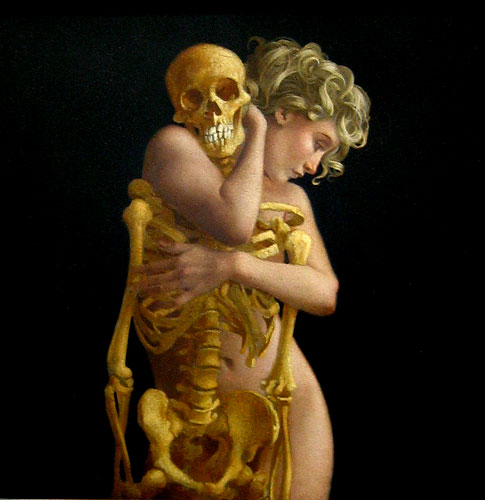
The erotic bond between sex and death is deeply-rooted in the human psyche and has been played out in the allegory Death and the Maiden since the beginning of time. The story always follows the same theme: a pretty young girl is seduced by death.
The erotic bond between sex and death is deeply-rooted in the human psyche and has been played out in the allegory Death and the Maiden since the beginning of time. The story always follows the same theme: a pretty young girl is seduced by death. The girl represents purity and fertility. Death is depicted as a horny old man with his last carnal desires.
The first known version of Death and the Maiden appears in The Myth of Hades and Persephone. Persephone, the daughter of Zeus, performs a dance while gathering flowers in a lush garden. She reveals her white breasts as she bends to pick a narcissus. At that moment, the ground opens beneath her feet and she falls into the arms of Hades, who carries her down to the underworld.
Before the Christian era, man and his morals were less tightly bound. Gory death in gladiatorial combat and, for the rich, wine-soaked orgies were the staff of life. Campfire stories of virgins and crucifixions travelled the silk routes from India and Mesopotamia. When the gospel writers came to tell parables of Jesus, Mary and the Holy Ghost, they would have drawn on classical legends to create an account that was both fresh and familiar, the formula designed to woo the pagans into the new church.
During the Middle Ages, the maiden transforms into a virgin and the union between sex and death grows stronger. The iconography changes from the girl dancing with death to the girl having sex with death, the images ever more erotic, the basic premise the same: that young girls should be plucked when ripe like an apple from a tree. The earliest painting of Death and the Maiden is a 1517 work by Niklaus Manuel Deutsch. It shows death as a rotting corpse, its hand brushing the maiden’s sex. As death presses against the girl, she does not resist, but yields to its kiss.
When Schubert in 1824 wrote his String Quartet No.14, I am not sure if he was reminiscing over all the young women he had bedded, or would like to have bedded, but the work became known as Death and the Maiden and has become one of the most popular pieces of music of all time. The Chilean playwright Ariel Dorfman used Schubert’s composition for his production of Death and the Maiden in 1990, the play turned into a movie by Roman Polanski.
The story is set during a violent dictatorship. Political prisoner Paulina Salas is raped by a sadistic doctor whose face she never sees. Years pass and the regime falls. Paulina now lives in a country house with her husband, who returns home one night with a stranger named Dr Miranda. Paulina recognizes the voice of her warder. She takes him prisoner, reversing their roles, and makes audiences feel uncomfortable as they witness her own sexual desires stirred by this messenger of death.
Gabriel García Márquez in his last novel, Memories of My Melancholy Whores, 2005, relates the tale of a man who decides to pay for a final night of love with a virgin on his ninetieth birthday – a new slant in the new world, but still we can picture the white breasts of Persephone as Hades reaches out from the underworld.
Death and the Maiden reminds us in each revival that the sand is racing through the hourglass, youth is fleeting, and death comes for us all. Eat, drink and make love now, this instant, before it is too late. Not bad advice, but the retelling of the story has always been taken up by men who pay scant regard to beauty as a product of character, or love as a mysterious fusion. Their pens are stiffened by visions of the virgin falling for their own mirror image, a foul-smelling old bloke sliding towards the grave.
New times warrant a twist on the theme, Death and the Maiden as Death and the Adonis, perhaps, the slim young deity (played by Justine Bieber?) falling for the Gorgon Medusa with her fearful features and snakes for hair. Now, who shall we cast in that role?
Visit me at chloethurlow.com
Chloe Thurlow is an exciting writer and blogger with many erotic books to her credit. They are all available at amazon.com in print or e-book.
THE SNOW FIELD


The Snow Field
by Mark Scheel ©2007
A man said to the universe:
“Sir, I exist!”
“However,” replied the universe,
“The fact has not created in me
A sense of obligation.”
— Stephen Crane
First one jungle boot, then the other. Slowly, in the blackness. Deliberately. His hands tap the rubber heel against the landing mat, then invert the canvas top. Empty. Both empty, of slitherings and crawlings. From beneath the poncho, turning, he inserts one naked foot, then the other, into the cool, damp leather. Stands. The olive-drab boxer shorts loose about his taut bladder. Then steps. Steps against the wet, resisting tropical air. Out from the dark, sandbagged metal walls into faint morning pinkness. Step. Step. The only sound a distant clanking of an armored tread along the berm. Then a sudden whine. And the white flash. And the ringing in his ears. All at once his shoulder is cold. And again the ringing. The icy cold spreading down his back. And the ringing! And he knows now he’s been hit.
He bolted upright out of the dream. Soft light from the window suffused the bedroom walls, early morning sun reflecting off snow. The comforter had slid partially off the bed and he felt cold. His shoulder ached. Then once again the ringing blasted in his ears—the phone on the letter desk in the adjacent room.
He pushed the sheet back and swung his feet onto the chilly hard-wood. The alarm clock showed 6:45. Rising, he sensed immediately the pressure to urinate. Goosebumps formed on his arms as he walked across the throw rug and out into the dining room. With an urgent persistence the phone rang once more before he could lift the receiver.
“Yeah,” he mumbled, still clearing the fog of sleep from his head.
“Did I wake ya?” his father’s voice asked through the earpiece. There was a worried edge in the old man’s tone.
“That’s okay,” he replied, after a pause.
“Well . . . I got some trouble out here.”
“Trouble? What’s wrong?”
“You know that spotted heifer? Started calving last night. I checked’er this morning and something’s hung up. The calf’s not coming.”
“No?”
“There’s a foot showing. That’s all. An’ I called awhile ago and Doc Grimsley’s outta town.”
“Who? Oh, the vet.”
“And I was wondering . . . when do you teach that class up to the college?”
“What time? Three-thirty.”
“Maybe you oughta come out. I think we’re gonna have to pull that calf.”
“Yeah . . . sounds like it.” He paused, trying to focus everything in his mind. Trying to assess the situation. Then, “How much snow did we get last night?” he asked.
“Well, now. There’s another problem. It ain’t the snow, it’s the ice. It started with freezing rain and we got power lines going down. The electric’s been off here for an hour.”
“Yeah? Well. Okay. Give me a few minutes to eat and shave. I’ll be there.”
“Take it easy on the roads. Don’t know what you’ll run into.”
“Right.”
He replaced the receiver in the cradle and paced back through the bedroom straight into the bathroom. Standing in front of the toilet bowl, he could feel a cold draft drifting up against his naked calves. He washed his hands and threw some water on his face, then stepped back into the bedroom. The dull ache in his shoulder was growing stronger, and he reached up and rubbed the puckered shrapnel scars. Damn, he hated cold air!
* * *
Stepping down off the back porch, his overshoes crunching the icy crust, he was surprised but undeterred by the world that met him. The chill, bright, white silence. The layer of snow like granulated salt topping the ice-glazed landscape. Spirea bushes bowing to the ground. Limbs drooping leadenly from all the trees, some broken and dangling, some lying below. The rays of sunlight keen off the crystals like a laser.
He took a few steps toward the garage. The cold air stung his nostrils. The snow was no more than an inch deep, but the walk beneath was solid ice. Luckily he’d pulled the car in last night.
The old Chevy Bel Air started with no trouble, and he cautiously backed it out into the alley and pulled ahead toward the street, the rear wheels spinning at the slightest overacceleration. As he swung onto Twelfth Street, the car spun out and slid across the lanes, the tires nudging the opposite curb. He muttered to himself, righted the vehicle and edged on ahead. All along the way, the scene was the same—limbs lying broken, overhead lines drooping precariously. At least, he mused, the traffic was sparse.
When he reached the highway heading north, he was relieved to see that it had been plowed. But the glassy ice patches on the blacktop still looked treacherous. He held his speed down to 20 miles per hour. When he came to the steel bridge across the river, he slowed a little and nearly coasted across. It looked as though it had been dipped in clear, shining syrup and dried hard.
He remembered driving this highway every day last summer when the heat had baked the foliage brown and dust-coated the weeds in the ditches. Driving on the way to the nursing home where, standing in the small room by the air conditioner, the cold air freezing the metal in his shoulder, he would look into his mother’s face, hoping to see some remnant there of recognition. Some momentary retrieval of the linkage to “son.” But the quiet process of the malignancy had kept doing its work, honey-combing her memory, appropriating every last familial connection. Until, near the end, in one last mocking gesture, it would leave her a babbling infant, holding out her arms to the white-uniformed aide and crying, “Mama!”
He looked in the rear-view mirror and saw a red pickup truck coming up rapidly. It caught up to him as he reached the first of the rolling hills, then began to tailgate him impatiently.
He slowed further as he approached the next crossroad and signaled right, edging over to allow the truck to pass. It sped by with a roar, fishtailing as it steered back into the right lane, and vanished over the next hill. On these roads he wouldn’t chance that speed on a bet—and in a pickup yet! As he passed the crossroad, he looked both ways and saw the telephone line running beside it had snapped. The snow on the roadway was still unbroken.
He held his speed steady and topped the next rise and there down below was the red pickup, slid rear end first down into the steep ditch. The driver’s door was open and a man in a jean jacket and Levi’s was climbing out. It didn’t appear anyone was hurt. He contemplated the mishap as he drew even with the truck. A heifer in distress, he told himself, should take priority over a damn fool any day. He continued on up the next rise.
* * *
Turning into the barnyard, he spotted his father standing by the corner of the cow shed. He pulled the car up beside the corral, shut off the engine and got out. The black and white heifer stood in the middle of the lot, equidistant from the shed and the perimeter fence, watching the two men suspiciously. Clouds of condensation rose from her nostrils; a single small hoof protruded from beneath her tail.
“Looks like nothing’s changed,” he commented to his father as he walked in and shut the gate.
“We’re gonna have to try an’ rope her, then see what we can do.”
His father lifted the lariat off the fence post and opened out the noose. They began ambling toward the heifer, the frozen crust on the mud cracking and breaking with every step. The heifer tossed her head back and bolted for the opposite fence.
The two men followed, spreading apart, moving methodically. Trying as best they could not to spook her further. The old man held the rope, loop at the ready. “Here bossy. Here bossy,” he coaxed gently. The heifer started and ran down the fence line past them, back toward the shed. They hurried across the snow after her, angling for the far corner.
She ran into the corner by the gate, then spun around to face them. Eyes wide with panic. They caught up and stopped a few yards away. The heifer lowered her head.
“Move up on her slow,” the old man said. “I’ll try to rope’er when she comes out.”
“I think she’s gonna charge.”
“Naw. Move up slow.”
He began moving ahead in a semi-crouch, arms out. The heifer charged. He turned sideways to avoid the blow. Her shoulder caught his chest as she passed. His feet slipped out from under him, and he went down hard in the snow. Lifting himself on one elbow, he saw that his father had dropped the loop over her head, but the force of her motion had jerked the rope from his hands. Now the heifer was running away toward the other end of the corral trailing the lariat in the snow.
He got to his feet. His father was starting to chase after the rope. “Dad! Wait a minute,” he shouted. “The last damn thing you need is a busted hip or a heart attack. Let me.”
The heifer spun around when she reached the far corner, then darted down the fence line past the water tank. As his father tried to follow behind her, he struck out running at an angle he hoped might head her off into the shed.
She followed the fence line out from the corner and broke across in front of the shed. Then turned, just beyond the middle support pole, and retraced her path. He plunged forward and grabbed the trailing rope and got it half-wrapped around the pole before it jerked tight. He dug in his heels against the pull and held it until his father drove her back. She ran into the shed, and he quickly took up the slack and wound it onto the pole. When she ran out on the other side of the support, they had her fast.
More pulling and shoving and maneuvering got her head near the pole, and they tied her there securely. His father brought a second lariat from inside the shed, and, standing one on each side, they began lacing it around the heifer’s midsection and back to her hips. That done, together they pulled on the end, drawing it tighter and tighter against her flanks until the paralyzing squeeze collapsed her legs. And she went down on her side.
“Now, let’s see what we got,” his father said, moving around and squatting by her rear. “Well, judging from the foot, at least it ain’t breech.”
They tied the loose end of the second rope to the small foot, hunkered down in the snow with their feet against the heifer’s rump and began to pull. A sharp pain stabbed down his arm and he caught his breath.
“That shoulder?” his father asked.
“It’s okay.”
After several minutes of effort had yielded few results, his father stood up and dropped the rope. “What we need is a come-along,” he said. “Maybe that old wire-stretcher with the pulleys will work. Get that and the tractor an’ bring’em over.”
He walked over to the shop, fit the drawbar on the tractor, hung the wire-stretcher on the lift lever, and drove the tractor over to the corral. He backed it up behind the heifer, and they rigged the wire-stretcher to the drawbar and the calf. Then his father began to crank the tension. Gradually the calf’s leg extended further. Then a second foot appeared.
“Now we’re gettin’ somewhere,” his father declared.
They transferred the wire-stretcher to the other foot and pulled that leg out. A nose appeared. Next they tied the wire-stretcher to both legs and applied more tension. The heifer had relaxed and was intermittently straining on her own. “If we can just get the head out, we’re halfway home,” his father said. They cranked once more and suddenly the line on the pulleys snapped and the wire-stretcher collapsed in the snow.
“Damn that rotted line,” he said. “And we were getting close.”
“Yeah,” his father replied. “But you smell that stench? That calf’s dead. And been that way awhile.”
“Probably swelling up. Maybe that’s the problem.”
“Well, we’re down to savin’ the heifer now. Gotta make room for that head.”
“How we gonna do that?”
“I saw a vet do this once. I’m gonna try cuttin’ one leg off the calf to give clearance.”
His father took out his pocketknife and opened up a blade. Then he knelt down and worked his fingers into the birth canal, feeling for the shoulder. And with his other hand he inserted the blade and began slicing.
Squatting beside his father, the odor of death in his nose, he studied the old man’s motions. “Don’t cut her,” he cautioned. “And watch your fingers.”
After a few minutes, the leg pulled away, and he took it from his father and placed it to the side.
“Now,” his father said. “I think she’s dilated good enough. We’re gonna have to try an’ use the tractor. You start it up. Go real easy on the clutch. I’ll work down here. We don’t want to tear her rear end out.”
They looped the rope over the drawbar and tied the end to the foot. Then he started the tractor, shifted into low gear and gently eased ahead. The rope went taut. The heifer moaned. “Easy on that clutch!” his father warned. She slid a little in the snow, and his father checked the rope around her neck. “Easy,” his father called out. He edged further ahead. Suddenly the calf’s head emerged, and the shoulders followed and the body, wet and mucus-slippery, slid smoothly from the canal out onto the snow. And there the small, black, lifeless form lay steaming against the white earth.
He shut off the tractor and got down and walked back to where his father stood. “Well, we saved the heifer at least,” he said.
His father took out his red bandanna and wiped his hands. Then he stepped around and loosened the rope from the pole. All at once the heifer shuddered and strained again and began to expel a watery, bloody, fleshy, membranous mass. As they watched, it kept coming, spewing out, almost as large as the calf had been.
“Oh, no!” his father exclaimed.
“What the . . . ? That’s more than afterbirth!”
“The stress was too much. She’s expelled her uterus!”
“Her uterus! Son-of-a-bitch! Now what?”
“We’ll have to put her down.”
“We can’t shove it back in?”
“Naw. She’d get infected. There’s nothin’ more to do.”
He looked at his father and then down at the pool of flesh and at the heifer gasping for air. So, she must have known all along, before they had, what the outcome would be. That she carried the seed of death wrapped in her belly, and no matter how fast and far she ran, there’d be no escape. Still, she fought it to the end.
His father walked to the shop and got the sledge hammer and walked back. He stood, feet apart, by the heifer’s head. “Sorry, bossy,” he said, “we done what we could.” And he raised the sledge hammer high in the air and brought it down hard between her eyes. She jerked and trembled and her tongue flopped out the side of her mouth. A tricklet of blood traced down the white hair of her nose and dropped onto the snow. And she lay still.
* * *
“The dead wagon ain’t gonna come out in this weather,” his father said. “An’ we sure can’t bury her. Guess we might as well drag’er up on the pasture hill and leave’er to the coyotes.”
“That’s the best we can do,” he agreed.
They unwound the ropes and wrapped a log chain around her hind legs and fastened that to the clevis on the drawbar. His father spread a burlap sack across the tractor hood, and they heaved the stillborn calf up onto that and headed out.
Standing on the drawbar behind his father, holding onto the fender, he looked back at the thin trail of blood in the snow. They drove past the feedlot, where the other cows peered out curiously, down the slope and over the creek crossing and back up by the edge of the ice-coated woods. Birthing a calf, he thought to himself, should be a simple thing. Like a new moon or the opening of a flower. But there were times when in a godless universe nature got crosswise with itself. When the intentions of the process all became tangled, and the only way for it to right itself again, to get going straight, was for something to die.
He’d known that was so since that morning years before when he’d parted the vines with the barrel of his M-16 and discovered the dead Viet Cong. Ants were crawling all over the tattered black cloth; the exposed bone was bleached white as polished rice. The back of his head had been blown away, the empty eye sockets staring skyward. And a sprig of green vegetation had taken root, sprouting up out of the gaping mouth toward the sun. Growing as if from a planter.
Nature didn’t entertain pleas. Nature didn’t bargain or compromise. Nature simply took what it needed for the process and moved on. For a long time, he’d known that was so. Yet he still felt a stab of resentment deep in his gut each time he saw it happen again.
When they’d abandoned the carcasses at the crown of the hill and started back down, his father turned half-around and called over his shoulder: “Ya know, it may be awhile before we get the electric back. Maybe you could help me move the old stove in from the woodshed. I can cook off of that if I have to.”
“Yeah. No problem.”
It wasn’t quite noon yet. He had only four student papers left to grade before class. There was still time.
The sun was intense and directly overhead now. They parked the tractor in the shop and walked up the lane toward the house. The ice on the trees had begun to melt and break loose. Crystalline shards were falling beneath the trees like hail, and the snow in the lane was beginning to turn to slush.
THE SNOW FIELD was initially published in a different version in Swill magazine.
Mark Scheel was born and raised on a farm in rural, east-central Kansas. After graduating from the University of Kansas in 1967, and spending a period "on the road," he served overseas with the American National Red Cross in Vietnam, Thailand, Germany and England. He later took graduate studies and taught at Emporia State University. More recently he was an information specialist with the Johnson County Library in Shawnee Mission, Kansas. He now writes full time and has served as a volunteer on the editorial staff of Kansas City Voices magazine. His stories, articles and poems have appeared in numerous magazines such as Kansas Quarterly, The Midwest Quarterly, Cincinnati Poetry Review and The Kansas City Star, and he is coauthor of the book OF YOUTH AND THE RIVER: THE MISSISSIPPI ADVENTURE OF RAYMOND KURTZ, SR. His most recent book, A BACKWARD VIEW: STORIES AND POEMS, won the J. Donald Coffin Memorial Book Award from the Kansas Authors Club. He is presently a member of the Kansas Authors Club, National Writers Union and The Writers Place as well as a charter member and officer in 5th Street Irregulars writers group and a former member of the Board of Directors of Whispering Prairie Press, 2005-2006 as well as Library Liaison and member Board of Directors of Potpourri Publications Co., 1991-1995. His bio appears in the Directory of American Poets & Fiction Writers; International Authors and Writers Who’s Who; Two Thousand Notable American Men; Who’s Who in America; Who’s Who in the World and Who’s Who in U.S. Writers, Editors & Poets. He has conducted numerous readings, media appearances and book signings, 1988-present. Selections from his writings appear on gather.com, speakwithoutinterruption.com and skyways.lib.ks.us as well as other Internet sites.
Web page: http://www.writers.net/writers/7032 - See more at: https://scriggler.com/Profile/mark_scheel#sthash.3WD3W1aN.dpuf
WHAT IS IN THE MIND OF GOD?

by Kenneth Harper Finton ©2014
People often say, when they do not know the answer, “Who knows what is in the mind of God?”
People say that “God knows all.”
Take the common conception of God as a divine being that creates and governs the universe. Then take all the people here on Earth – what they all are thinking, what they all have been, and what they all will be.
Imagine that God knows all that.
Then add all the other conscious forms of life on Earth, the history of the planet and solar system.
Imagine that God knows that as well.
Then realize that the Earth is a small speck of dust in a commonplace galaxy. Remember that there are trillions of stars and billions of galaxies and uncounted billions of planets.
Try to imagine a mind that knows all this.
What would it be like? One thing is certain. It would not be like the human mind. It would be more like consciousness itself.
But would God even have a Self? Is God self-aware?
What need would God have for self awareness?
Humans have self-awareness. Some animals have been shown to have self-awareness. Self-awareness is a curse and a blessing.
It creates loneliness. It creates unhappiness.
If God were self-aware, God would be lonely.
Does God get lonely?
The self only exists when there is another that exists outside. It can only be aware of the self by knowing that there is another outside that is not the self.
If God is everything then what would exist outside God for God to be self-aware?
If God isn’t everything then what is this thing outside that is not God?
What is a mind? What are the makings of a mind? Neural synapses? Connections? Electrical impulses? Fields of energy?
Some would call it a brain, but what use would a brain be for God?
A brain is far too small to hold everything unless it is an infinitely large brain. If God is everything, then God is a brain.
Perhaps we have used the wrong image. Perhaps we should use membrane instead of brain.
Could God be the membrane that binds the electrical impulses––fused, united, linked, and bound together to create thought?
And then the thought creates action?
What is this membrane made of? Electrical fields, atomic and subatomic particles?Quarks and electrons that only have a place in time and space when they are observed?
Are they only mere observations?
If so, then the observation is everything. Observation is what causes the universe to come into being. Observations are the history, the present and the future of all.
Who says that this which observes must be self-aware?
The observer does not need to be consciously self-aware. The world existed before self-awareness. The observer has no need to be self-aware.
So, as far as we can tell––and surely we know little––the universe has only had conscious self-awareness for a minute fraction of an eternal epoch. The universe has gotten along quite well for billions of years without self-awareness.
So do we live in a fraction of an eon when the mud stands up and sees that there are others outside themselves?
And does that matter at all to the mind of God that has no self and no need for a self?
The 10 Biggest Mistakes New Authors Make

Cindy Bates is a freelance writer and blogger. She has kindly shared with me this guest post, on some mistakes made by new new authors. Aaand… take it Cindy! 🙂
The 10 Biggest Mistakes New Authors Make
 Have you brushed your teeth? Washed your hands? Proofread your book?
New authors are going to make newbie mistakes–it is only natural. But, a lot of them can be avoided by simply reading articles like this one. Most of the mistakes an author makes are ones that he or she can live without. Sure, they are learning experiences, but you can learn them from articles and save yourself a lot of struggling.
1 – Writing to be a success or to earn big money
You think you can take up writing in order to become successful or to earn big money? To quote the fates, “Ha…Ha…Ha…” Fame and success happen by accident. Sure…
View original post 768 more words
SHE COULDN’T WAIT
by Karen Mc Entegart ©2014

She couldn’t wait
to go to bed,
Excited thoughts
filled up her head.
“Oh god,” she moaned.
She’d waited days.
For this great moment,
she’d long prayed.
She placed herself
beneath the sheets,
She felt too high
to get some sleep.
Fresh from the shower,
her body shone.
She lay in wait
for what’s to come.
Nothing on Earth
could this replace
Her breath came quick,
her heartbeat raced.
Alone at last,
her body shook –
As she turned the page
of her brand new book …
Karen lives in the Canary Islands. You may see more of her work at:


The Malevolence of Everyday Things

The Malevolence of Everyday Things
by J Hardy Carroll ©2014
It starts when you drop your keys square on your foot
kick out and send them rattle-clang smack
down the staircase
your arms full of groceries, you lose it
as the bottom of the sack
packed by that lazy pit-faced troglodyte
at the Shop-n-Sav gives way
when the freezer spinach plastic
slick with condensation soaks the corners soggy
lurches from your arms, heavy black bean cans
he stupidly set atop the bags of frozen stuff
tumble and roll goddamn it and you
went to all the trouble to sort that shit
on the conveyor belt to save time
and every fucking red light in the world
and the AC doesn’t get cold until
you pull up in front of your building and fucking great
the goddamned fucking box of spaghetti
you almost didn’t buy since gluten
goddamn spills out fuck fuck fuck
joins the cans and the keys on a nice trip downstairs
God must fucking hate you fuck fuck fuck
the eggs, of course
are fine. Some kind of lesson, God.
Thanks for that. The flour. on the other hand
drifts in powdered mockery, whiteface
bags of chips, blood, shit, drop your guts like a slit hog right
there in the fucking stairwell
sending you a goddamned message
burn down this joke of a life, it says
one thing and another
all roads lead to Rome
because the God damned Romans built the roads
Follow the keys and the cans and goddamn
APOSTLES OF GLORY

by Kenneth Harper Finton ©2014
Across the street in the cool of dusk it came, absorbed in the dirty air with the fumes from the refinery, the exhaust vapors and the laundry lint. A song in the twilight, a gentle ballad of people forgotten except in song – sung with the grace and feeling of a girl who has known life and the odious emotions of men.
Harry Johnson sat at the table sipping his coffee as the song slipped through the open window to his ears. He called to his wife with the voice of a bear, but entwined with the song it was the voice of a lamb. He didn’t notice the coffee stained table and the barren floor, the curtainless window and the peeling paint. He listened to the song, each painful note slapping his ears, the melancholy words playing on his upper lip.
His wife Marge was a big-hipped woman and the floorboards creaked as she entered the kitchen. “What now?” she asked.
Harry Johnson looked at his wife – her hair, once wind-swept lovely – was done up in a twisted knot, her face, once painted up with care, ashy and melted.
“That song.” he said. “Where does that song come from?” he asked, pointing to the window.
“How should I know? Am I supposed to he a mind reader or something?”
“It sounds like it comes from across the street,” Harry said.
“Might be. I heard we were getting new neighbors. It’s about time, too. It hasn’t been rented since the Talberts moved out.”
“Listen to the song,” he said. She listened with a wrinkle in her brow as the song blew in the window window with the sounds of passing cars, listened until it stopped and the sounds of the street were the only sounds.
“She’s got a good voice,” Harry said.
“She must be young,” his wife said. “No more than fifteen, l’d say.”
“It sure carries,” Harry said. “All the way over here from across to street and it sounded like she might have been sitting here at our own table.”
“You could have bought that house, you know,” Marge said. “How would you like to be raised up in this place like Carolyn? How would you like it if you didn’t have a yard or trees or a house where you could stretch out and live? You could have given us something decent to live in for once. You could have bought that house, Harry.”
Harry’s face reflected thoughts and longings that ran deeper than his mind. “I know,” he said in a husky voice.
The cool of the evening was streaming in the window. “It’s probably the night that makes her voice carry,” Marge said, sensing Harry’s feelings. “Voices carry along towards night.”
“That must be it,” Harry said.
But now the song is gone and Harry notices the coffee-stained table and the drabness of the room. He was glad that it was Friday.
“Tonight’s bowling night,” he said. “Where’s my ball?”
“In the closet.”
Harry knew that the ball was in the closet. He always know where it was, yet every Friday evening be would ask, “Where’s my ball, for that was the way he asked if he could go bowling; and every Friday evening Marge would say, “In the closet,” for that was the way she would tell him he could go.
He went to the closet and picked up the brown canvas bag that felt heavy and worn in his big hands. He slipped on his jacket, for the night air would be cool. After he was gone he looked back at his apartment from the shadowed street, then looked over at the house across the street – the house he should have bought. It felt good to be away from the apartment.
Harry Johnson saw his three friends waiting for him at the intersection. There was no use catching a bus for is was only seven blocks to the bowling lanes and it certainly was a fine night.
He was glad to get away, glad to leave the apartment. He had always felt like a prisoner there with the dingy rooms and the burdensome voices and the evening when there was no peace. He would have bought the house across the street, but the neighborhood was becoming shabby and Harry was afraid he would lose if he invested.
“Hello, Harry.”
“We’ve been waiting.”
“Hello, Art, Dick. Joe.”
They walked down the street toward the lanes. Art Richard was a tall man, half a cracker thin. He held his hands against his sharp and jutting chin. “Hear the news?” he asked.
“What news?”
“About the new neighbors.”
“Across the street?” Harry asked.
“Oh, you know then.”
“Know what?”
“They’re niggers.”
Harry looked hard at the tall man with the sharp chin and a mouth that spoke lies. “That’s nothin’ to joke about,” he said.
Their strides quickened as though they wanted to leave a place where dirt and scum flowed into the gutter. “Moved in today,” Dick Marcus said. “A whole family of them.The nigger’s got a wife and two kids.”
“It can’t be,” Harry said.
“The whole neighborhood will go next.” Art Richards said, “I saw it happen over on 42nd Street. One nigger moved in and the rest started to come. It won’t be safe to step outside if we let them stay.”
“That’s a fact,” Dick Marcus said.
“We can’t let them get away with it. We gotta drive them out.”
“The way I look at it, we don’t have any choice,” Dick Marcus said. “We have our families to protect. Don’t you think so, Harry?”
Harry was thinking of a little Negro girl with a dark face, a song floating from clipped white teeth into the dark of night. “Sure,” he said. “Sure. It’s the only way.”
None of the men bowled well that night. There were plans to make and wrongs to right. As the balls spun down the alleys and the pins clattered and the beer foamed in their throats, they talked.
After the match they stopped at the bar. Their voices stilled and they were silent. The bartender’s bald head glistened with as he asked them what was wrong. Still, they were silent.
Then they walked down the street. The night air was getting cooler. Art Richards pulled the zipper on his jacket clear up to his pointed chin, but the chill stayed in his spine. The city was enveloped with a hush that could only be surpassed by the silence that hung over a little town called Bethlehem, so far away and so many centuries ago. With the silence came a fear that that sliced the night.
Harry Johnson felt the fear, felt it crawling is his spine, felt it twisting is his stomach, felt its macerations in his knees.
“Isn’t anyone going to do it?” he yelled. “Here, should I throw the first stone?”
He picked up a stone from the deep, silt-filled gutter and hurled it with all his might. The crash of breaking glass slapped his ears. He dropped his arms and his mouth hung open wide. Suddenly, everyone was throwing rocks and stones end shouting curses, yet the house stayed dark and quiet. The air was heavy with an oppressive blackness.
After it as all over, Harry Johnson stood at his kitchen window in his underwear looking out across the street at to house that he should have bought. He saw the yawning blackness and the broken panes, noticed that there was one window still unbroken, one window reflecting the twisting flames of the burning cross.
-2-
Tomorrow morning came as tomorrow mornings have a habit of doing. The untried light from the liquid sun found four men standing at a bus stop, waiting. Thee refinery was to run overtime today. The four men men were happy to make some extra money for themselves and their families.
Art Richards whispered – for he didn’t want the world to hear, “We sure got them last night, didn’t we?”
No one said a word.
“They had it comin’. Just wait ’til tonight if they’re still there.”
“I don’t know if I want to do it again,”Joe Gantner said.
“For Chrissake,” Harry said. “You don’t want your kids to grow up with a nigger for a neighbor, do you?”
The words came out of Harry’s mouth, but he did not know why.
“No, but still…”
“Still hell,” Art Richards said. “We’ve got to get rid of them, that’s all.”
The bus came out of the morning and the four men went to work.
That evening after the factories closed and the men poured out like ants from their threatened castle. Harry Johnson sat over his supper of meat and potatoes, but he only picked at his food.
“Did you hear what happened to our new neighbors, Daddy?” Carolyn Johnson asked.
“Yes, I heard.”
“It serves them right,” Carolyn said. “Imagine the gall of them moving into an all white neighborhood. They have a daughter my age, too. How creepy!”
“That’s enough,” Harry snapped. “I don’t want to hear any more about it.”
He looked up at his wife’s face and saw the smirk on her lips. She knew.
After the last cup of coffee had been downed, after the dishes had been cleaned away to the sink and Harry Johnson was left alone with the falling sun, the song began. It was the same song, but ever so more haunting than before, scratching on the window, begging to penetrate the walls and bound into the heart.
He got up from the table and went to the window. Nothing seemed important except the song, for the song was life and life was important. But after the song ended, Harry felt the emptiness that he had felt before, for the song had lifted him to places he had never been before.
He went into the bedroom and took off his dirty work clothes and threw them on the bed on top of the sheets that looked like dirty handkerchiefs. He tried not to think.
“Going out?” his wife asked, as he walked toward the door.
Harry shook his head.
“Do you want your bowling hall?”
“No, I don’t want my bowling ball.
He opened the door, but behind him were words: “Harry?” He turned around. “Harry, be careful.” The look in her eye said ‘be careful’ and the sound of his heels on the steps rang out in his mind like a solemn chorus whispering the words ‘be careful’.
Dick Marcus was already at the bar. They sat at a little table in a darkened corner and nobody saw them. In an hour there were six of them. They were Art’s friends. Harry didn’t care to know them.
He sat fingering his drink, but finally drank it. It felt good and warm in a hollow stomach. He had another and another, then another until he was dizzy and weak and nothing mattered anymore – not the blacks across the street, not the apartment, not his wife or daughter of the house across the street.
Nothing.
It was nearly midnight when they walked back, the six of them. They thought they were an army. Six thousand strong they might have been and they could not have felt stronger of more fearless. They walked down the street on this Saturday night with Sunday morning a haze in a crystal ball. They walked under the stars that were blinking in the sky, under the moon that was an ocean moon like the ones that Harry had known and loved on a battleship is the South Pacific so may centuries ago.
Then they were is front of the house with the shattered glass. “Hey, you in there. Hey, niggers,” Art yelled, the liquor warm in his stomach. “Hey, you goddamned black-eyed son-of-a-bitch. We’re gonna get you. We’ll come back ’til you’re gone! You hear that niggers. Until you’re gone. Every goddamn night ’til you’re gone. We’re gonna get you, niggers.”
“Get their car,” yelled one of Art’s friends. “Get these black sons-a-bitches.”
The little army ran to the old, shabby car. One of Art’s friends drew a hammer and the glass was smashed. The tires were cut end the six were able to turn it on its side so that it lay dead with its tires spinning.
Somone had phoned the police and they heard the sirens cutting into their backs as the big black man and his daughter came running from the house.
“Get away,” the man yelled. “Get away from my car. Get away from my house.”
“You black-eyed son-of-a-bitch,” yelled one of Art’s friends. “You black scum of the street, we’ll show you.” Four of them grabbed the big man and left him bleeding on the walk.
“Get away from Poppa,” yelled the girl, pulling on Art. “Get away!”
A fist to the face sent her reeling on the walk, her night dress was up to her waist.
“Get her.” screamed the night. “Take her away,” but no one could tell who was doing the yelling. Harry saw two of them pick up to girl and run down the street under the street light and into to dark. “Run, you fools. Can’t you hear the cops?”
They ran into to alley and up to block. The sirens stopped, but the red lights flashed and shone orange upon to house across the street.
3
Harry awoke to to rattling of coffee in the percolator and to pungent odor of frying bacon. He could hear the floorboards creak as his wife walked over to to bed. “Harry?”
“Yeah, I’m awake.”
“Get up. You’ll be late for church.”
“Huh?”
“Get up. It’s Sunday morning.”
He opened his ayes and looked into the face of his wife, the ashen face with wrinkles he had never seen before.
“I don’t want to go to church,” Harry said and closed his eyes. He could feel her staring at him and he opened them again.
“The girl, Harry. What about the girl?” There were tears in his wife’s eyes.
“What about her?”
“What did they do to her?”
“Oh, hell, I don’t know. There were these two friends of Art’s. 1 don’t know.”
“They raped her, didn’t they, Harry?” she said. Her voice was coarse and cracked.
“I don’t know.”
“I’ll bet they didn’t stop there, Harry.”
“I don’t know.” He saw the tears stream down her cheeks and reached up to brush then away with the back of his hand. “Do you really think I ought to go?”
“Where?”
“To church.”
“Sure,” she said. “Oh God, yes. Oh, Harry…”
Harry stood at the window and looked down upon the street before he put on his woolen suit and the snap-on bow tie. He saw the broken glass and the blood on the walk, the peeling paint and the broken shrubs.
He thought of a song, a song in the dusk and the voice of a maiden ringing out like a bell in the twilight – a voice that made him forget. He looked around the room that was more dismal than it. had ever been before and he knew that he would never forget again.
Not ever.
 HELIOS