MARK STRAND, POET LAUREATE

mstrand

Poet Mark Strand (books by this author) was born in Summerside, Prince Edward Island, Canada (1934), though he spent much of his adolescence in South and Central America. His father worked for Pepsi-Cola and moved the family from Cuba to Peru to Mexico. Strand once said, “I never found my own place. I really come from nowhere.” For a long time, he spoke English with a heavy French accent.

Strand’s parents wanted him to be a doctor or a lawyer, but he wanted to be a painter, so he enrolled in the Yale School of Art. He’d been painting since he was 13, when he did a self-portrait after copying figures from a book on Donatello, the Italian Renaissance sculptor.  Strand was a good student at Yale, though poor, and he worked as a waiter and delivered laundry to pay his way. He also started to read poetry, mostly Wallace Stevens, which led him to enroll in English courses, and his professors encouraged his writing, and he decided to become a poet. After Yale, Strand went to Italy and studied 19th-century Italian poetry. “I was never much good with language as a child,” he said. “Believe me, the idea that I would someday become a poet would have come as a complete shock to everyone in my family.” He wrote steadily during the 1960s, enjoying the wild atmosphere that came with being an artist. Some people complained his poems were too intense and dark, but he dismissed his critics, saying, “I find them evenly lit.”

Strand’s books include Sleeping With One Eye Open (1964), The Continuous Life (1990), and Almost Invisible (2012). He won the Pulitzer Prize for his collection Blizzard of One: Poems (1998) and even served as poet laureate for the United States, though he was uncomfortable with the post. He said, “It’s too close to the government. It’s too official.”

He served as poet laureate of the United States from 1990 to 1991 and as a Chancellor of the Academy of American Poets from 1995 to 2000. He taught English and comparative literature at Columbia University in New York City. He died at eighty years old on November 29, 2014, in Brooklyn, New York.

Mark Strand died in 2014. In his last years, he stopped writing poetry and returned to art, mostly making collages by hand.


Harmony in the Boudoir
by Mark Strand
After years of marriage, he stands at the foot of the bed and
tells his wife that she will never know him, that for everything
he says there is more that he does not say, that behind each
word he utters there is another word, and hundreds more be-
hind that one. All those unsaid words, he says, contain his true
self, which has been betrayed by the superficial self before her.
“So you see,” he says, kicking off his slippers, “I am more than
what I have led you to believe I am.” “Oh, you silly man,” says
his wife, “of course you are. I find that just thinking of you
having so many selves receding into nothingness is very excit-
ing. That you barely exist as you are couldn’t please me more.”
“Harmony in the Boudoir” by Mark Strand from Almost Invisible. © Alfred A. Knopf, 2012. .

SOURCES: WIKIPEDIA/MPR

Minnesota Public Radio. 480 Cedar Street, Saint Paul, MN 55101

BILLY COLLINS INTERVIEW

Interview by Joy Biles for The Writer’s Almanac

Billy Collins

Billy Collins - photo by Bill HayesBilly Collins is the author of twelve collections of poetry, including his most recent Aimless Love (2013) and The Rain in Portugal (2016). He is also the editor of Poetry 180: A Turning Back to Poetry180 More: Extraordinary Poems for Every Day, and Bright Wings: An Illustrated Anthology of Poems About Birds. A Distinguished Professor of English at Lehman College of the City University of New York, and Senior Distinguished Fellow at the Winter Park Institute of Rollins College, he was Poet Laureate of the United States from 2001 to 2003 and New York State Poet from 2004 to 2006. In 2016 he was inducted into the American Academy of Arts and Letters.
You grew up in Queens and, an only child, have said that your mother read to you often. You said: “I have a secret theory that people who are addicted to reading are almost trying to re-create the joy, the comfortable joy of being read to as a child by a parent or a friendly uncle or an older sibling. Being read to as a child is one of the great experiences in life.”

Can you tell us about growing up in New York, the books you loved, the sights and tactile memories that remain vibrant in your memory?

I was born in the French Hospital, which was on West 30th Street, so I can proudly say I was born in Manhattan, but we lived in Jackson Heights, Queens. Now that Brooklyn is saturated, Queens has become the new hip destination. A little late for me. They say people who claim to have happy childhoods are just good at repression, but I had a family as sturdy as a milking stool, the three legs being my mother, father and me. My mother did read to me just about every night at bedtime. If I had a babysitter, she would be handed a book and told to read to me. Most of them read a couple of sentences and said, “OK, I read to you, now go to sleep.” Once I outgrew Mother Goose, my mother read the classics of the day: memorably, Black Beauty and The Yearling. Later I was on to the Hardy Boys and the collie novels of Albert Payson Terhune. More animals than human characters. So reading and the saying of poetry were common activities in my childhood. I think a point occurs in the reading development of some young people where they change from identifying with the characters to identifying with the writer, that mysterious, creative presence behind and in the words. The more noticeable that shift, the more likely it is that the reader will become a writer, or at least fantasize about being one.

You published your first poems in the back of Rolling Stone magazine. They paid $35.00 a poem. Did you get letters from the large readership for any of these poems? I think it’d be terrific if traditionally nonliterary print magazines published poetry nowadays, and music fans seem like a rightful and appreciative audience for emerging poets.

Thirty-five dollars might not seem like a lot of money for a poem, even a short one, but at the time a pack of cigarettes cost 32 cents. We’re talking cartons! Rolling Stone is not a literary magazine, but the little poems (mostly involving states of mind while staring at something) were read by lots of people. What it lacked in highbrow cachet, it made up for in subscribers.

Although you never attended a writing program or took writing workshops, you did meet poet Robert Frost when he visited your class at Holy Cross College. What was this experience like?

Frost paid a visit to my college in 1962 to give a reading, not surprisingly because Frost popularized the now-ubiquitous practice of inviting poets and prose writers to university campuses. About six or seven students who made up the staff of the student literary magazine were invited to join the poet and a few teachers (mostly Jesuits) for dinner in a private room on campus. So technically, I did have a meal with Robert Frost, but none of us dared to ask him a question or even say a word. Frost was elderly, his face deeply furrowed under that blinding white hair, and we were intimidated. Plus, the priests kept shooting us looks of discouragement just in case we opened our mouths and made fools of ourselves. At least that is the way I interpreted those glances.

Do you think writing workshops are helpful, now that you’ve gone on to teach many?

There is no guarantee that you will leave a workshop as a better writer, but you will be a better reader. No harm in that. One of the workshop’s drawbacks, as someone pointed out, is that some teachers want their students to write poems just like theirs, only not quite as good. I tell my students that I don’t know how to write their poems. And even if I did, I wouldn’t let that take time away from trying to figure out how to write my poems. I never took a workshop, mostly because such things simply weren’t around much when I was young. Plus, I was attracted to writing poetry because you did it alone. In fact, the main subject of my early poems was being alone.  I laughed in agreement when Kay Ryan told me that she would consider taking a workshop “an invasion of privacy.”

So many bios about you mention that you didn’t publish your first book until you were 40 years old. As if that’s ancient! It’s not as if writing is playing tennis and you’re past your prime. Why do you think there is such focus on the age a writer publishes his or her first book? It’s as though you may as well not even try if you haven’t published prodigiously by age 23.

The pressure to publish early, often prematurely and at your own peril, arises from a single source: the MFA craze. Once a pleasurable activity becomes part of academic curricula, something inside it dies

You said something once, and it always stuck with me. You may or may not recall. Actually two things. One: Always put your best poems first in a book. And two: Avoid a poem with cicadas. I’m paraphrasing. But ever since I heard you say this, I notice poems with cicadas everywhere — every fourth or fifth chapbook has a poem mentioning them. They were not there before you pointed it out; I’m sure of it. It’s a curse on the poetry world that once seen cannot be unseen.

More importantly, I now always read the first five pages of any poetry collection, even if I end up skipping to other pages from there. Why put the best poems first? I think one might want to spread them around. How do you determine what is the “best” poem — or the ones to put first? Do you want readers to approach your collections sequentially? 

Here are the two ways to arrange the poems in a manuscript: a) when you submit a ms, front-load it. Put all your best poems right up front. (If you can’t tell which ones are your best, it’s too early for you to be thinking about publication.) Editors are among the few people who read mss from front to back; if you catch their interest early, they might just keep reading. b) after your ms has been accepted, tell the editor you’d like to change the order of the poems. An editor doesn’t want to get in the way of that, leaving you free to fiddle the poems into some kind of “creative” order. Remember that what editors are looking for above all else in a manuscript is a reason to stop reading it.

Don’t get me started on cicadas. When I see one, I stop reading the poem. Next!

In 2001, you launched a project called Poetry 180, encouraging high schools to read one poem over the intercom every day, with no analysis or discussion allowed. You said, “[My hope is that it will] take poetry out of the coffin of an anthology … [that] it floats out to the student in an unexpected way.” Can you tell us more about Poetry 180?

The best thing I can say about Poetry 180 is that it works. Based on many hundreds of anecdotal reports from high school teachers, their students love hearing a poem a day and even clamor for it. It’s not “school” poetry, and students are not asked to interpret it.

Do you have a certain place you write, a favorite desk? Does it face a window or wall? What time of day do you like to write? Do you prefer silence or some sort of ambient noise as you concentrate?

I write anywhere. I don’t require a scented candle or a favorite cardigan. I can write on a train or in Yankee stadium. When it comes, it comes. Of course, I can enjoy a long train ride and extra innings in the Bronx without writing a thing.

What’s the deal with mice, Mr. Collins? They enjoy coming around your poems. 

Too much attachment to cartoons plus living in a porous 1860s farmhouse for many years.

Please tell us about your latest collection, The Rain in Portugal (2016). The first poem in the book is called “1960” and was recently featured on Almanac.

I can’t say much about the contents, but the book’s title is an admission that I’m not much good at rhyming. One of the themes of my poetry is absence, in this case, the absence of Spain.

Advice for aspiring writers? Poets in particular.

Read, read, read. Aim for 10,000 hours of reading. Start with Wordsworth’s The Prelude.

Interview by Joy Biles


THE STAR TREK ECONOMY

https://medium.com/@RickWebb/the-economics-of-star-trek-29bab88d50#.h0xt0pi5j

FinderScreenSnapz035

Go to the profile of Rick Webb  by Rick Webb

I’ve been reading a lot about robots lately. When I read about robots, and the future, I can’t help but think about it in economic terms. And that inevitably turns my mind to the branch of economics called post-scarcity economics. Traditional economics, of course, deals with the efficient allocation of inherently scarce materials. Post-scarcity economics deals with the economics of economies that are no longer constrained by scarcity of materials — food, energy, shelter, etc.

The thing that never sits quite right with post-scarcity economics, though, at least the very little that I’ve read, is that it’s always sort of an all or nothing affair: you either don’t have enough of anything or you have enough of everything. Thinking of this as a mental exercise is kind of fun, I think, but in reality it seems to me that getting from point A — a scarcity economy — to point B — post-scarcity — is going to be a long, complicated journey as some things become more abundant in some places, while other things are still scarce.

What is needed is some sort of interim—or proto-post scarcity economics.

More and more I find myself thinking we are, as a race, constrained by the economic models we have. We have capitalism, of course, the proverbial worst model except for every other one that dominates much of our planet right now. It’s definitely a scarcity-based system. Then we have the centrally planned systems of Communism and Marxism, not particularly effective, as it turns out. We have European-style socialist capitalism, but that’s still capitalism, and scarcity-based, albeit with a much more robust safety net than we have here in the US. Some Americans seem to think that a robust safety net somehow nullifies the distributed planning of capitalism. I’ll listen to them again when our schools are decent and our life span starts increasing again magically.

The key here, to me, is to start thinking about how economics would work when we decouple labor from reward. Does that make a system inherently communist? I don’t think it does. People work. They get paid. It is market driven, and not centrally planned. In reality, the market already basically dictates this, for who can claim that a Wall Street banker works more than a teacher? The only thing we really need to do is take this to a logical extreme: that people can still get paid doing zero work. This fear seems to be at the heart of most people who say that Europe is communist: if we give people so much welfare, some of them might stop working! Quelle Horreur!

It seems to me that with the rise of machines and robotics, advances in mining technology, energy technology (both fracking and green energy technologies), the obesity epidemic in the US, etc., that there are plenty of reasons to believe that we may be at the beginnings of a post-scarcity economy. We have a surplus, no doubt. Of course, we still have legions of people in the world that are starving, and even people still here at home. But we actually have the capacity to feed them, to feed everyone, even now, even if we don’t have the will. It’s not a matter of scarcity; it’s a matter of the organization of labor and capital.

Take a mental journey for a moment with me: what if, one day, technology reaches the point that a small number of humans — say, 10 million — can produce all of the food, shelter, and energy that the race needs. This doesn’t seem like insanely wishful thinking, given current trends. There’s no rational reason why the advances in robotics, factories, energy and agriculture couldn’t continue unabated for long periods of time. Of course, I’m not saying they will, but rather, they could.

So, then, take that journey. What, then, of labor? In today’s terms, a ‘healthy’ economy now is one at or near full employment. A healthy economy now is one where everyone has a job. But in our mental exercise, those jobs are actually unrelated to a healthy economy, at least from strict economic terms. Everyone’s fed and housed and tons of people simply don’t need to work. Right now, we have them working making shit we don’t need. Is that any better than them not working?

I give you we’re in some fringe areas of economics here, but I have always wondered: is there any economic proof that we need full employment to reach full satisfaction of needs? To my knowledge, there isn’t. There’s a body of economics that goes into standards of living, and the increased standard of living. And here we get to our shitty world of unabated consumerism, Thorstein Veblen’s conspicuous consumption and George Bataille’s accursed share — the inevitable destiny of all economies to eventually produce more than they need, and, thus, waste it.

Seems to me that if we could think beyond capitalism and think of a new model, we could break out of this pointless cycle of more and more consumption of shit we don’t need and model things in another way.

Yes yes, of course. We all know that. The problem seems to me that the minute we leave capitalism behind, we only look at the past alternatives of communism, marxism and pure socialism and pooh-pooh them. Few people seem to be able to look beyond capitalism without regressing to the other failed economic models of the early 20th century as if they are the only alternate possibilities for man.

Yet there have been some other attempts to leave capitalism behind that attempt to also leave the baggage of communism, marxism, and socialism behind. The most notable is participatory economics or parecon. This is a worthwhile attempt, I think, but to me, it doesn’t quite pass the smell test of being sufficiently un-communist, what with its worker’s councils and lack of any sort of ruling class. All very un-American, and in any case, a bit preoccupied with “workers” and “individual need” to really work in any post-scarcity economy where the very concept of a laborer is iffy. When you start thinking this way you start getting into the dodgy world of heterodox economics and, well, that’s a world of a lot of crackpots. Some good ideas, sure, but a lot of crackpots, and more to the point, it’s a world devoid of empirical research, which is a serious problem. Economics is really at its worst when it’s just making up theories. It’s a lot more noble when there’s some real data to back it up.

Parecon does have some awesome concepts, though, by the way. I don’t hate it completely. I especially like that people’s say over any issue is proportional to the amount that issue affects them. It also has some states’ rights-ish aura similar to “laws being made at the level closest to those affected.” It’s a worthy school of thought to consider when looking for a pure alternative to capitalism in a vacuum, though probably not very practical in reality for reasons similar to communism (despite not being centrally planned, it still very much hinges on some third party deciding the relative worth of each job — a messy business). More to the point, it doesn’t help us in thinking about our mental picture: a world where a small number of people can produce enough for everyone.

Then I got to thinking. Screw the dodgy world of heterodox economics. Let’s go full-on fantastical and look at sci-fi. There IS actually a model out there that deals fairly realistically with a post-scarcity economy. Not only that, it actually takes into account the difficulties of migrating from a capitalist society to a post-scarcity society incrementally. It’s not just a theory in a vacuum.

It’s called Star Trek.

Stay with me here.

Star Trek and Economics

The Previous Theories

When looking at the economics of Star Trek, there have been three broad approaches in the past:

  1. Trying to shoehorn Star Trek’s economics into the model of parecon. This is problematic because of the obviously hierarchical society of Starfleet, with Admirals, captains, commanders, chancellors, governors and whatnot, and the clear existence of a relatively strong Federation president, who is democratically elected. Plus we never once see a labor meeting, and it’s pretty obvious personal freedom and enrichment are important to society.
  2. Calling the Federation Communist, based on comments from Kirk in Star Trek IV on not having any money in the future and Picard’s speech about the economics of the federation being significantly different than 21st-century economics and people pursuing personal enrichment rather than the accumulation of wealth. The problem with this definition is it’s lazy — just because they don’t pursue the accumulation of wealth, it does not mean the Federation is communistic. There is obviously, still private property in the Federation: most obviously Joseph Sisko’s restaurant in New Orleans and Chateau Picard, evidencing that not just small possessions are allowed but that the land itself is still privately owned. One could argue that these aren’t really Sisko and Picard’s to own, but they are routinely referred to as “his” restaurant and vineyard so we gotta go with Occam’s Razor here and assume they do, in fact, own them.
  3. A sort of guessing game based on the various mentions of Federation Credits and trying to glean knowledge of the system from every single mention of money or payments within the series. This is always a pain in the ass, especially given the original series sometimes did things that were pretty out there according to later firmly established canon, and later firmly rejected by Roddenberry himself before his death. Additionally, many of the assumptions about Federation Credits seem iffy: are they really currency? Do they have to be? Are they scrip? Rations? We simply don’t know. And in any case, trying to define the entire economy of the Federation — and perhaps even learning something from it — should be more than a matter of resolving obscure trivia references (though of course, it’s fun).

None of them seem correct. None of them seem realistic. And yes, let’s go for realistic here, why not?

Let’s take a different approach here.

What we know

Let’s start with the facts.

The Federation is clearly not a centrally planned economy, and therefore obviously not communist. Individual freedom of choice is very obvious. Everyone chooses their careers, and there are many mentions of this throughout the series — witness every single time someone waxes nostalgic about why they chose to enter Starfleet. Witness Bashir going on about why he wanted to be a doctor instead of a tennis player. Witness Wesley dropping out of Starfleet. Witness Vash being an archeologist and Kasidy Yates being a cargo ship captain.

Private ownership still exists — the biggest examples, to me, are Sisko’s restaurant and Chateau Picard, but many other examples abound from all the trinkets everyone owns in their quarters. Crusher’s family owns a (haunted) cottage on some old-Scottish settlement planet. The Maquis routinely refer to “our land,” which they presumably owned, and while an individual tribe may have collectively owned the land through a corporation, like the Alaska Native Land Claims Settlement Act, or through a co-op, they clearly “owned” the land, just like anyone else owned land, while the Federation was the superseding government that could give that territory away to another sovereign party, much like the ceding of the Sudetenland or Guam. Any alternative situation (the government owning the land and renting it to the settlers?) is never alluded to and in any case the words stated (“our land”) clearly indicate private ownership is still very much part of the cultural zeitgeist. Then we have JJ Abram’s Star Trek and it’s pretty unlikely that, what? The Federation owned that shack Kirk grew up in, that sweet Corvette or that roadhouse bar? Those items sure looked privately owned. Some spaceships were privately owned. Finally, let’s not forget Star Trek: Generations when Kirk says in the Nexus “This is my house. I sold it years ago.”

Next: The Federation is not true post-scarcity economyfamines routinely still exist, transportation lines are vital in moving goods within the Federation. Transportation is a whole gray area in most post-scarcity economic works, at least the few I’ve read. The Federation might have enough food, but at any time some planet may well be starving or in need of medicine that needs to come from somewhere else.

It seems pretty clear cut that jobs are optional. They explicitly state on many occasions that the Federation is based on a philosophy of self improvement and cultural enrichment, and in any case we sure do run into a lot of “artists” in the Federation. I particularly love those hippies in TOS. The Federation seems a bit like Williamsburg — a lot of artists who don’t need to work. Or maybe more like the UK at the height of its social programs supporting artists. Let a million JK Rowlings bloom. It’s a bit weird, to me, that we’ve never seen people who sit around and literally do nothing, but then why would we? And, of course, we’ve certainly seen more than a few societies that are all chilled out and not doing much (Risa, etc).

Next: The Federation doesn’t use money. This is basically absolute. Kirk says it in Star Trek IV. Picard says it several times. Quark mocks it to RomRoddenberry put it down as a hard and fast rule. No theory of Star Trek economics can be real while ignoring this fact. It has to be addressed. It is the basis of all confusion and, honestly, interest in figuring it out at all.

Money still exists, so do banks. Crusher buys fabric at Farpoint. DS9 makes mention of theBank of Bolias, on a Federation planet. Nog loans Jake latinum.

We also know there exists such a thing as the Federation Credit. This presumably causes some confusion since they are routinely referred to as a form of money (Kirk mentions that the Federation has invested 122,200 credits in Spock), and things are purchased for credits (Uhura buys a tribble, Quark occasionally accepts them at his bar).

This would seem to be a giant contradiction to the lack of existence of money. We’ll get to that in a bit.

There is still a ruling class, or classes — it is not perfectly egalitarian in a communist manner. We have admirals and presidents and governors and colony leaders. There is enlisted personnel in Starfleet and officers. Some are elected, some are appointed. Some Federation members were even hereditary nobilities.

There is still commerce (and even Vulcan commerce), tradetrading vessels, and, we can assume, corporations, in some form (though this may not be 100% definite — Dytallix is mined for the Federation. It isn’t 100% clear it is in the Federation).

Some thought exercises

Let’s do a couple thought exercises.

First: if you eat a meal at Sisko’s Creole Kitchen, do you pay? It seems almost definite that you don’t pay. If you paid, with anything, including Federation Credits, that would be money. You could barter, but it seems if the entire economy was a barter economy, we’d hear it. No, it seems almost certain that you go to eat at Sisko’s, you don’t pay, and Joseph Sisko doesn’t pay for his supplies, and his suppliers probably don’t pay for theirs.

Next: Can everyone have anything? Anything at all? Is the Federation a perfect post-scarcity society? The answer seems almost certainly no. If you went to a replicator, or a dealer, or the Utopia Planatia Fleet Yards and asked for 10 million star ships, the answer would be no. More concretely, when the Borg attacked, and during the Dominion War, the Federation suffered from a serious starship shortage.

Next: Imagine there’s some level of welfare benefits in every country, including America. That’s easy. That’s true. Imagine that, as the economy became more efficient and wealthy, the society could afford to give more money in welfare benefits, and chooses to do so. Next, imagine that this kept happening until society could afford to give the equivalent of something like $10 million US dollars at current value to every man, woman, and child. And imagine that, over the time that took to happen, society got its shit together on education, health, and the dignity of labor. Imagine if that self-same society frowned upon the conspicuous display of consumption and there was a large amount of societal pressure, though not laws, on people that evolved them into not being obsessed with wealth. Is any of that so crazy? Is it impossible?

I think that is basically what’s going on on Star Trek.

A Theory of Star Trek Economics

I believe the federation is a proto-post scarcity society evolved from democratic capitalism. It is, essentially, European socialist capitalism vastly expanded to the point where no one has to work unless they want to.

It is massively productive and efficient, allowing for the effective decoupling of labor and salary for the vast majority (but not all) of economic activity. The amount of welfare benefits available to all citizens is in excess of the needs of the citizens. Therefore, money is irrelevant to the lives of the citizenry, whether it exists or not. Resources are still accounted for and allocated in some manner, presumably by the amount of energy required to produce them (say Joules). And they are indeed credited to and debited from each citizen’s “account.” However, the average citizen doesn’t even notice it, though the government does, and again, it is not measured in currency units — definitely not Federation Credits. There is some level of scarcity — the Federation cannot manufacture a million starships, for example. This massive accounting is done by the Federation government in the background (witness the authority of the Federation President over planetary power supplies).

Because the welfare benefit is so large, and social pressure is so strong against conspicuous consumption, the average citizen never pays any attention to the amounts allocated to them, because it’s perpetually more than they need. But if they go crazy and try and purchase, say, 10 planets or 100 starships, the system simply says “no.”

Citizens have no financial need to work, as their benefits are more than enough to provide a comfortable life, and there is, clearly, universal health care and education. The Federation has clearly taken the plunge to the other side of people’s fears about European socialist capitalism: yes, some people might not work. So What? Good for them. We think most still will.

However, if they so choose they can also get a job. Many people do so for personal enrichment, societal pressure or through a desire to promote social welfare. Are those jobs paid? I would assume that yes, those jobs are “paid,” in the sense that your energy allocation is increased in the system, though, again, your allocation is large enough that you wouldn’t even really notice it. Why do I say this? The big challenge here is how does society get someone to do the menial jobs that cannot be done in an automated manner. Why would anyone? There are really only two options: there is some small, incremental increase in your hypothetical maximum consumption, thus appealing to the subconscious in some primal way, or massive societal pressure has ennobled those jobs in a way that we don’t these days. I opt for the former since it grounds everything in market economics, albeit on a bordering-on-infinitesimal manner, and that stands to reason since that’s how people talk in Star Trek. They talk about individual fulfillment, buying, selling, etc. No one was ever guilt-tripped into joining Starfleet, save by maybe their family.

There is almost zero mention of central planning. It’s a capitalistic society, its benefits are just through the roof. Also, market economics = crowdsourced. That is, it’s not centrally planned. It’s democratic. It’s the only mechanism we know of to allocate resources that isn’t centrally planned. The alternative is that all allocations are done algorithmically through a computer and the economy is completely decoupled from market forces, but that’s still basically central planning, and infinitely more complex than assuming there is still some semblance of market underpinning, much like we stayed on the gold standard for far longer than we needed to and we still have pennies even though we don’t need them. It’s a vestige of the past. It’s the constitutional monarchy.

Either way, presumably, you take whatever job you want, and your benefits allocations are adjusted accordingly. But by and large you just don’t care, because the base welfare allocation is more than enough. Some people might care, some people might still care about wealth, such as Carter Winston. More power to them. They can go try and be “rich” in some non-Federation-issued currency. But most people just don’t care. After all, if you were effectively “wealthy” why would you take a job to become wealthy? It pretty much becomes the least likely reason to take a job.

So, behind the scenes there is a massive internal accounting and calculation going on — the economics still happen. They just aren’t based on a currency unit, and people don’t acquire things based upon a currency value. People just acquire things from replicators, from restaurants such as Sisko’s or coffee shops like Cosimo’s, or, presumably, get larger things from dealerships or (more likely) factories. This could still be called “buying,” as a throwback.

Two points here: first, the accounting is done in energy units, so that there is no need for currency. And why not? Resource allocation is mainly about energy anyhow, doubly so if it’s only robots building most things. And secondly, if you never had money, never saw it, and it didn’t physically exist to measure things, you’d pretty much tell people, like a certain 20th-century oceanographer, that you don’t have money in the 24th century, regardless of some automated accounting. This jibes with Federation people knowing what money is — because other societies have it — but saying they don’t use it. Because they don’t.

However, you could still buy and sell things. You could take a thing from a replicator and go to someone else and “buy” something else with it. Why couldn’t you? It’s a free society. It is essentially barter. Kirk may well have sold his house for a year’s supply of Romulan ale.

Or Federation Credits.

It is tempting to argue here that the massive accounting system uses a unit called the Federation Credit, but i don’t believe that’s the case. If it were, the credit would be too much like money because a) accounting is done in it, b) it is issued by a governing body (like a fiat currency) and c) it is fungible, i.e. you can already buy things with it and if you could buy things with it AND a and b were true, it would pretty much be a currency. This would fly in the face of Roddenberry’s absolute diktat that the Federation has no currency.

I’m gonna make a bold new theory here. Federation Units are “Federation” the same way that American Cheese is American. It is simply descriptive. Currency was invented long before capitalism as a means to disintermediate trades: you wanted my grain, I didn’t want your cows, I wanted farmer Ted’s grapes. Rather than make every trade a 3, 4 or 5-way trade, we made a little certificate we all agreed was worth something to us and us only. This need would still occasionally crop up in the Federation, even without money. I believe the Federation Unit is a private currency, developed by third parties to facilitate complex trades or trades outside the Federation. I believe that the Federation Unit is not actually underwritten or issued by the Federation. I think it is more akin to the Calgary Dollar or the Chiemgauer. Or bitcoin. This would solve so many problems. It would make it unequivocally true that the Federation doesn’t use money. It would give people a unit to use as a reference when they say things are expensive. It would be a thing citizens could acquire, if they wanted to, through barter originally, then allowing them to use them to purchase things (like Tribbles or Holosuites) from people who elected to take them, since taking them is optional (witness Quark’s vacillations on whether he accepts them or not). It would make a nice proxy for talking about investment levels, such as when Kirk said how much the Federation had invested in Spock.

Foreign Reserves

Additionally, I believe that the Federation acts like any current sovereign nation state and holds foreign reserves of currencies of other nations. It’s assumed that not all foreign trade is done through barter. The federation itself probably holds foreign reserves in foreign currency just as China holds US dollars and England keeps a reserve of Euros. Sisko at one point tells Quark he could have charged rent for the bar, but he chose not to. Presumably, that would have been paid in latinum. Presumably, the Federation would have just held onto it as foreign reserves. All evidence, in fact, points to the fact that the Federation operates as a nation and uses foreign reserves exactly as we do now. The Chinese government holds US Dollars but you don’t hear a Chinese person say “we use dollars.” This is a bit confusing by the episode in which the Federation offers 1.5 million Federation Credits for use of the Barzanian wormhole, but it doesn’t have to be contradictory. Federation Credits had value to the Barzanians, so the Federation could simply procure them from the issuer with its foreign reserves of other currencies at market rate.

The Individual Can Have Money

An individual of the Federation can procure latinum by barter for goods, labor or, presumably Federation Credits if they had them. I assume that there’s probably some black market value for Federation Credits just like any other currency, sovereign issued or not (you can buy aLewes Pound on eBay right now for $7.98). Perhaps it is more legitimate and the Units are traded on a commodities exchange. It really doesn’t matter. As a Federation Citizen, I can have gold pressed latinum, Federation Credits, FrangsDarseksIsiksLeks, or Quatloos in my wallet. I can have a wallet. I can buy things with Self Sealing Stem Bolts if I want. But none of that is in conflict with the fact that the Federation has no unit of currency, has no money, and my society is predominantly concerned with societal good and self-improvement.

Then there’s the matter of Quark’s bar. What’s up with that? He never seems to charge anyone for drinks but is obsessed with money, and you can buy holosuites in latinum or Federation Credits, and you can bet on the Dabo table with Latinum. At first, I thought there was a whole complex thing where Quark doesn’t charge Starfleet personnel because he made the mental calculation it was cheaper to give them drinks for free and keep accepting free rent from Sisko, but then I realized that doesn’t really work because he charges them for the Holosuites and Dabo tables. Then I realized: Quark’s is like any other casino. The drinks are free: they are a loss leader against the higher profits of the Dabo Table and Holosuites.

The Proto Post-Scarcity Economy

The thing I love most about this theory is that it seems plausible for our future. Tom Paris said that a new world economy takes shape in the 22nd century. That might be a smidge optimistic but we already have a world economy, in one sense, so the new one could be something only incrementally different from this one. Money went the way of the dinosaur, he said, and Ft. Knox was turned into a museum. Most of us are already off the gold standard, and it’s certainly not inconceivable in another 180 years we don’t use paper money at all, and a single currency has dominated the planet — the Dollar is already close — and it slowly fades into the background.

From there, perhaps a cultural shift takes place as we realize that “everyone in a job” isn’t the same as a full economy, and we start to look for models beyond capitalism that aren’t all communist hoo-ha.

I sort of love that Star Trek forces us to think about a society that has no money but still operates with individual freedom and without central planning. I love that democracy is still in place. I love that people can still buy and sell things. It’s real. It’s a more realistic vision of post-capitalism than I have seen anywhere else. Scarcity still exists to some extent, but society produces more than enough to satisfy everyone’s basic needs. The frustrating thing is that we pretty much do that now, we just don’t allocate properly. And allocating properly cannot be done via central planning.

The only real “out there” requirement in all of this is a governmental layer higher than the nation, and indeed, higher than the planet. This doesn’t seem insane, I suppose, if we were to suddenly find ourselves not alone in the universe. And indeed we already have some measure of international government now. Moreover, the Federation clearly adheres to the “laws made as close to home as possible” routine, since as far as we can tell the Federation president really only has authority over Starfleet, Foreign Relations and power allocation and accounting. Virtually every other law we encounter in the Federation happens at the individual planet or colony level.

It’s interesting to me because these are things we’re going to have to reckon with, I believe, in my lifetime. If robots do all the dirty work, and the US is hugely rich, does every single person really need a job? Are we going to let all of that money pile up in the 0.1% ruling elite, or can it be distributed to everyone? Does wealth being distributed to the people in an equal manner mean communism absolutely? Of course, it doesn’t. The US isn’t communist. The UK isn’t communist. Denmark isn’t communist. What happens when the surplus is more than enough?


Go to the profile of Rick Webb

Rick Webb

author, @agencythebook@mannupbook. writing an ad economics book. reformed angel investor, record label owner, native alaskan. co-founded @barbariangroup.

Experiment Reaffirms Quantum Weirdness

FOR ENTIRE ARTICLES SEE:

https://www.quantamagazine.org/20170207-bell-test-quantum-loophole/?utm_source=Quanta+Magazine&utm_campaign=35f038b225-Quanta_Newsletter_Feb_27_2015&utm_medium=email&utm_term=0_f0cb61321c-35f038b225-389572177 


Physicists are closing the door on an intriguing loophole around the quantum phenomenon Einstein called “spooky action at a distance.”

Particles_SpookyAction_Stars_2H

By Natalie Wolchover
February 7, 2017

There might be no getting around what Albert Einstein called “spooky action at a distance.” With an experiment described today in Physical Review Letters — a feat that involved harnessing starlight to control measurements of particles shot between buildings in Vienna — some of the world’s leading cosmologists and quantum physicists are closing the door on an intriguing alternative to “quantum entanglement.”
“Technically, this experiment is truly impressive,” said Nicolas Gisin, a quantum physicist at the University of Geneva who has studied this loophole around entanglement.

According to standard quantum theory, particles have no definite states, only relative probabilities of being one thing or another — at least, until they are measured, when they seem to suddenly roll the dice and jump into formation. Stranger still, when two particles interact, they can become “entangled,” shedding their individual probabilities and becoming components of a more complicated probability function that describes both particles together. This function might specify that two entangled photons are polarized in perpendicular directions, with some probability that photon A is vertically polarized and photon B is horizontally polarized, and some chance of the opposite. The two photons can travel light-years apart, but they remain linked: Measure photon A to be vertically polarized, and photon B instantaneously becomes horizontally polarized, even though B’s state was unspecified a moment earlier and no signal has had time to travel between them. This is the “spooky action” that Einstein was famously skeptical about in his arguments against the completeness of quantum mechanics in the 1930s and ’40s…


But given the choice between quantum entanglement and super-determinism, most scientists favor entanglement — and with it, freedom. “If the correlations are indeed set [at the Big Bang], everything is preordained,” Larsson said. “I find it a boring worldview. I cannot believe this would be true.”

This article was reprinted on TheAtlantic.com.

https://www.quantamagazine.org/20170207-bell-test-quantum-loophole/?utm_source=Quanta+Magazine&utm_campaign=35f038b225-Quanta_Newsletter_Feb_27_2015&utm_medium=email&utm_term=0_f0cb61321c-35f038b225-389572177

ENTROPY CREATES NEW FORMS

SEE ENTIRE ARTICLE IN Quanta Magazine

https://www.quantamagazine.org/20170308-digital-alchemist-sharon-glotzer-interview-emergence/?utm_source=Quanta+Magazine&utm_campaign=35f038b225-Quanta_Newsletter_Feb_27_2015&utm_medium=email&utm_term=0_f0cb61321c-35f038b225-389572177

‘Digital Alchemist’ Seeks Rules of Emergence

Computational physicist Sharon Glotzer is uncovering the rules by which complex collective phenomena emerge from simple building blocks.

By Natalie Wolchover
March 8, 2017

Sharon Glotzer has made a number of career-shifting discoveries, each one the kind “that completely changes the way you look at the world,” she said, “and causes you to say, ‘Wow, I need to follow this.’”

A theoretical soft condensed matter physicist by training who now heads a thriving 33-person research group spanning three departments at the University of Michigan in Ann Arbor, Glotzer uses computer simulations to study emergence — the phenomenon whereby simple objects give rise to surprising collective behaviors. “When flocks of starlings make these incredible patterns in the sky that look like they’re not even real, the way they’re changing constantly — people have been seeing those patterns since people were on the planet,” she said. “But only recently have scientists started to ask the question, how do they do that? How are the birds communicating so that it seems like they’re all following a blueprint?”

Glotzer is searching for the fundamental principles that govern how macroscopic properties emerge from microscopic interactions and arrangements. One big breakthrough came in the late 1990s when she was a young researcher at the National Institute of Standards and Technology in Gaithersburg, Maryland. She and her team developed some of the earliest and best computer simulations of liquids approaching the transition into glass, a common yet mysterious phase of matter in which atoms are stuck in place, but not crystallized. The simulations revealed strings of fast-moving atoms that glide through the otherwise frustrated material like a conga line. Similar flow patterns were later also observed in granular systems, crowds and traffic jams. The findings demonstrated the ability of simulations to illuminate emergent phenomena.

A more recent “wow” moment occurred in 2009 when Glotzer and her group at Michigan discovered that entropy, a concept commonly conflated with disorder, can actually organize things. Their simulations showed that entropy drives simple pyramidal shapes called tetrahedra to spontaneously assemble into a quasicrystal — a spatial pattern so complex that it never exactly repeats. The discovery was the first indication of the powerful, paradoxical role that entropy plays in the emergence of complexity and order.

Lately, Glotzer and company have been engaged in what she calls “digital alchemy.” Let’s say a materials scientist wants to create a specific structure or material. Glotzer’s team can reverse-engineer the shape of the microscopic building blocks that will assemble themselves into the desired form. It’s like whipping up gold from scratch ­­­— only in modern times, the coveted substance might be a colloidal crystal or macromolecular assembly.

Glotzer ultimately seeks the rules that govern emergence in general: a single framework for describing self-assembling quasicrystals, crystallizing proteins, or living cells that spontaneously arise from simple precursors. She discussed her eureka-studded path with Quanta Magazine in February; a condensed and edited version of the interview follows.


Reprinted by permission from Macmillan Publishers Ltd: Nature 462, 773-777, copyright (2009)


Glotzer01-Quasicrystal

QUANTA MAGAZINE: Tell me about your famous 2009 Nature paper that linked self-assembly with entropy….


THE GENETICS OF ANCIENT HUMANS

Gaia Vince discovers that analyzing the genetics of ancient humans means changing ideas about our evolution.

http://digg.com/2017/human-evolution-mosaic?utm_source=digg&utm_medium=email

The Rock of Gibraltar appears out of the plane window as an immense limestone monolith sharply rearing up from the base of Spain into the Mediterranean. One of the ancient Pillars of Hercules, it marked the end of the Earth in classical times. Greek sailors didn’t go past it. Atlantis, the unknown, lay beyond.

In summer 2016, Gibraltar is in the throes of a 21st-century identity crisis: geographically a part of Spain, politically a part of Britain; now torn, post Brexit, between its colonial and European Union ties. For such a small area – less than seven square kilometers – Gibraltar is home to an extraordinarily diverse human population. It has been home to people of all types over the millennia, including early Europeans at the edge of their world, Phoenicians seeking spiritual support before venturing into the Atlantic, and Carthaginians arriving in a new world from Africa.

But I’ve come to see who was living here even further back, between 30,000 and 40,000 years ago, when sea levels were much lower and the climate was swinging in and out of ice ages. It was a tough time to be alive and the period saw the species that could, such as birds, migrate south to warmer climes, amid plenty of local extinctions. Among the large mammal species struggling to survive were lions, wolves and at least two types of human: our own ‘modern human’ ancestors, and the last remaining populations of our cousins, the Neanderthals.

By understanding more about these prehistoric people, we can learn about who we are as a species today. Our ancestors’ experiences shaped us, and they may still hold answers to some of our current health problems, from diabetes to depression.

Everyone of European descent has some Neanderthal DNA in their genetic makeup

I’m picked up outside my hotel by archaeologists Clive and Geraldine Finlayson, in a car that itself looks fairly ancient. Typical for this crowded little peninsula, they are of diverse origins – he, pale-skinned and sandy-haired, can trace his ancestry back to Scotland; she, olive-skinned and dark-haired, from the Genoese refugees escaping Napoleon’s purges. How different we humans can look from each other. And yet the people whose home I am about to visit truly were of a different race.

We don’t know how many species of humans there have been, how many different races of people, but the evidence suggests that around 600,000 years ago one species emerged in Africa that used fire, made simple tools from stones and animal bones, and hunted big animals in large cooperative groups. And 500,000 years ago, these humans, known as Homo heidelbergensis, began to take advantage of fluctuating climate changes that regularly greened the African continent, and spread into Europe and beyond.

Neanderthals were thriving from Siberia to southern Spain by the time a few families of modern humans made it out of Africa around 60,000 years ago.

By 300,000 years ago, though, migration into Europe had stopped, perhaps because a severe ice age had created an impenetrable desert across the Sahara, sealing off the Africans from the other tribes. This geographic separation enabled genetic differences to evolve, eventually resulting in different races, although they were still the same species and would prove able to have fertile offspring together. The race left behind in Africa would become Homo sapiens sapiens, or ‘modern humans’; those who evolved adaptations to the cooler European north would become Neanderthals, Denisovans and others whom we can now only glimpse with genetics.

Neanderthals were thriving from Siberia to southern Spain by the time a few families of modern humans made it out of Africa around 60,000 years ago. These Africans encountered Neanderthals and, on several occasions, had children with them. We know this because human DNA has been found in the genomes of Neanderthals, and because everyone alive today of European descent – including me – has some Neanderthal DNA in their genetic makeup. Could it be that their genes, adapted to the northerly environment, provided a selective advantage to our ancestors as well?

After driving through narrow tunnels on a road that skirts the cliff face, we pull up at a military checkpoint. Clive shows the guard our accreditation and we’re waved through to park inside. Safety helmets on to protect from rockslides, we leave the car and continue on foot under a low rock arch. A series of metal steps leads steeply down the cliff to a narrow shingle beach, 60 meters below. The tide is lapping the pebbles and our feet must negotiate the unstable larger rocks to find a dry path.

I’ve been concentrating so hard on keeping my footing that it is something of a shock to look up and suddenly face a gaping absence in the rock wall. We have reached Gorham’s Cave, a great teardrop-shaped cavern that disappears into the white cliff face and, upon entering, seems to grow in height and space. This vast, cathedral-like structure, with a roof that soars high into the interior, was used by Neanderthals for tens of thousands of years. Scientists believe it was their last refuge. When Neanderthals disappeared from here, some 32,000 years ago, we became the sole inheritors of our continent.

I pause, perched on a rock inside the entrance, in order to consider this – people not so different from myself once sat here, facing the Mediterranean and Africa beyond. Before I arrived in Gibraltar, I used a commercial genome-testing service to analyze my ancestry. From the vial of saliva I sent them, they determined that 1 percent of my DNA is Neanderthal. I don’t know what health advantages or risks these genes have given me – testing companies are no longer allowed to provide this level of detail – but it is an extraordinary experience to be so close to the intelligent, resourceful people who bequeathed me some of their genes. Sitting in this ancient home, knowing none of them survived to today, is a poignant reminder of how vulnerable we are – it could so easily have been a Neanderthal woman sitting here wondering about her extinct human cousins.

Gorham’s Cave seems an oddly inaccessible place for a home. But Clive, who has been meticulously exploring the cave for 25 years, explains that the view was very different back then. With the sea levels so much lower, vast hunting plains stretched far out to sea, letting people higher on the rock spot prey and signal to each other. In front of me would have been fields of grassy dunes and lakes – wetlands that were home to birds, grazing deer and other animals. Further around the peninsula to my right, where the dunes gave way to shoreline, would have been clam colonies and mounds of flint. It was idyllic, Clive says. The line of neighboring caves here probably had the highest concentration of Neanderthals living anywhere on Earth. “It was like Neanderthal City,” he adds.

Deep inside the cave, Clive’s team of archaeologists have found the remains of fires. Further back are chambers where the inhabitants could have slept protected from hyenas, lions, leopards and other predators. “They ate shellfish, pine seeds, plants and olives. They hunted big game and also birds. There was plenty of fresh water from the springs that still exist under what is now seabed,” Clive says. “They had spare time to sit and think – they weren’t just surviving.”

He and Geraldine have uncovered remarkable evidence of Neanderthal culture in the cave, including the first example of Neanderthal artwork. The ‘hashtag’, a deliberately carved rock engraving, is possibly evidence of the first steps towards writing. Other signs of symbolic or ritualistic behavior, such as the indication that Neanderthals were making and wearing black feather capes or headdresses as well as warm clothes, all point to a social life not so different to the one our African ancestors were experiencing.

Clive shows me a variety of worked stones, bone and antler. I pick up a flint blade and hold it in my hand, marveling at how the same technology is being passed between people biologically and culturally linked but separated by tens of thousands of years. Other sites in Europe have uncovered Neanderthal-made necklaces of strung eagle talons dating back 130,000 years, little ochre clamshell compacts presumably for adornment, and burial sites for their dead.

These people evolved outside of Africa but clearly had advanced culture and the capability to survive in a hostile environment. “Consider modern humans were in the Middle East perhaps 70,000 years ago, and reached Australia more than 50,000 years ago,” says Clive. “Why did it take them so much longer to reach Europe? I think it was because Neanderthals were doing very well and keeping modern humans out.”

© Tom Sewell

But by 39,000 years ago, Neanderthals were struggling. Genetically they had low diversity because of inbreeding and they were reduced to very low numbers, partly because an extreme and rapid change of climate was pushing them out of many of their former habitats. A lot of the forested areas they depended on were disappearing and, while they were intelligent enough to adapt their tools and technology, their bodies were unable to adapt to the hunting techniques required for the new climate and landscapes.

“In parts of Europe, the landscape changed in a generation from thick forest to a plain without a single tree,” Clive says. “Our ancestors, who were used to hunting in bigger groups on the plains, could adapt easily: instead of wildebeest they had reindeer, but effectively the way of capturing them was the same. But Neanderthals were forest people.

“It could’ve gone the other way – if instead the climate had got wetter and warmer, we might be Neanderthals today discussing the demise of modern humans.”

Although the Neanderthals, like the Denisovans and other races we are yet to identify, died out, their genetic legacy lives on in people of European and Asian descent. Between 1 and 4 per cent of our DNA is of Neanderthal origins, but we don’t all carry the same genes, so across the population around 20 per cent of the Neanderthal genome is still being passed on. That’s an extraordinary amount, leading researchers to suspect that Neanderthal genes must be advantageous for survival in Europe.

Interbreeding across different races of human would have helped accelerate the accumulation of useful genes for the environment, a process that would have taken much longer to occur through evolution by natural selection. Neanderthal tweaks to our immune system, for example, may have boosted our survival in new lands, just as we prime our immune system with travel vaccines today. Many of the genes are associated with keratin, the protein in skin and hair, including some that are linked to corns and others that play a role in pigmentation – Neanderthals were redheads, apparently. Perhaps these visible variants were considered appealing by our ancestors and sexually selected for, or perhaps a tougher skin offered some advantage in the colder, darker European environment.

Some Neanderthal genes, however, appear to be a disadvantage, for instance making us more prone to diseases like Crohn’s, urinary tract disorders and type 2 diabetes, and to depression. Others change the way we metabolize fats, risking obesity, or even make us more likely to become addicted to smoking. None of these genes are a direct cause of these complicated conditions, but they are contributory risk factors, so how did they survive selection for a thousand generations?

‘Why did it take [humans] so much longer to reach Europe? I think it was because Neanderthals were doing very well and keeping modern humans out.’

It’s likely that for much of the time since our sexual encounters with Neanderthals, these genes were useful. When we lived as hunter-gatherers, for example, or early farmers, we would have faced times of near starvation interspersed with periods of gorging. Genes that now pose a risk of diabetes may have helped us to cope with starvation, but our new lifestyles of continual gorging on plentiful, high-calorie food now reveal harmful side-effects. Perhaps it is because of such latent disadvantages that Neanderthal DNA is very slowly now being deselected from the human genome.

While I can (sort of) blame my Neanderthal ancestry for everything from mood disorders to being greedy, another archaic human race passed on genes that help modern Melanesians, such as people in Papua New Guinea, survive different conditions. Around the time that the ancestors of modern Europeans and Asians were getting friendly with Neanderthals, the ancestors of Melanesians were having sex with Denisovans, about whom we know very little. Their surviving genes, however, may help modern-day Melanesians to live at altitude by changing the way their bodies react to low levels of oxygen. Some geneticists suspect that other, yet-to-be-discovered archaic races may have influenced the genes of other human populations across the world.

Interbreeding with Neanderthals and other archaic humans certainly changed our genes, but the story doesn’t end there.

I am a Londoner, but I’m a little darker than many Englishwomen because my father is originally from Eastern Europe. We are attuned to such slight differences in skin color, face shape, hair and a host of other less obvious features encountered across different parts of the world. However, there has been no interbreeding with other human races for at least 32,000 years. Even though I look very different from a Han Chinese or Bantu person, we are actually remarkably similar genetically. There is far less genetic difference between any two humans than there is between two chimpanzees, for example.

The reason for our similarity is the population bottlenecks we faced as a species, during which our numbers dropped as low as a few hundred families and we came close to extinction. As a result, we are too homogeneous to have separated into different races. Nevertheless, variety has emerged through populations being separated geographically – and culturally, in some cases – over thousands of years. The greatest distinctions occur in isolated populations where small genetic and cultural changes become exaggerated, and there have been many of them over the 50,000 years since my ancestors made the journey out of Africa towards Europe.

According to the analysis of my genome, my haplogroup is H4a. Haplogroups describe the mutations on our mitochondrial DNA, passed down through the maternal line, and can theoretically be used to trace a migratory path all the way back to Africa. H4a is a group shared by people in Europe, unsurprisingly, and western Asia. It is, the genome-testing company assures me, the same as Warren Buffet’s. So what journey did my ancestors take that would result in these mutations and give me typically European features?

Interbreeding with Neanderthals and other archaic humans certainly changed our genes, but the story doesn’t end there.

“I was dumped by helicopter in the wilderness with two other people, a Russian and an indigenous Yukaghir man, with our dogs, our guns, our traps, a little food and a little tea. There we had to survive and get food and furs in the coldest place on Earth where humans live naturally – minus 60 degrees.”

Eske Willerslev lived for six months as a trapper in Siberia in his 20s. Separately, his identical twin brother Rane did the same. When they were teenagers, their father had regularly left them in Lapland to survive alone in the wilderness for a couple of weeks, fostering a passion for the remote tundra and the people who live there, and they went on increasingly lengthy expeditions. But surviving practically alone was very different. “It was a childhood dream, but it was the toughest thing I have ever done,” Eske admits.

These experiences affected the twins deeply, and both have been driven towards a deeper understanding of how the challenge of survival has forged us as humans over the past 50,000 years. It led Eske into the science of genetics, and to pioneering the new field of ancient DNA sequencing. Now director of the Centre for GeoGenetics at the Natural History Museum of Denmark, Eske has sequenced the world’s oldest genome (a 700,000-year-old horse) and was the first to sequence the genome of an ancient human, a 4,000-year-old Saqqaq man from Greenland. Since then, he has gone on to sequence yet more ancient humans and, in doing so, has fundamentally changed our understanding of early human migration through Europe and beyond. If anyone can unpick my origins, it is surely Eske.

First, though, I go to meet his twin Rane, who studied humanities, went into cultural anthropology and is now a professor at Aarhus University. He’s not convinced that his brother’s genetic approach can reveal all the answers to my questions: “There exists an uneasy relationship between biology and culture,” he tells me. “Natural scientists claim they can reveal what sort of people moved around, and they are not interested in having their models challenged. But this cannot tell you anything about what people thought or what their culture was.”

To put this point to Eske, I visit him in his delightful museum office, opposite a petite moated castle and in the grounds of the botanic gardens – there could scarcely be a more idyllic place for a scientist to work. Greeting him for the first time, just hours after meeting Rane, is disconcerting. Identical twins are genetically and physically almost exactly the same – looking back, many years from now, at DNA left by the brothers, it would be all but impossible to tell them apart or even to realize that there were two of them.

Eske tells me that he is increasingly working with archaeologists to gain additional cultural perspective, but that genetic analysis can answer questions that nothing else can. “You find cultural objects in certain places and the fundamental question is: Does that mean people who made it were actually there or that it was traded? And, if you find very similar cultural objects, does that mean there was parallel or convergent cultural evolution in the two places, or does that mean there was contact?” he explains.

“For example, one theory says the very first people crossing into the Americas were not Native Americans but Europeans crossing the Atlantic, because the stone tools thousands of years ago in America are similar to stone tools in Europe at the same time. Only when we did the genetic testing could we see it was convergent evolution, because the guys carrying and using those tools have nothing to do with Europeans. They were Native Americans. So the genetics, in terms of migrations, is by far the most powerful tool we have available now to determine: was it people moving around or was it culture moving around? And this is really fundamental.”

What Eske went on to discover about Native American origins rewrote our understanding completely. It had been thought that they were simply descendants of East Asians who had crossed the Bering Strait. In 2013, however, Eske sequenced the genome of a 24,000-year-old boy discovered in central Siberia, and found a missing link between ancient Europeans and East Asians, the descendants of whom would go on to populate America. Native Americans can thus trace their roots back to Europe as well as East Asia.

And what about my ancestors? I show Eske the H4a haplotype analyzed by the sequencing company and tell him it means I’m European. He laughs derisively. “You could be and you could be from somewhere else,” he says. “The problem with the gene-sequencing tests is that you can’t look at a population and work back to see when mutation arose with much accuracy – the error bars are huge and it involves lots of assumptions about mutation rates.

“This is why ancient genetics and ancient genomics are so powerful – you can look at an individual and say, ‘Now we know we are 5,000 years ago, how did it look? Did they have this gene or not?’”

The things that we thought we understood about Europeans are coming unstuck as we examine the genes of more ancient people. For example, it was generally accepted that pale skin evolved so we could get more vitamin D after moving north to where there was little sun and people had to cover up against the cold. But it turns out that it was the Yamnaya people from much further south, tall and brown-eyed, who brought pale skins to Europe. Northern Europeans before then were dark-skinned and got plenty of vitamin D from eating fish.

It is the same with lactose tolerance. Around 90 per cent of Europeans have a genetic mutation that allows them to digest milk into adulthood, and scientists had assumed that this gene evolved in farmers in northern Europe, giving them an additional food supply to help survive the long winters. But Eske’s research using the genomes of hundreds of Bronze Age people, who lived after the advent of farming, has cast doubt on this theory too: “We found that the genetic trait was almost non-existent in the European population. This trait only became abundant in the northern European population within the last 2,000 years,” he says.

It turns out that lactose tolerance genes were also introduced by the Yamnaya. “They had a slightly higher tolerance to milk than the European farmers and must have introduced it to the European gene pool. Maybe there was a disaster around 2,000 years ago that caused a population bottleneck and allowed the gene to take off. The Viking sagas talk about the sun becoming black – a major volcanic eruption – that could have caused a massive drop in population size, which could have been where some of that stock takes off with lactose.”

While ancient genomics can help satisfy curiosity about our origins, its real value may be in trying to unpick some of the different health risks in different populations. Even when lifestyle and social factors are taken into account, some groups are at significantly higher risk of diseases such as diabetes or HIV, while other groups seem more resistant. Understanding why could help us prevent and treat these diseases more effectively.

It had been thought that resistance to infections like measles, influenza and so on arrived once we changed our culture and started farming, living in close proximity with other people and with animals. Farming started earlier in Europe, which was thought to be why we have disease resistance but Native Americans don’t, and also why the genetic risks of diabetes and obesity are higher in native Australian and Chinese people than in Europeans.

“Then,” says Eske, “we sequenced a hunter-gatherer from Spain, and he showed clear genetic resistance to a number of pathogens that he shouldn’t have been exposed to.” Clearly, Europeans and other groups have a resistance that other groups don’t have, but is this really a result of the early agricultural revolution in Europe, or is something else going on?

Eske’s analysis of people living 5,000 years ago has also revealed massive epidemics of plague in Europe and Central Asia, 3,000 years earlier than previously thought. Around 10 per cent of all skeletons the team analyzed had evidence of plague. “Scandinavians and some northern Europeans have higher resistance to HIV than anywhere else in the world,” Eske notes. “Our theory is that their HIV resistance is partly resistance towards plague.”

It could be that the cultural changes we have made, such as farming and herding, have had less influence on our genes than we thought. Perhaps it is simply the randomness of genetic mutation that has instead changed our culture. There’s no doubt that where mutations have occurred and spread through our population, they have influenced the way we look, our health risks and what we can eat. My ancestors clearly didn’t stop evolving once they’d left Africa – we’re still evolving now – and they have left an intriguing trail in our genes.

At the Gibraltar Museum, a pair of Dutch archaeology artists have created life-size replicas of a Neanderthal woman and her grandson, based on finds from nearby. They are naked but for a woven amulet and decorative feathers in their wild hair. The boy, aged about four, is embracing his grandmother, who stands confidently and at ease, smiling at the viewer. It’s an unnerving, extraordinarily powerful connection with someone whose genes I may well share, and I recall Clive’s words from when I asked him if modern humans had simply replaced Neanderthals because of our superior culture.

“That replacement theory is a kind of racism. It’s a very colonialist mentality,” he said. “You’re talking almost as if they were another species.”

Professor Eske Willerslev is a research associate at the Wellcome Trust Sanger Institute, which is funded by a core grant from the Wellcome Trust, which publishes Mosaic. 

This article first appeared on Mosaic and is republished here under a Creative Commons license.

THE BEGINNINGS OF THE UNIVERSE

sleep-paralysis-lucid-dream-e1297199806299


The hosting of awareness is something inherent in all things existent. This awareness of which I speak is the same awareness that you are using at this very moment. All awareness comes from and shares the same origin in the zero dimension. Awareness is the source of things, but awareness is not a thing. Neither is it nothing. It is what we might term the soul of the universe, not a material substance.

I am aware of the existence of a universe around me. Other things that are not my being validly exist but I can never prove it unless the world outside me and my own conscious awareness are one and the same. If the universe outside me and my being are ultimately connected and the fundamental awareness that is present in both is one and the same, then both are logically substantiated. The per­ceptions I use to perceive my being are the same as those used to perceive the universe.

What we call the Now, this fleeting moment that seems to move through time and space, is the very embodiment of our human personal awareness. It is always present—a universal phenomenon that can be viewed from many points of reference.

Awareness is non-material. It is not a product of a nervous system any more than it is the product of the evolution of elemental interactions. That thing which makes you aware of yourself and the world around you is not unique to you personally, but the basic property that creates the geometry and form of all things existent. Awareness has evolved an unconscious network of differentiated components that build and project an actualized world into our locally personalized world and the universe about us. The business of physical sciences is showing how this happens in a physical manner.

When we examine the material world for evidence of its history, we discover things that are both previously unknown and surprising. These things exist independently of our perception, just as the world exists independently of our perception. Why is this so if we are all of the same elemental awareness?

Each of us has our own constantly changing version of that which we are aware. It is composed of what we have been taught and what we have learned both consciously and unconsciously.

Primal awareness, the precursor of consciousness, creates the world through observation, materializing matter from a field of virtual energy, forcing time and space into existence by observing movement and slowing the speed of that movement by adding physical dimensions. (See https://en.wikipedia.org/wiki/Virtual_state /react-text )

In quantum physics, a virtual state is a very short-lived, unobservable quantum state. In many quantum processes a virtual state is an intermediate state, sometimes described as “imaginary” in a multi-step process that mediates otherwise forbidden transitions. Such is the state of the universe before the actualization of dimensional realities.

Whywecannotseegod0.png

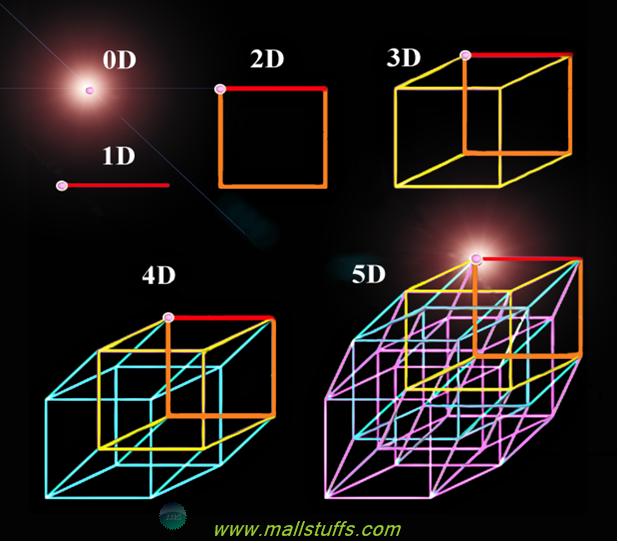
The first step in actualizing an outside world is the creation of dimensional awareness. The first dimension has no time and space. It is simply a point that exists everywhere and nowhere simultaneously, as there is no time nor space nor observer with which to measure and define it.

The second dimension records the point in motion. That movement creates space, which until that movement took place, never existed. A line is composed of many clones of that individual point. All are all the same point. The prototype line also exists everywhere and nowhere simultaneously. Space is defined, but not the duration, as time does not yet exist. The positions and entanglements of electrons are possible because they exist in the second dimension, everywhere at once but not in time.

It is through the ‘observation’ of itself, perhaps by touch, that a point becomes a line. This second dimension is the birth of the finite. It creates a process of a beginning and an ending. It creates an observed, closed system.

The only way a point can be influenced by itself is to clone itself into many points, all of which are the same point, and then move in a curved line that comes back to its beginning location. This creates a closed, circular system or orbit.  Only at this moment is there is an inside and an outside. What is inside is virtual energy and empty, unused fields of possibility. What is outside is the undifferentiated awareness of the zero dimension.

With the third dimension, we have the birth of the unconscious mind from the formless, undifferentiated primal awareness. This awareness unconsciously observes the two-dimensional closed circle from above and adds the dimension of height to the width and length of the two-dimensional circle, creating what appears to be a sphere by the act of awareness observing a circle from above in three dimensions.

Light itself, the photon, is one dimensional and has no experience of time and duration. Light gets to its destination as soon as it leaves. We are in the 4th dimension. This dimension gives duration and time to light and perceive is as traveling many light years to reach us, but the photon does not experience time and duration. This is relativity. By the same process, electrons, being in the primary dimensions, can be many places at once and are not fixed until they interact and are observed. This is quantum mechanics.

The fourth dimension emerges as the duration of time is observed and merges with space as duration—and spacetime is added to the primordial soup. As we live in the 3rd and 4th dimensions, our awareness seems to be locked into these dimension, though more elementary existences—such as waves and particles— exist in the many dimensions.

In 1993, the physicist Gerard ‘t Hooft put forward the holographic principle, which explains that the information about an extra dimension is visible as a curvature in a spacetime with one fewer dimension. For example, holograms are three-dimensional pictures placed on a two-dimensional surface, which gives the image a curvature when the observer moves. Similarly, in general relativity, the fourth dimension is manifested in observable three dimensions as the curvature path of a moving infinitesimal (test) particle. Hooft has speculated that the fifth dimension is really the spacetime fabric.

If this is so, then we may live in the 5th dimension as well, but we cannot perceive it with our senses, as we cannot perceive any of the larger dimensions by virtue of our physical senses.


penteract_projected

A perspective projection of a five-dimensional penteract


What Is Entanglement Anyway? Chris Fields


Entanglement or non-separability is the core idea of quantum theory. It is a simple idea: the universe is not a bunch of independent parts, but is rather one entity that evolves through time as one entity. That’s it. The problem is that this means there’s no such thing as causation. This is very hard to wrap your head around. Quantum theory is extraordinarily accurate, and our knowing quantum theory is why we have things like cell phones and computers. But what is quantum theory, really? Why is entanglement its primary prediction? This talk will explain what quantum theory is. It will show that quantum theory has nothing to do with tiny particles, wave-function collapse, or Schroedinger’s cat. Quantum theory is about how observers obtain information about the world. It is, in particular, about how observers who have memories and use language obtain information about the world. It is, in other words, about how you and I interact with perfectly ordinary things like tables and chairs and each other. You will leave this talk with a new understanding of quantum theory, and a new appreciation for entanglement. Chris Fields is an interdisciplinary information scientist interested in both the physics and the cognitive neuroscience underlying the human perception of objects as spatially and temporally bounded entities. His current research focuses on deriving quantum theory from classical information theory; he also works on cell-cell communication and cellular information processing, the role of the “unconscious mind” in creative problem solving, and early childhood development, particularly the etiology of autism-spectrum conditions. He and his wife, author and yoga teacher Alison Tinsley, recently published Meditation: If You’re Doing It, You’re Doing It Right, in which they explore the experience of meditation with meditators from many walks of life. Dr. Fields has also been a volunteer firefighter, a visual artist, and a travel writer. He currently divides his time between Sonoma, CA and Caunes Minervois, a village in southwestern France.

NEW PHYSICS ON THE ORIGIN OF LIFE


Jeremy England

By Natalie Wolchover, January 22, 2014

Why does life exist?

Popular hypotheses credit a primordial soup, a bolt of lightning and a colossal stroke of luck. But if a provocative new theory is correct, luck may have little to do with it. Instead, according to the physicist proposing the idea, the origin and subsequent evolution of life follow from the fundamental laws of nature and “should be as unsurprising as rocks rolling downhill.”

From the standpoint of physics, there is one essential difference between living things and inanimate clumps of carbon atoms: The former tend to be much better at capturing energy from their environment and dissipating that energy as heat. Jeremy England, a 31-year-old assistant professor at the Massachusetts Institute of Technology, has derived a mathematical formula that he believes explains this capacity. The formula, based on established physics, indicates that when a group of atoms is driven by an external source of energy (like the sun or chemical fuel) and surrounded by a heat bath (like the ocean or atmosphere), it will often gradually restructure itself in order to dissipate increasingly more energy. This could mean that under certain conditions, matter inexorably acquires the key physical attribute associated with life.

“You start with a random clump of atoms, and if you shine light on it for long enough, it should not be so surprising that you get a plant,” England said.


SEE LARGER ARTICLE AT https://www.quantamagazine.org/20140122-a-new-physics-theory-of-life/


Researchers have discovered that simple “chemically active” droplets grow to the size of cells and spontaneously divide, suggesting they might have evolved into the first living cells.

Once droplets start to divide, they can easily gain the ability to transfer genetic information, essentially divvying up a batch of protein-coding RNA or DNA into equal parcels for their daughter cells. If this genetic material coded for useful proteins that increased the rate of droplet division, natural selection would favor the behavior. Protocells, fueled by sunlight and the law of increasing entropy, would gradually have grown more complex.

droplet_1000

SOURCES:

https://www.quantamagazine.org/20170119-active-droplets-cell-division/?utm_source=Quanta+Magazine&utm_campaign=331a2e37f3-Quanta_Newsletter_Feb_27_2015&utm_medium=email&utm_term=0_f0cb61321c-331a2e37f3-389572177

https://www.quantamagazine.org/20140122-a-new-physics-theory-of-life/


MUSINGS OF AN EVIL SKEPTIC

https://scriggler.com/StartClub/Post/preposterous_opinions/52435

mlp__good_v_s_evil_by_katythedog-d5synz0
by Dmitry Selemir

Why I think Evil does not exist and why we should recognize this sooner rather than later

There is a good reason for using that word ‘musings’ in my title. To start, I don’t want this article to have a feel of an overly academic exercise. It wasn’t conceived nor was it constructed as such. Also, I am much more interested in the subsequent discussion and in the thought process it might stimulate rather than claim my stake on a unique piece of knowledge I supposedly put together for everyone’s benefit. Dear academics, if you are reading this, please forgive me for having a go at you, it is by no means done out of smugness or disrespect, I most certainly hold you in the highest regard possible.

But enough with the niceties, after all, we are talking about Evil.

In our modern society Evil is a pretty important concept and it became even more prominent in the academic circles in the last few decades as we are collectively trying to process the causes and consequences of major events of both the 20th and the 21st century (I will not insult your intelligence by bringing up specific examples). As far as Evil empires or axes (take your pick) are concerned — we have had a number of seemingly mutually exclusive accusations and what better place to start understanding what on Earth are they on about than understanding what they might mean by Evil?

While for most people Evil as a concept would be something primal, almost axiomatic, existing in its own right outside of our judgment, the reality is — it is relatively young. In fact, I would go as far as to state that Evil as a term made its debut, in today’s understanding of it at least, as a necessary attribute of a monotheistic belief system. Within that system, we have a supreme, perfect being, who creates the world, which we see as imperfect (i.e., there are things we don’t like or things that don’t make sense to us). The supposed imperfection of the world is a subject of a separate and a rather long discussion. I will only suggest here that, again, the reason we even talk about it today is because it is necessary for a belief system to instill the need to strive for a different way of life, dictated by one central authority. It is a fundamental feature of any organized religion, essential for both its survival and spread and that internal conflict between the desired and actual reality is key to its appeal.

images
It is important for a successful religion to offer just the right blend of Love and Fear in its message in order to achieve maximum impact and the presence of that evil dark side and its consequences for non-believers and sinners is right on the money. It is not at the heart of the system, it exists at the fringes. Yet, it is ever present and it is enough to ensure you are always aware — if you deviate from the “right” path — there will be consequences.
While providing the ammunition for a successful spread of religion, it simultaneously creates a bit of a problem for the philosophers working within its paradigm — i.e., how can the world, created by the perfect being, be imperfect? Perhaps the most notable theory was suggested by Leibniz, who stated that the best possible world has the right balance between the Good and Evil and therefore in order to create the world God has to introduce both Good and Evil and that it’s all about the proportion (which, of course, God got exactly right, being the perfect being).

I am not here to challenge the understanding of Good vs. Evil relationship within the context of organized religion, however. I think the main problem is to do with the fact that it traveled into the post-religious world and is commonly used in a supposedly secular context having acquired that fundamental, universal property we attribute to it.

From a secular point of view, Evil is a purely human construct, created in order for us to classify and in a way measure events taking place around us. Moreover, I would argue that the concepts of good, bad, ugly, beautiful, moral or immoral etc., just like the concept of Evil, do not exist outside of human society. We pass our judgment on both physical phenomena like hurricanes, tsunamis, earthquakes (Evil in the broad sense if we use Kant’s classification) and the inter-species phenomena, i.e. actions of fellow humans or other animals (Evil in the narrow sense). We feel the need to classify the events taking place around us, this helps us arrive at the optimal mode of behavior within our environment and there is nothing wrong with it. However, extending it further and attributing a more independent and universal quality to it is a mistake, which can be rather costly as we make an erroneous assumption that everyone understands it in exactly the same way, or that there is this mysterious struggle between Good and Evil within us, influencing our decisions.

Let’s look at the broad and narrow definition separately.

The broad sense withstands no criticism. While ancient Greeks believed natural disasters happened because they displeased Gods in one way or the other, we should really know better. We know the nature and the causes of these phenomena and there is absolutely no need to give their analysis any kind of moral angle. Moreover, while the effects of these phenomena might be harmful to us, they can be absolutely vital to other species (forest fires is one example, with certain types of seeds unable to germinate without them) and even to the other members of our own species and the effect might end up being beneficial to us perhaps in a very long run, even if it is significantly longer than a lifetime. We can only give them that negative judgment in a very narrow sense — right now it is bad for me and therefore it is Evil, which makes it a purely emotional, minute construction. In fact even invoking the argument that something is Evil because it threatens our very existence is inherently flawed because our existence is only important to us. Period.

Let’s now turn to a more complex concept of Evil in the narrow sense — i.e., the moral/inter and intra-species evil, i.e., murder, theft, abuse etc.

As a species — we, humans, construct increasingly complex and theoretical concept of what constitutes good and bad, to the point that we have forgotten its origin and treat it as self-evident. As with any dogmatic concept, we inevitably find that our theoretical and idealized version fails to adequately serve the world around us. Let’s take the most fundamental and seemingly obvious one — murder. While I will concentrate on murder in my line of argument, exactly the same reasoning can be applied to any other such concept.

The first reaction is a resounding negative — murder is bad and murderers are evil, right?

Let’s have a look at it in more detail, though. Most of us have no problem with killing animals for food, those who do will have to accept that killing of animals by other animals (or fish, insects, viruses etc.) in nature is not only inevitable — it is absolutely necessary for a self-regulating biological system, not only ensuring their evolution and ability to adapt to and withstand natural disasters, but also their very survival as species. Predation is necessary for balance (and ability to process waste and avoid propagation of diseases).
If we look at our own species and killings among ourselves, we find another dilemma. For most of us not all killing is bad, otherwise, we would have never had any wars. If the cause appears fair (another peculiar concept) to us — it justifies the means and to a certain extent justifies both the killing of the enemy combatants and even the collateral damage. There are those who believe in the necessity of capital punishment. And, of course, not to be forgotten, there is the moral dilemma of euthanasia and abortion. In any case — many of us believe that some murders are justified (inviting the rather peculiar concept of necessary Evil). Note that I only lump all these together into one line of discussion, not in order to pass judgment on them, but simply because they all deal with a loss of life caused by or involving another individual.
While I am not arguing that murder is somehow good or in any way excusable — it is an inevitable feature of all societies we, as humans, managed to construct and its classification as bad and evil is also a feature of our society. In fact, we don’t have to go far back in history, even within the most “killing-averse” western society to find that the further back we go, the wider the circle of socially and morally acceptable killings becomes (take duels for example or honor killings).
One could argue that it is a natural phenomenon as it is one of the side effects of the evolutionary mechanisms built into all living things. Being highly evolved and being able to construct much more complex societal structures than any other species known to us, we strive to eradicate it. We see it as counterproductive in the long run; however, so far we have been unable to really tackle the problem. In part this is because as evolved we are as a species, we are still governed by the same instincts as our more primitive ancestors or relations in the animal kingdom. Killing a rival (or even rival’s offspring) is commonplace in nature and the reason we have departed from such practice is dictated by a more complex branch of evolution responsible for the social constructs within our society rather than a peculiar brain function. It certainly has nothing to do with the rules passed on to us from above — groups (and later tribes/villages/ countries) where the level of violence between its members has been reduced tended to be more successful, leading to their dominance and subsequent, much greater impact on our current societies.

Today, we look at most murders as purely individual undertakings — decisions made by an individual because that individual is Evil, or has more Evil than Good within his/her nature. While there is always a high degree of individual responsibility in each such action, it is also a by-product of our inability to effectively manage societies we construct. A concept of Evil is used to absolve society of all responsibility — putting all of the blame on the individual. In the process, we conveniently forget that each individual is a product of that society and in most cases interacts with that society constantly in the run-up to the fateful event itself. Perhaps this is my liberal side manifesting itself, but personally, I think attempting to always lay the blame squarely on the individual and only individual (for any type of offense) is a gross oversimplification.

It’s not all about finding who is to blame, however. This inability to understand the responsibility of societies every time something happens ensures we don’t take any steps towards eradicating the problem (or at least any significant improvement). In a way, we are always treating (and when I say treating — I mean cutting away) the symptoms only, because we seem to be unable or unwilling to study and understand the real causes. I am not suggesting that we are missing something simple here, though. Studying and understanding the causes can only be done with increased access to individual data — which means increased surveillance and redefinition of the relationship between the individual and society. This is an interesting problem in itself, however, this is outside of the scope of this particular discussion.

We also fail to understand how large groups of individuals — the whole societies can get lured into committing atrocities and we’ve had numerous examples of that happening in the 20th century. What we often forget is — most of the individuals involved actually believed they were acting against Evil, not the other way round. It’s the very understanding of the concept that was flawed.

In fact, this point deserves special attention. As a human construct the concept of Evil forms within a particular society and depends squarely on the fundamental principles taken as the basis of laws governing the relationships within these societies. The understanding of what constitutes Evil, therefore, changes from one society to another. To give one example — within the tribe which formed no concept of private property — theft (and associated with it the Evil label) simply does not exist. A person who grew up within that framework will struggle to understand why something they would do without a second thought might cause an offense.
These societies can overlap and fragments (as small as one individual in size) can exist within each other, more often than not without creating any conflicts. Unfortunately, this is not always possible. From time to time, we find ourselves clashing over specific examples when the two concepts end up producing opposite judgments. The biggest mistake we make is we always assert that our own concept is the right one and the other one is barbaric at best. It feels natural to do that, however, we often forget that the other side feels exactly the same way and the truth is — both are entirely justified within their own moral framework.
I would argue that the only way to avoid conflict is not by trying to impose our own rules on others, but by recognising the differences and limitations of our authority. This would pave the way towards agreeing on the applicability of these rules and ways of interpreting them in potential conflict situations.

Of course, it will be naive to suggest that getting rid of the concept of Evil will solve these problems. It wouldn’t stop conflicts, killings, it wouldn’t make us any kinder to each other. Yet, if we discredit the concept as an absolute, we remove this convenient excuse our leaders can fall back on — perhaps we can make it more difficult for them to justify their ill-advised actions and would force us to take a much more critical look at ourselves and encourage us to take more individual responsibility for the actions of societies we belong to. Perhaps it will also allow us to look at the world around us in a slightly different light and help prepare us for the challenges yet to come.

Up to now, we have mostly relied on either external factors (natural phenomena, like hurricanes, tsunamis, famines and diseases) or violent actions (wars, coups and revolutions) to achieve temporary balance. In other words, we have always waited until situation resolved itself. It is essentially equivalent to driving a car without the breaks because it’s bound to stop at some point by itself anyway.
While technological advances of the last two hundred years meant that the impact of the natural phenomena has decreased significantly — these same technological advances meant that the violent option became that much more devastating. Using my car analogy — the speeds are much higher now, so we are less likely to stall in the mud, but if we hit a wall — it’s game over.
With increased life expectancies, and continuing increases in population and inevitable strain on available resources we can not avoid reaching such singularity points — when resolution can not be achieved by itself. In fact — one could argue that we are in the process of dealing with one of such singularity points developing right now.

In order to develop a new mechanism for managing this process, arguably, we need a paradigm shift. Recognizing the limitations of some of these supposedly fundamental concepts could very well be the first step paving the way to a different, more effective principle on which we construct our societies and manage relationships between them.

– See more at: https://scriggler.com/DetailPost/Opinion/52435#sthash.WWKnqLTu.dpuf


DMITRY SELEMIR operates the great writer’s platform at Scriggler.com. His articles are found at https://scriggler.com/Profile/dmitry_selemir


finderscreensnapz002

Washington’s Farewell Address 1796

washington1

1796

Friends and Citizens:

The period for a new election of a citizen to administer the executive government of the United States being not far distant, and the time actually arrived when your thoughts must be employed in designating the person who is to be clothed with that important trust, it appears to me proper, especially as it may conduce to a more distinct expression of the public voice, that I should now apprise you of the resolution I have formed, to decline being considered among the number of those out of whom a choice is to be made.

I beg you, at the same time, to do me the justice to be assured that this resolution has not been taken without a strict regard to all the considerations appertaining to the relation which binds a dutiful citizen to his country; and that in withdrawing the tender of service, which silence in my situation might imply, I am influenced by no diminution of zeal for your future interest, no deficiency of grateful respect for your past kindness, but am supported by a full conviction that the step is compatible with both.

The acceptance of, and continuance hitherto in, the office to which your suffrages have twice called me have been a uniform sacrifice of inclination to the opinion of duty and to a deference for what appeared to be your desire. I constantly hoped that it would have been much earlier in my power, consistently with motives which I was not at liberty to disregard, to return to that retirement from which I had been reluctantly drawn. The strength of my inclination to do this, previous to the last election, had even led to the preparation of an address to declare it to you; but mature reflection on the then perplexed and critical posture of our affairs with foreign nations, and the unanimous advice of persons entitled to my confidence, impelled me to abandon the idea.

I rejoice that the state of your concerns, external as well as internal, no longer renders the pursuit of inclination incompatible with the sentiment of duty or propriety, and am persuaded, whatever partiality may be retained for my services, that, in the present circumstances of our country, you will not disapprove my determination to retire.

The impressions with which I first undertook the arduous trust were explained on the proper occasion. In the discharge of this trust, I will only say that I have, with good intentions, contributed towards the organization and administration of the government the best exertions of which a very fallible judgment was capable. Not unconscious in the outset of the inferiority of my qualifications, experience in my own eyes, perhaps still more in the eyes of others, has strengthened the motives to diffidence of myself; and every day the increasing weight of years admonishes me more and more that the shade of retirement is as necessary to me as it will be welcome. Satisfied that if any circumstances have given peculiar value to my services, they were temporary, I have the consolation to believe that, while choice and prudence invite me to quit the political scene, patriotism does not forbid it.

In looking forward to the moment which is intended to terminate the career of my public life, my feelings do not permit me to suspend the deep acknowledgment of that debt of gratitude which I owe to my beloved country for the many honors it has conferred upon me; still more for the steadfast confidence with which it has supported me; and for the opportunities I have thence enjoyed of manifesting my inviolable attachment, by services faithful and persevering, though in usefulness unequal to my zeal. If benefits have resulted to our country from these services, let it always be remembered to your praise, and as an instructive example in our annals, that under circumstances in which the passions, agitated in every direction, were liable to mislead, amidst appearances sometimes dubious, vicissitudes of fortune often discouraging, in situations in which not unfrequently want of success has countenanced the spirit of criticism, the constancy of your support was the essential prop of the efforts, and a guarantee of the plans by which they were effected. Profoundly penetrated with this idea, I shall carry it with me to my grave, as a strong incitement to unceasing vows that heaven may continue to you the choicest tokens of its beneficence; that your union and brotherly affection may be perpetual; that the free Constitution, which is the work of your hands, may be sacredly maintained; that its administration in every department may be stamped with wisdom and virtue; that, in fine, the happiness of the people of these States, under the auspices of liberty, may be made complete by so careful a preservation and so prudent a use of this blessing as will acquire to them the glory of recommending it to the applause, the affection, and adoption of every nation which is yet a stranger to it.

Here, perhaps, I ought to stop. But a solicitude for your welfare, which cannot end but with my life, and the apprehension of danger, natural to that solicitude, urge me, on an occasion like the present, to offer to your solemn contemplation, and to recommend to your frequent review, some sentiments which are the result of much reflection, of no inconsiderable observation, and which appear to me all-important to the permanency of your felicity as a people. These will be offered to you with the more freedom, as you can only see in them the disinterested warnings of a parting friend, who can possibly have no personal motive to bias his counsel. Nor can I forget, as an encouragement to it, your indulgent reception of my sentiments on a former and not dissimilar occasion.

Interwoven as is the love of liberty with every ligament of your hearts, no recommendation of mine is necessary to fortify or confirm the attachment.

The unity of government which constitutes you one people is also now dear to you. It is justly so, for it is a main pillar in the edifice of your real independence, the support of your tranquility at home, your peace abroad; of your safety; of your prosperity; of that very liberty which you so highly prize. But as it is easy to foresee that, from different causes and from different quarters, much pains will be taken, many artifices employed to weaken in your minds the conviction of this truth; as this is the point in your political fortress against which the batteries of internal and external enemies will be most constantly and actively (though often covertly and insidiously) directed, it is of infinite moment that you should properly estimate the immense value of your national union to your collective and individual happiness; that you should cherish a cordial, habitual, and immovable attachment to it; accustoming yourselves to think and speak of it as of the palladium of your political safety and prosperity; watching for its preservation with jealous anxiety; discountenancing whatever may suggest even a suspicion that it can in any event be abandoned; and indignantly frowning upon the first dawning of every attempt to alienate any portion of our country from the rest, or to enfeeble the sacred ties which now link together the various parts.

For this you have every inducement of sympathy and interest. Citizens, by birth or choice, of a common country, that country has a right to concentrate your affections. The name of American, which belongs to you in your national capacity, must always exalt the just pride of patriotism more than any appellation derived from local discriminations. With slight shades of difference, you have the same religion, manners, habits, and political principles. You have in a common cause fought and triumphed together; the independence and liberty you possess are the work of joint counsels, and joint efforts of common dangers, sufferings, and successes.

But these considerations, however powerfully they address themselves to your sensibility, are greatly outweighed by those which apply more immediately to your interest. Here every portion of our country finds the most commanding motives for carefully guarding and preserving the union of the whole.

The North, in an unrestrained intercourse with the South, protected by the equal laws of a common government, finds in the productions of the latter great additional resources of maritime and commercial enterprise and precious materials of manufacturing industry. The South, in the same intercourse, benefiting by the agency of the North, sees its agriculture grow and its commerce expand. Turning partly into its own channels the seamen of the North, it finds its particular navigation invigorated; and, while it contributes, in different ways, to nourish and increase the general mass of the national navigation, it looks forward to the protection of a maritime strength, to which itself is unequally adapted. The East, in a like intercourse with the West, already finds, and in the progressive improvement of interior communications by land and water, will more and more find a valuable vent for the commodities which it brings from abroad, or manufactures at home. The West derives from the East supplies requisite to its growth and comfort, and, what is perhaps of still greater consequence, it must of necessity owe the secure enjoyment of indispensable outlets for its own productions to the weight, influence, and the future maritime strength of the Atlantic side of the Union, directed by an indissoluble community of interest as one nation. Any other tenure by which the West can hold this essential advantage, whether derived from its own separate strength, or from an apostate and unnatural connection with any foreign power, must be intrinsically precarious.

While, then, every part of our country thus feels an immediate and particular interest in union, all the parts combined cannot fail to find in the united mass of means and efforts greater strength, greater resource, proportionably greater security from external danger, a less frequent interruption of their peace by foreign nations; and, what is of inestimable value, they must derive from union an exemption from those broils and wars between themselves, which so frequently afflict neighboring countries not tied together by the same governments, which their own rival ships alone would be sufficient to produce, but which opposite foreign alliances, attachments, and intrigues would stimulate and embitter. Hence, likewise, they will avoid the necessity of those overgrown military establishments which, under any form of government, are inauspicious to liberty, and which are to be regarded as particularly hostile to republican liberty. In this sense it is that your union ought to be considered as a main prop of your liberty, and that the love of the one ought to endear to you the preservation of the other.

These considerations speak a persuasive language to every reflecting and virtuous mind, and exhibit the continuance of the Union as a primary object of patriotic desire. Is there a doubt whether a common government can embrace so large a sphere? Let experience solve it. To listen to mere speculation in such a case were criminal. We are authorized to hope that a proper organization of the whole with the auxiliary agency of governments for the respective subdivisions, will afford a happy issue to the experiment. It is well worth a fair and full experiment. With such powerful and obvious motives to union, affecting all parts of our country, while experience shall not have demonstrated its impracticability, there will always be reason to distrust the patriotism of those who in any quarter may endeavor to weaken its bands.

In contemplating the causes which may disturb our Union, it occurs as matter of serious concern that any ground should have been furnished for characterizing parties by geographical discriminations, Northern and Southern, Atlantic and Western; whence designing men may endeavor to excite a belief that there is a real difference of local interests and views. One of the expedients of party to acquire influence within particular districts is to misrepresent the opinions and aims of other districts. You cannot shield yourselves too much against the jealousies and heartburnings which spring from these misrepresentations; they tend to render alien to each other those who ought to be bound together by fraternal affection. The inhabitants of our Western country have lately had a useful lesson on this head; they have seen, in the negotiation by the Executive, and in the unanimous ratification by the Senate, of the treaty with Spain, and in the universal satisfaction at that event, throughout the United States, a decisive proof how unfounded were the suspicions propagated among them of a policy in the General Government and in the Atlantic States unfriendly to their interests in regard to the Mississippi; they have been witnesses to the formation of two treaties, that with Great Britain, and that with Spain, which secure to them everything they could desire, in respect to our foreign relations, towards confirming their prosperity. Will it not be their wisdom to rely for the preservation of these advantages on the Union by which they were procured? Will they not henceforth be deaf to those advisers, if such there are, who would sever them from their brethren and connect them with aliens?

To the efficacy and permanency of your Union, a government for the whole is indispensable. No alliance, however strict, between the parts can be an adequate substitute; they must inevitably experience the infractions and interruptions which all alliances in all times have experienced. Sensible of this momentous truth, you have improved upon your first essay, by the adoption of a constitution of government better calculated than your former for an intimate union, and for the efficacious management of your common concerns. This government, the offspring of our own choice, uninfluenced and unawed, adopted upon full investigation and mature deliberation, completely free in its principles, in the distribution of its powers, uniting security with energy, and containing within itself a provision for its own amendment, has a just claim to your confidence and your support. Respect for its authority, compliance with its laws, acquiescence in its measures, are duties enjoined by the fundamental maxims of true liberty. The basis of our political systems is the right of the people to make and to alter their constitutions of government. But the Constitution which at any time exists, till changed by an explicit and authentic act of the whole people, is sacredly obligatory upon all. The very idea of the power and the right of the people to establish government presupposes the duty of every individual to obey the established government.

All obstructions to the execution of the laws, all combinations and associations, under whatever plausible character, with the real design to direct, control, counteract, or awe the regular deliberation and action of the constituted authorities, are destructive of this fundamental principle, and of fatal tendency. They serve to organize faction, to give it an artificial and extraordinary force; to put, in the place of the delegated will of the nation the will of a party, often a small but artful and enterprising minority of the community; and, according to the alternate triumphs of different parties, to make the public administration the mirror of the ill-concerted and incongruous projects of faction, rather than the organ of consistent and wholesome plans digested by common counsels and modified by mutual interests.

However combinations or associations of the above description may now and then answer popular ends, they are likely, in the course of time and things, to become potent engines, by which cunning, ambitious, and unprincipled men will be enabled to subvert the power of the people and to usurp for themselves the reins of government, destroying afterwards the very engines which have lifted them to unjust dominion.

Towards the preservation of your government, and the permanency of your present happy state, it is requisite, not only that you steadily discountenance irregular oppositions to its acknowledged authority, but also that you resist with care the spirit of innovation upon its principles, however specious the pretexts. One method of assault may be to effect, in the forms of the Constitution, alterations which will impair the energy of the system, and thus to undermine what cannot be directly overthrown. In all the changes to which you may be invited, remember that time and habit are at least as necessary to fix the true character of governments as of other human institutions; that experience is the surest standard by which to test the real tendency of the existing constitution of a country; that facility in changes, upon the credit of mere hypothesis and opinion, exposes to perpetual change, from the endless variety of hypothesis and opinion; and remember, especially, that for the efficient management of your common interests, in a country so extensive as ours, a government of as much vigor as is consistent with the perfect security of liberty is indispensable. Liberty itself will find in such a government, with powers properly distributed and adjusted, its surest guardian. It is, indeed, little else than a name, where the government is too feeble to withstand the enterprises of faction, to confine each member of the society within the limits prescribed by the laws, and to maintain all in the secure and tranquil enjoyment of the rights of person and property.

I have already intimated to you the danger of parties in the State, with particular reference to the founding of them on geographical discriminations. Let me now take a more comprehensive view, and warn you in the most solemn manner against the baneful effects of the spirit of party generally.

This spirit, unfortunately, is inseparable from our nature, having its root in the strongest passions of the human mind. It exists under different shapes in all governments, more or less stifled, controlled, or repressed; but, in those of the popular form, it is seen in its greatest rankness, and is truly their worst enemy.

The alternate domination of one faction over another, sharpened by the spirit of revenge, natural to party dissension, which in different ages and countries has perpetrated the most horrid enormities, is itself a frightful despotism. But this leads at length to a more formal and permanent despotism. The disorders and miseries which result gradually incline the minds of men to seek security and repose in the absolute power of an individual; and sooner or later the chief of some prevailing faction, more able or more fortunate than his competitors, turns this disposition to the purposes of his own elevation, on the ruins of public liberty.

Without looking forward to an extremity of this kind (which nevertheless ought not to be entirely out of sight), the common and continual mischiefs of the spirit of party are sufficient to make it the interest and duty of a wise people to discourage and restrain it.

It serves always to distract the public councils and enfeeble the public administration. It agitates the community with ill-founded jealousies and false alarms, kindles the animosity of one part against another, foments occasionally riot and insurrection. It opens the door to foreign influence and corruption, which finds a facilitated access to the government itself through the channels of party passions. Thus the policy and the will of one country are subjected to the policy and will of another.

There is an opinion that parties in free countries are useful checks upon the administration of the government and serve to keep alive the spirit of liberty. This within certain limits is probably true; and in governments of a monarchical cast, patriotism may look with indulgence, if not with favor, upon the spirit of party. But in those of the popular character, in governments purely elective, it is a spirit not to be encouraged. From their natural tendency, it is certain there will always be enough of that spirit for every salutary purpose. And there being constant danger of excess, the effort ought to be by force of public opinion, to mitigate and assuage it. A fire not to be quenched, it demands a uniform vigilance to prevent its bursting into a flame, lest, instead of warming, it should consume.

It is important, likewise, that the habits of thinking in a free country should inspire caution in those entrusted with its administration, to confine themselves within their respective constitutional spheres, avoiding in the exercise of the powers of one department to encroach upon another. The spirit of encroachment tends to consolidate the powers of all the departments in one, and thus to create, whatever the form of government, a real despotism. A just estimate of that love of power, and proneness to abuse it, which predominates in the human heart, is sufficient to satisfy us of the truth of this position. The necessity of reciprocal checks in the exercise of political power, by dividing and distributing it into different depositaries, and constituting each the guardian of the public weal against invasions by the others, has been evinced by experiments ancient and modern; some of them in our country and under our own eyes. To preserve them must be as necessary as to institute them. If, in the opinion of the people, the distribution or modification of the constitutional powers be in any particular wrong, let it be corrected by an amendment in the way which the Constitution designates. But let there be no change by usurpation; for though this, in one instance, may be the instrument of good, it is the customary weapon by which free governments are destroyed. The precedent must always greatly overbalance in permanent evil any partial or transient benefit, which the use can at any time yield.

Of all the dispositions and habits which lead to political prosperity, religion and morality are indispensable supports. In vain would that man claim the tribute of patriotism, who should labor to subvert these great pillars of human happiness, these firmest props of the duties of men and citizens. The mere politician, equally with the pious man, ought to respect and to cherish them. A volume could not trace all their connections with private and public felicity. Let it simply be asked: Where is the security for property, for reputation, for life, if the sense of religious obligation desert the oaths which are the instruments of investigation in courts of justice ? And let us with caution indulge the supposition that morality can be maintained without religion. Whatever may be conceded to the influence of refined education on minds of peculiar structure, reason and experience both forbid us to expect that national morality can prevail in exclusion of religious principle.

It is substantially true that virtue or morality is a necessary spring of popular government. The rule, indeed, extends with more or less force to every species of free government. Who that is a sincere friend to it can look with indifference upon attempts to shake the foundation of the fabric?

Promote then, as an object of primary importance, institutions for the general diffusion of knowledge. In proportion as the structure of a government gives force to public opinion, it is essential that public opinion should be enlightened.

As a very important source of strength and security, cherish public credit. One method of preserving it is to use it as sparingly as possible, avoiding occasions of expense by cultivating peace, but remembering also that timely disbursements to prepare for danger frequently prevent much greater disbursements to repel it, avoiding likewise the accumulation of debt, not only by shunning occasions of expense, but by vigorous exertion in time of peace to discharge the debts which unavoidable wars may have occasioned, not ungenerously throwing upon posterity the burden which we ourselves ought to bear. The execution of these maxims belongs to your representatives, but it is necessary that public opinion should co-operate. To facilitate to them the performance of their duty, it is essential that you should practically bear in mind that towards the payment of debts there must be revenue; that to have revenue there must be taxes; that no taxes can be devised which are not more or less inconvenient and unpleasant; that the intrinsic embarrassment, inseparable from the selection of the proper objects (which is always a choice of difficulties), ought to be a decisive motive for a candid construction of the conduct of the government in making it, and for a spirit of acquiescence in the measures for obtaining revenue, which the public exigencies may at any time dictate.

Observe good faith and justice towards all nations; cultivate peace and harmony with all. Religion and morality enjoin this conduct; and can it be, that good policy does not equally enjoin it – It will be worthy of a free, enlightened, and at no distant period, a great nation, to give to mankind the magnanimous and too novel example of a people always guided by an exalted justice and benevolence. Who can doubt that, in the course of time and things, the fruits of such a plan would richly repay any temporary advantages which might be lost by a steady adherence to it ? Can it be that Providence has not connected the permanent felicity of a nation with its virtue ? The experiment, at least, is recommended by every sentiment which ennobles human nature. Alas! is it rendered impossible by its vices?

In the execution of such a plan, nothing is more essential than that permanent, inveterate antipathies against particular nations, and passionate attachments for others, should be excluded; and that, in place of them, just and amicable feelings towards all should be cultivated. The nation which indulges towards another a habitual hatred or a habitual fondness is in some degree a slave. It is a slave to its animosity or to its affection, either of which is sufficient to lead it astray from its duty and its interest. Antipathy in one nation against another disposes each more readily to offer insult and injury, to lay hold of slight causes of umbrage, and to be haughty and intractable, when accidental or trifling occasions of dispute occur. Hence, frequent collisions, obstinate, envenomed, and bloody contests. The nation, prompted by ill-will and resentment, sometimes impels to war the government, contrary to the best calculations of policy. The government sometimes participates in the national propensity, and adopts through passion what reason would reject; at other times it makes the animosity of the nation subservient to projects of hostility instigated by pride, ambition, and other sinister and pernicious motives. The peace often, sometimes perhaps the liberty, of nations, has been the victim.

So likewise, a passionate attachment of one nation for another produces a variety of evils. Sympathy for the favorite nation, facilitating the illusion of an imaginary common interest in cases where no real common interest exists, and infusing into one the enmities of the other, betrays the former into a participation in the quarrels and wars of the latter without adequate inducement or justification. It leads also to concessions to the favorite nation of privileges denied to others which is apt doubly to injure the nation making the concessions; by unnecessarily parting with what ought to have been retained, and by exciting jealousy, ill-will, and a disposition to retaliate, in the parties from whom equal privileges are withheld. And it gives to ambitious, corrupted, or deluded citizens (who devote themselves to the favorite nation), facility to betray or sacrifice the interests of their own country, without odium, sometimes even with popularity; gilding, with the appearances of a virtuous sense of obligation, a commendable deference for public opinion, or a laudable zeal for public good, the base or foolish compliances of ambition, corruption, or infatuation.

As avenues to foreign influence in innumerable ways, such attachments are particularly alarming to the truly enlightened and independent patriot. How many opportunities do they afford to tamper with domestic factions, to practice the arts of seduction, to mislead public opinion, to influence or awe the public councils. Such an attachment of a small or weak towards a great and powerful nation dooms the former to be the satellite of the latter.

Against the insidious wiles of foreign influence (I conjure you to believe me, fellow-citizens) the jealousy of a free people ought to be constantly awake, since history and experience prove that foreign influence is one of the most baneful foes of republican government. But that jealousy to be useful must be impartial; else it becomes the instrument of the very influence to be avoided, instead of a defense against it. Excessive partiality for one foreign nation and excessive dislike of another cause those whom they actuate to see danger only on one side, and serve to veil and even second the arts of influence on the other. Real patriots who may resist the intrigues of the favorite are liable to become suspected and odious, while its tools and dupes usurp the applause and confidence of the people, to surrender their interests.

The great rule of conduct for us in regard to foreign nations is in extending our commercial relations, to have with them as little political connection as possible. So far as we have already formed engagements, let them be fulfilled with perfect good faith. Here let us stop. Europe has a set of primary interests which to us have none; or a very remote relation. Hence she must be engaged in frequent controversies, the causes of which are essentially foreign to our concerns. Hence, therefore, it must be unwise in us to implicate ourselves by artificial ties in the ordinary vicissitudes of her politics, or the ordinary combinations and collisions of her friendships or enmities.

Our detached and distant situation invites and enables us to pursue a different course. If we remain one people under an efficient government. the period is not far off when we may defy material injury from external annoyance; when we may take such an attitude as will cause the neutrality we may at any time resolve upon to be scrupulously respected; when belligerent nations, under the impossibility of making acquisitions upon us, will not lightly hazard the giving us provocation; when we may choose peace or war, as our interest, guided by justice, shall counsel.

Why forego the advantages of so peculiar a situation? Why quit our own to stand upon foreign ground? Why, by interweaving our destiny with that of any part of Europe, entangle our peace and prosperity in the toils of European ambition, rivalship, interest, humor or caprice?

It is our true policy to steer clear of permanent alliances with any portion of the foreign world; so far, I mean, as we are now at liberty to do it; for let me not be understood as capable of patronizing infidelity to existing engagements. I hold the maxim no less applicable to public than to private affairs, that honesty is always the best policy. I repeat it, therefore, let those engagements be observed in their genuine sense. But, in my opinion, it is unnecessary and would be unwise to extend them.

Taking care always to keep ourselves by suitable establishments on a respectable defensive posture, we may safely trust to temporary alliances for extraordinary emergencies.

Harmony, liberal intercourse with all nations, are recommended by policy, humanity, and interest. But even our commercial policy should hold an equal and impartial hand; neither seeking nor granting exclusive favors or preferences; consulting the natural course of things; diffusing and diversifying by gentle means the streams of commerce, but forcing nothing; establishing (with powers so disposed, in order to give trade a stable course, to define the rights of our merchants, and to enable the government to support them) conventional rules of intercourse, the best that present circumstances and mutual opinion will permit, but temporary, and liable to be from time to time abandoned or varied, as experience and circumstances shall dictate; constantly keeping in view that it is folly in one nation to look for disinterested favors from another; that it must pay with a portion of its independence for whatever it may accept under that character; that, by such acceptance, it may place itself in the condition of having given equivalents for nominal favors, and yet of being reproached with ingratitude for not giving more. There can be no greater error than to expect or calculate upon real favors from nation to nation. It is an illusion, which experience must cure, which a just pride ought to discard.

In offering to you, my countrymen, these counsels of an old and affectionate friend, I dare not hope they will make the strong and lasting impression I could wish; that they will control the usual current of the passions, or prevent our nation from running the course which has hitherto marked the destiny of nations. But, if I may even flatter myself that they may be productive of some partial benefit, some occasional good; that they may now and then recur to moderate the fury of party spirit, to warn against the mischiefs of foreign intrigue, to guard against the impostures of pretended patriotism; this hope will be a full recompense for the solicitude for your welfare, by which they have been dictated.

How far in the discharge of my official duties I have been guided by the principles which have been delineated, the public records and other evidence of my conduct must witness to you and to the world. To myself, the assurance of my own conscience is, that I have at least believed myself to be guided by them.

In relation to the still subsisting war in Europe, my proclamation of the twenty-second of April, I793, is the index of my plan. Sanctioned by your approving voice, and by that of your representatives in both houses of Congress, the spirit of that measure has continually governed me, uninfluenced by any attempts to deter or divert me from it.

After deliberate examination, with the aid of the best lights I could obtain, I was well satisfied that our country, under all the circumstances of the case, had a right to take, and was bound in duty and interest to take, a neutral position. Having taken it, I determined, as far as should depend upon me, to maintain it, with moderation, perseverance, and firmness.

The considerations which respect the right to hold this conduct, it is not necessary on this occasion to detail. I will only observe that, according to my understanding of the matter, that right, so far from being denied by any of the belligerent powers, has been virtually admitted by all.

The duty of holding a neutral conduct may be inferred, without anything more, from the obligation which justice and humanity impose on every nation, in cases in which it is free to act, to maintain inviolate the relations of peace and amity towards other nations.

The inducements of interest for observing that conduct will best be referred to your own reflections and experience. With me, a predominant motive has been to endeavor to gain time to our country to settle and mature its yet recent institutions, and to progress without interruption to that degree of strength and consistency which is necessary to give it, humanly speaking, the command of its own fortunes.

Though, in reviewing the incidents of my administration, I am unconscious of intentional error, I am nevertheless too sensible of my defects not to think it probable that I may have committed many errors. Whatever they may be, I fervently beseech the Almighty to avert or mitigate the evils to which they may tend. I shall also carry with me the hope that my country will never cease to view them with indulgence; and that, after forty-five years of my life dedicated to its service with an upright zeal, the faults of incompetent abilities will be consigned to oblivion, as myself must soon be to the mansions of rest.

Relying on its kindness in this as in other things, and actuated by that fervent love towards it, which is so natural to a man who views in it the native soil of himself and his progenitors for several generations, I anticipate with pleasing expectation that retreat in which I promise myself to realize, without alloy, the sweet enjoyment of partaking, in the midst of my fellow-citizens, the benign influence of good laws under a free government, the ever-favorite object of my heart, and the happy reward, as I trust, of our mutual cares, labors, and dangers.